Certification of Normal Category Rotorcraft — Changes 1–9
Normal category rotorcraft guidance with Changes 1–9 incorporated. Search the complete AC or start with the system safety, flight controls and instrument-flight guidance.
This source includes guidance for different amendments of Part 27. Match the guidance to the aircraft’s agreed certification basis: the 27.1309 entries for Amendments 27-21, 27-46 and 27-51 are separate. The base AC was issued on 30 September 1999; Change 9 is dated 23 June 2023. The FAA catalogue’s 30 September 2008 date is not the date of the latest change.
The source, within reach.
Search within this AC, jump to a source page, or download the complete saved publication.
This extraction supports search. Read the original page for complete notation and layout.
6/23/23                                          AC 27-1B, Chg 9


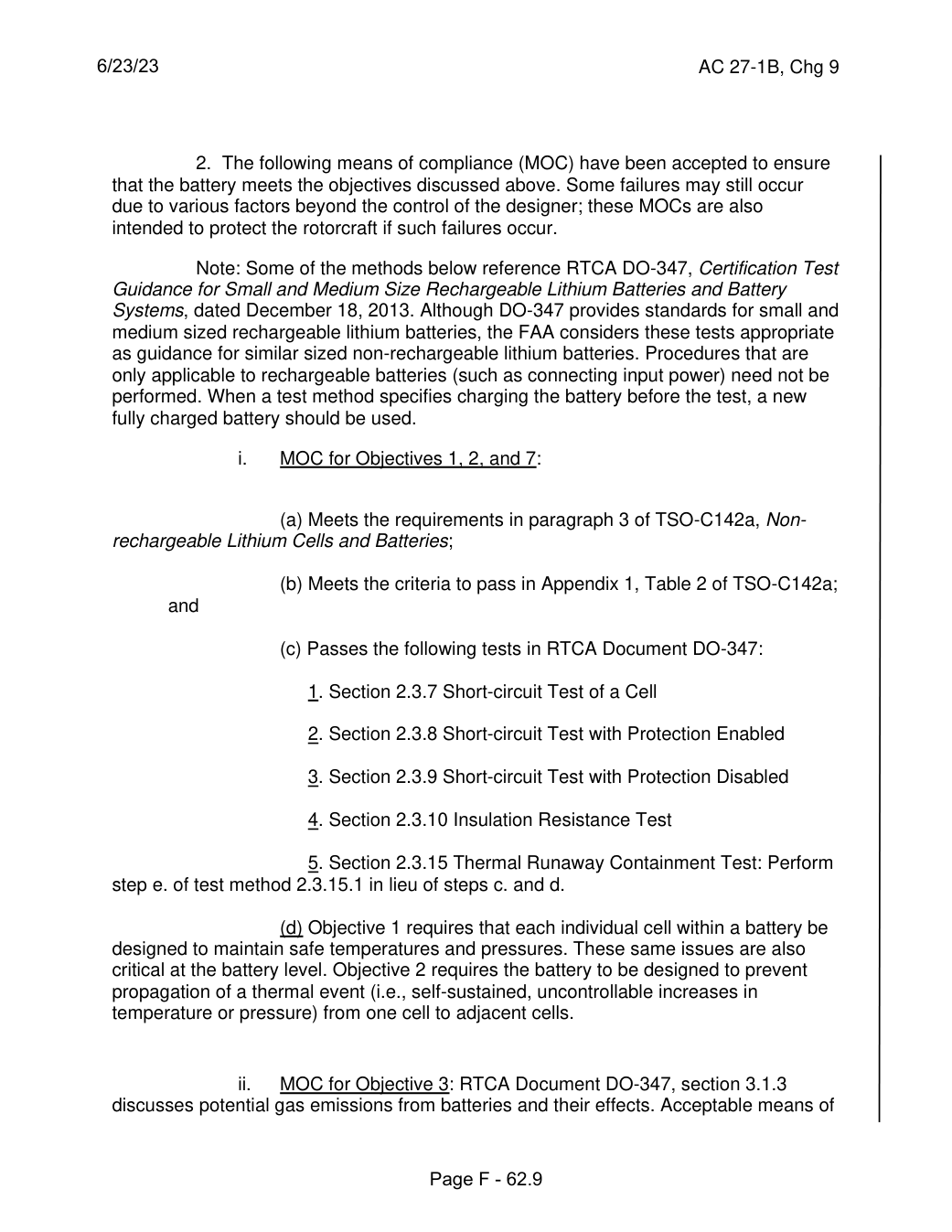
             2. The following means of compliance (MOC) have been accepted to ensure
  that the battery meets the objectives discussed above. Some failures may still occur
 due to various factors beyond the control of the designer; these MOCs are also
  intended to protect the rotorcraft if such failures occur.

           Note: Some of the methods below reference RTCA DO-347, Certification Test
  Guidance for Small and Medium Size Rechargeable Lithium Batteries and Battery
  Systems, dated December 18, 2013. Although DO-347 provides standards for small and
 medium sized rechargeable lithium batteries, the FAA considers these tests appropriate
  as guidance for similar sized non-rechargeable lithium batteries. Procedures that are
  only applicable to rechargeable batteries (such as connecting input power) need not be
  performed. When a test method specifies charging the battery before the test, a new
  fully charged battery should be used.

                              i.  MOC for Objectives 1, 2, and 7:


                        (a) Meets the requirements in paragraph 3 of TSO-C142a, Non-
  rechargeable Lithium Cells and Batteries;

                        (b) Meets the criteria to pass in Appendix 1, Table 2 of TSO-C142a;
       and

                         (c) Passes the following tests in RTCA Document DO-347:

                           1. Section 2.3.7 Short-circuit Test of a Cell

                           2. Section 2.3.8 Short-circuit Test with Protection Enabled

                           3. Section 2.3.9 Short-circuit Test with Protection Disabled

                           4. Section 2.3.10 Insulation Resistance Test

                           5. Section 2.3.15 Thermal Runaway Containment Test: Perform
  step e. of test method 2.3.15.1 in lieu of steps c. and d.

                        (d) Objective 1 requires that each individual cell within a battery be
  designed to maintain safe temperatures and pressures. These same issues are also
  critical at the battery level. Objective 2 requires the battery to be designed to prevent
  propagation of a thermal event (i.e., self-sustained, uncontrollable increases in
  temperature or pressure) from one cell to adjacent cells.


                                ii.  MOC for Objective 3: RTCA Document DO-347, section 3.1.3
  discusses potential gas emissions from batteries and their effects. Acceptable means of


                               Page F - 62.9
Saved from the FAA on November 17, 2026. All original pages are retained. Engineering explanations are presented separately below.
Aerospace Consulting / Engineering perspective
Start with the certification basis and the function.
Identify the applicable amendment before selecting the safety guidance. Connect intended functions and operating conditions to failure conditions, architecture decisions, common-cause considerations, verification and limitations. For flight controls and IFR work, carry the relevant 27.672, 27.1329 and Appendix B assumptions into the system safety and compliance evidence.
1196 original pages. 0 pages have reviewed text reflows. Original-first pages retain the source layout, with extracted text available for finding words.
A focused review, an agreed assessment package or ongoing support alongside your team. We can agree the relevant inputs and scope in the initial conversation.
This opens your email application.
Start a conversation
Tell us about your programme, the system you are developing and the support you need.
We can agree a focused use-case review, a defined evidence package or ongoing programme support.
This opens your email application.
Specialist aerospace expertise
Aerospace Consulting is led by Hussein Khimji, an FAA Designated Engineering Representative in systems and equipment, with a focus on system safety, flight controls and avionics.
We work with aircraft developers and systems suppliers to connect technical decisions, safety assessments and certification evidence.
This is the proposed introduction. The full About page will add your approved biography and associate expertise.
Systems engineering & development assurance
Tell us about the aircraft or system, its intended function, stage of development and the support you need.