Certification of Normal Category Rotorcraft — Changes 1–9
Normal category rotorcraft guidance with Changes 1–9 incorporated. Search the complete AC or start with the system safety, flight controls and instrument-flight guidance.
This source includes guidance for different amendments of Part 27. Match the guidance to the aircraft’s agreed certification basis: the 27.1309 entries for Amendments 27-21, 27-46 and 27-51 are separate. The base AC was issued on 30 September 1999; Change 9 is dated 23 June 2023. The FAA catalogue’s 30 September 2008 date is not the date of the latest change.
The source, within reach.
Search within this AC, jump to a source page, or download the complete saved publication.
This extraction supports search. Read the original page for complete notation and layout.
6/23/23 AC 27-1B, Chg 9
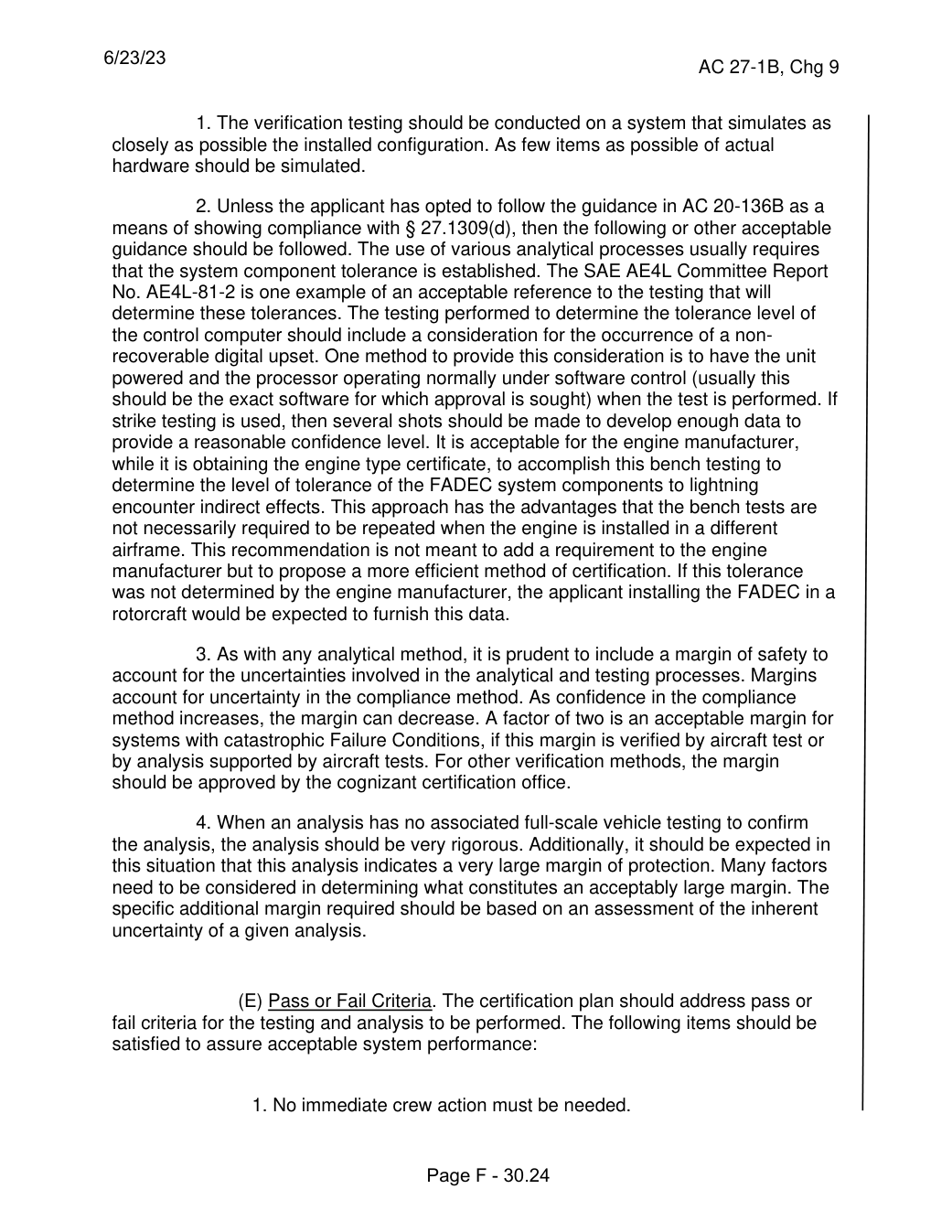
1. The verification testing should be conducted on a system that simulates as
closely as possible the installed configuration. As few items as possible of actual
hardware should be simulated.
2. Unless the applicant has opted to follow the guidance in AC 20-136B as a
means of showing compliance with § 27.1309(d), then the following or other acceptable
guidance should be followed. The use of various analytical processes usually requires
that the system component tolerance is established. The SAE AE4L Committee Report
No. AE4L-81-2 is one example of an acceptable reference to the testing that will
determine these tolerances. The testing performed to determine the tolerance level of
the control computer should include a consideration for the occurrence of a non
recoverable digital upset. One method to provide this consideration is to have the unit
powered and the processor operating normally under software control (usually this
should be the exact software for which approval is sought) when the test is performed. If
strike testing is used, then several shots should be made to develop enough data to
provide a reasonable confidence level. It is acceptable for the engine manufacturer,
while it is obtaining the engine type certificate, to accomplish this bench testing to
determine the level of tolerance of the FADEC system components to lightning
encounter indirect effects. This approach has the advantages that the bench tests are
not necessarily required to be repeated when the engine is installed in a different
airframe. This recommendation is not meant to add a requirement to the engine
manufacturer but to propose a more efficient method of certification. If this tolerance
was not determined by the engine manufacturer, the applicant installing the FADEC in a
rotorcraft would be expected to furnish this data.
3. As with any analytical method, it is prudent to include a margin of safety to
account for the uncertainties involved in the analytical and testing processes. Margins
account for uncertainty in the compliance method. As confidence in the compliance
method increases, the margin can decrease. A factor of two is an acceptable margin for
systems with catastrophic Failure Conditions, if this margin is verified by aircraft test or
by analysis supported by aircraft tests. For other verification methods, the margin
should be approved by the cognizant certification office.
4. When an analysis has no associated full-scale vehicle testing to confirm
the analysis, the analysis should be very rigorous. Additionally, it should be expected in
this situation that this analysis indicates a very large margin of protection. Many factors
need to be considered in determining what constitutes an acceptably large margin. The
specific additional margin required should be based on an assessment of the inherent
uncertainty of a given analysis.
(E) Pass or Fail Criteria. The certification plan should address pass or
fail criteria for the testing and analysis to be performed. The following items should be
satisfied to assure acceptable system performance:
1. No immediate crew action must be needed.
Page F - 30.24
Saved from the FAA on November 17, 2026. All original pages are retained. Engineering explanations are presented separately below.
Aerospace Consulting / Engineering perspective
Start with the certification basis and the function.
Identify the applicable amendment before selecting the safety guidance. Connect intended functions and operating conditions to failure conditions, architecture decisions, common-cause considerations, verification and limitations. For flight controls and IFR work, carry the relevant 27.672, 27.1329 and Appendix B assumptions into the system safety and compliance evidence.
1196 original pages. 0 pages have reviewed text reflows. Original-first pages retain the source layout, with extracted text available for finding words.
A focused review, an agreed assessment package or ongoing support alongside your team. We can agree the relevant inputs and scope in the initial conversation.
This opens your email application.
Start a conversation
Tell us about your programme, the system you are developing and the support you need.
We can agree a focused use-case review, a defined evidence package or ongoing programme support.
This opens your email application.
Specialist aerospace expertise
Aerospace Consulting is led by Hussein Khimji, an FAA Designated Engineering Representative in systems and equipment, with a focus on system safety, flight controls and avionics.
We work with aircraft developers and systems suppliers to connect technical decisions, safety assessments and certification evidence.
This is the proposed introduction. The full About page will add your approved biography and associate expertise.
Systems engineering & development assurance
Tell us about the aircraft or system, its intended function, stage of development and the support you need.