
Original FAA page, including its printed amendment and change markings. Extracted words support search; text reflow has not been reviewed.
AC 27-1B · F-30.17Open saved PDF here ↗
Extracted text for finding words
This extraction supports search. Read the original page for complete notation and layout.
6/23/23                                         AC 27-1B, Chg 9


        TTEST MAX = Maximum installed equipment temperature recorded during tests.

       TORH = The high reference outside air temperature. It varies with altitude starting
        at the highest sea level temperature at which rotorcraft operation is to be
       approved and decreases at 3.6° F/1,000 foot altitude. It can be no less than 100°
      F (reference § 27.1043(b)); however, it can be as high as the applicant wants.

      TH MAR = Temperature margin between the maximum equipment temperature
        substantiated in the laboratory and the maximum installed equipment
       temperature when the rotorcraft is operating in the highest available OAT and
       approximately corrected at the altitude under consideration. If the margin is zero
        or positive, the equipment passes. If the margin is negative, the equipment fails
        the test.

      TH MAR = TMAX - (TTEST MAX + (TORH - TOAT MAX))


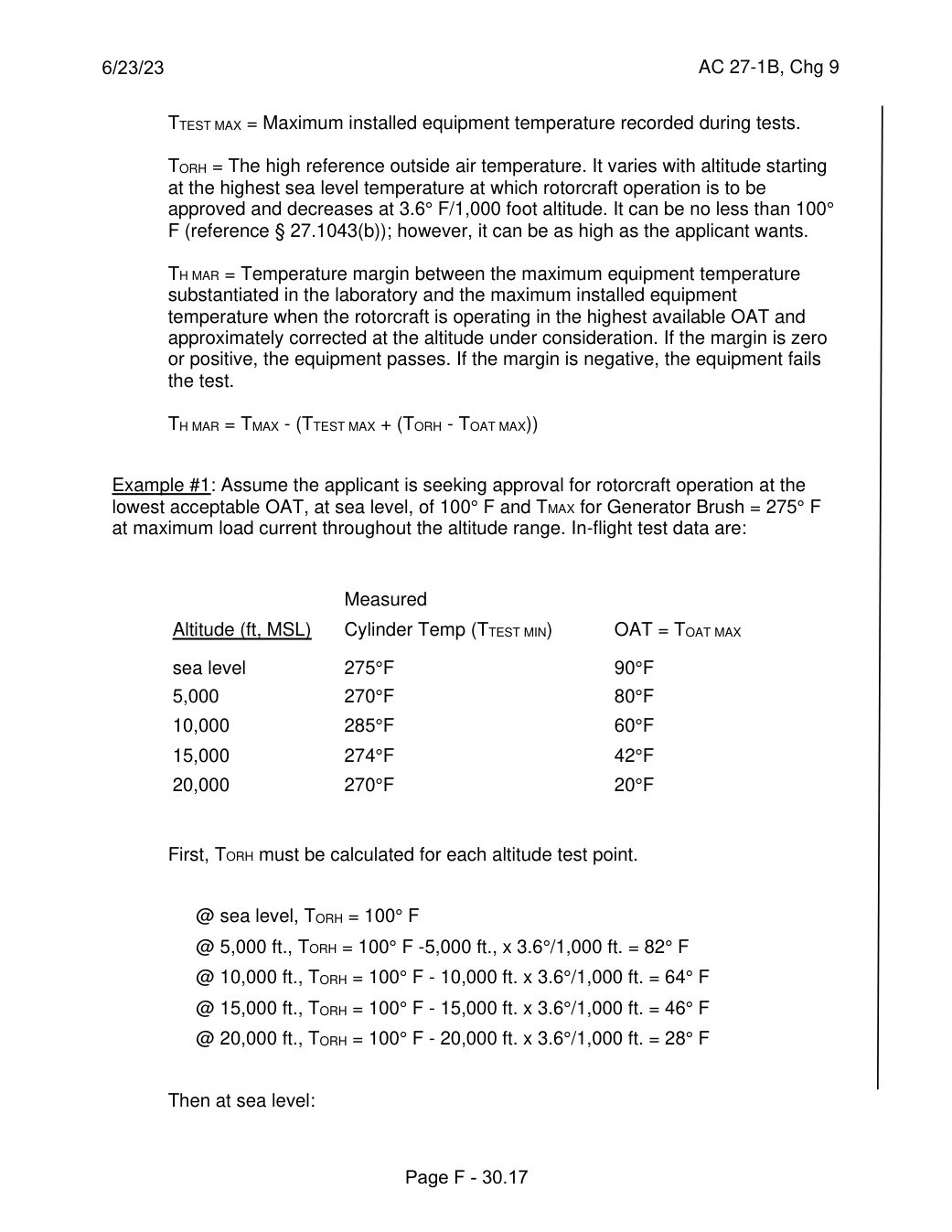
 Example #1: Assume the applicant is seeking approval for rotorcraft operation at the
 lowest acceptable OAT, at sea level, of 100° F and TMAX for Generator Brush = 275° F
 at maximum load current throughout the altitude range. In-flight test data are:


                       Measured
         Altitude (ft, MSL)    Cylinder Temp (TTEST MIN)     OAT = TOAT MAX

       sea level          275°F                      90°F
        5,000             270°F                      80°F
       10,000           285°F                      60°F
       15,000           274°F                      42°F
       20,000           270°F                      20°F


          First, TORH must be calculated for each altitude test point.


     @ sea level, TORH = 100° F
     @ 5,000 ft., TORH = 100° F -5,000 ft., x 3.6°/1,000 ft. = 82° F
     @ 10,000 ft., TORH = 100° F - 10,000 ft. x 3.6°/1,000 ft. = 64° F
     @ 15,000 ft., TORH = 100° F - 15,000 ft. x 3.6°/1,000 ft. = 46° F
     @ 20,000 ft., TORH = 100° F - 20,000 ft. x 3.6°/1,000 ft. = 28° F


      Then at sea level:


                            Page F - 30.17