
Original FAA page, including its printed amendment and change markings. Extracted words support search; text reflow has not been reviewed.
AC 27-1B · F-30.14Open saved PDF here ↗
Extracted text for finding words
This extraction supports search. Read the original page for complete notation and layout.
                                               AC 27-1B Chg 96/23/23

system under evaluation are an example of the type of event that would be considered
in a zonal analysis.

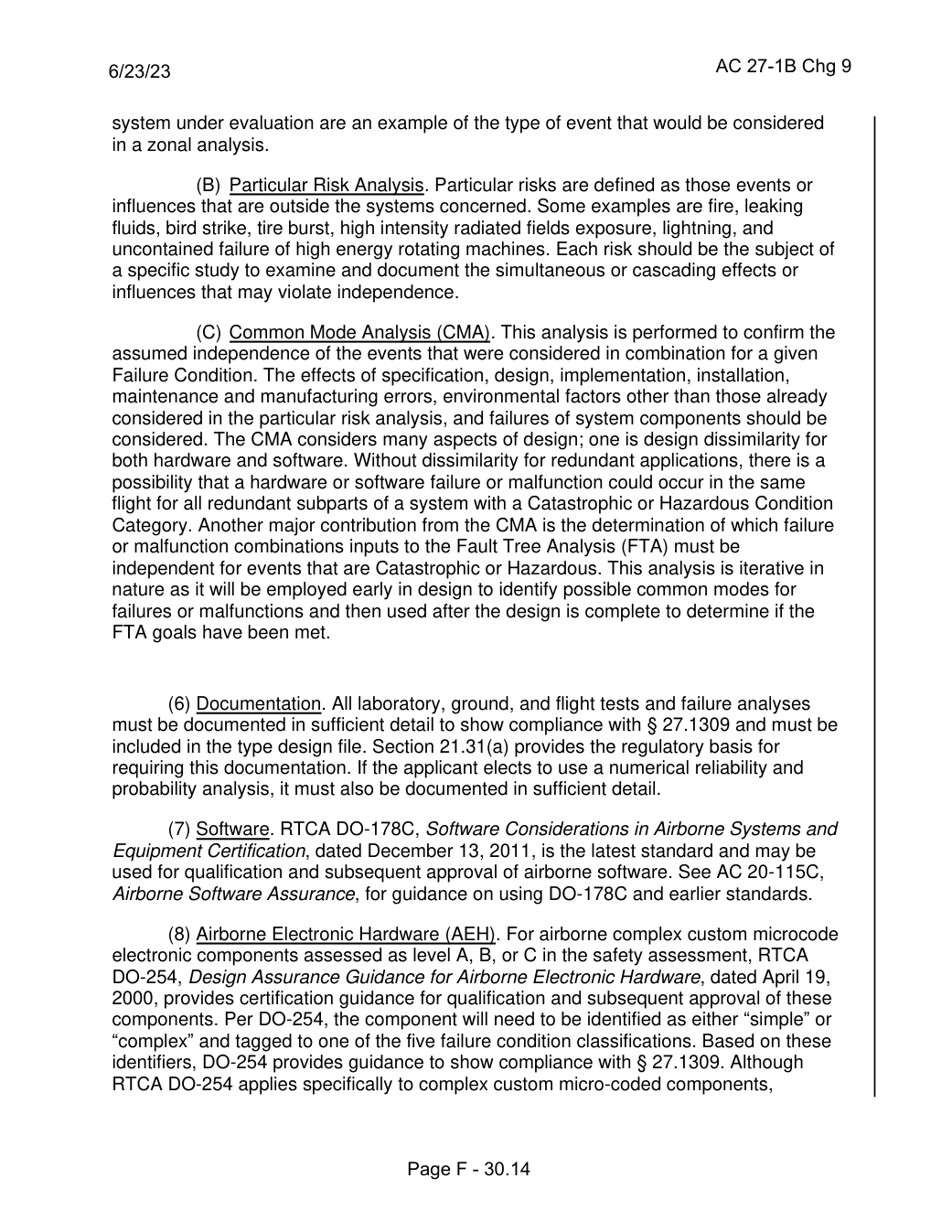
           (B) Particular Risk Analysis. Particular risks are defined as those events or
influences that are outside the systems concerned. Some examples are fire, leaking
fluids, bird strike, tire burst, high intensity radiated fields exposure, lightning, and
uncontained failure of high energy rotating machines. Each risk should be the subject of
a specific study to examine and document the simultaneous or cascading effects or
influences that may violate independence.

          (C) Common Mode Analysis (CMA). This analysis is performed to confirm the
assumed independence of the events that were considered in combination for a given
Failure Condition. The effects of specification, design, implementation, installation,
maintenance and manufacturing errors, environmental factors other than those already
considered in the particular risk analysis, and failures of system components should be
considered. The CMA considers many aspects of design; one is design dissimilarity for
both hardware and software. Without dissimilarity for redundant applications, there is a
possibility that a hardware or software failure or malfunction could occur in the same
 flight for all redundant subparts of a system with a Catastrophic or Hazardous Condition
Category. Another major contribution from the CMA is the determination of which failure
or malfunction combinations inputs to the Fault Tree Analysis (FTA) must be
independent for events that are Catastrophic or Hazardous. This analysis is iterative in
nature as it will be employed early in design to identify possible common modes for
failures or malfunctions and then used after the design is complete to determine if the
FTA goals have been met.


        (6) Documentation. All laboratory, ground, and flight tests and failure analyses
must be documented in sufficient detail to show compliance with § 27.1309 and must be
included in the type design file. Section 21.31(a) provides the regulatory basis for
requiring this documentation. If the applicant elects to use a numerical reliability and
probability analysis, it must also be documented in sufficient detail.

        (7) Software. RTCA DO-178C, Software Considerations in Airborne Systems and
Equipment Certification, dated December 13, 2011, is the latest standard and may be
used for qualification and subsequent approval of airborne software. See AC 20-115C,
Airborne Software Assurance, for guidance on using DO-178C and earlier standards.

        (8) Airborne Electronic Hardware (AEH). For airborne complex custom microcode
electronic components assessed as level A, B, or C in the safety assessment, RTCA
DO-254, Design Assurance Guidance for Airborne Electronic Hardware, dated April 19,
2000, provides certification guidance for qualification and subsequent approval of these
components. Per DO-254, the component will need to be identified as either “simple” or
“complex” and tagged to one of the five failure condition classifications. Based on these
identifiers, DO-254 provides guidance to show compliance with § 27.1309. Although
RTCA DO-254 applies specifically to complex custom micro-coded components,


                           Page F - 30.14