Certification of Normal Category Rotorcraft — Changes 1–9
Normal category rotorcraft guidance with Changes 1–9 incorporated. Search the complete AC or start with the system safety, flight controls and instrument-flight guidance.
This source includes guidance for different amendments of Part 27. Match the guidance to the aircraft’s agreed certification basis: the 27.1309 entries for Amendments 27-21, 27-46 and 27-51 are separate. The base AC was issued on 30 September 1999; Change 9 is dated 23 June 2023. The FAA catalogue’s 30 September 2008 date is not the date of the latest change.
The source, within reach.
Search within this AC, jump to a source page, or download the complete saved publication.
This extraction supports search. Read the original page for complete notation and layout.
3/31/2014                                      AC 27-1B, Chg 4


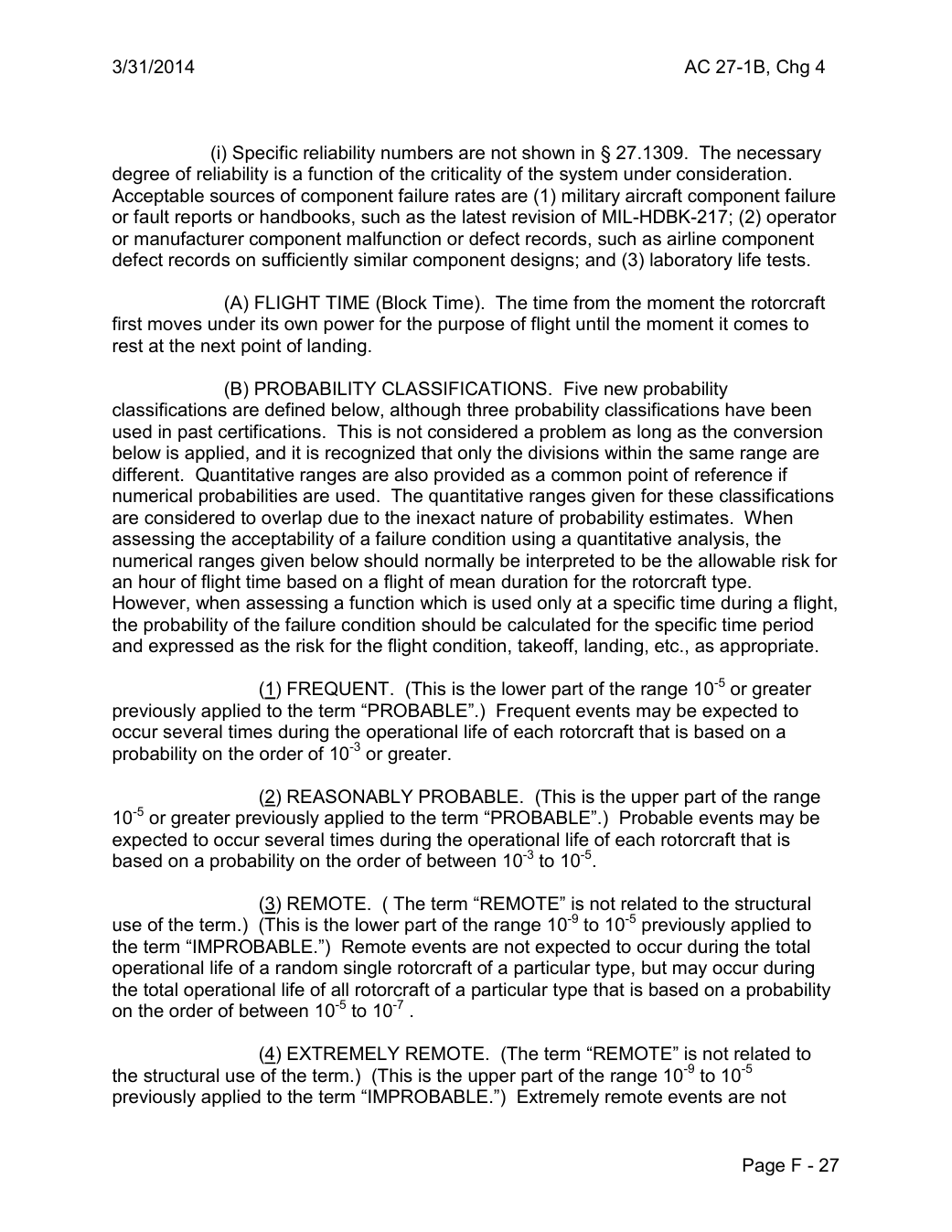
                  (i) Specific reliability numbers are not shown in § 27.1309. The necessary
degree of reliability is a function of the criticality of the system under consideration.
Acceptable sources of component failure rates are (1) military aircraft component failure
or fault reports or handbooks, such as the latest revision of MIL-HDBK-217; (2) operator
or manufacturer component malfunction or defect records, such as airline component
defect records on sufficiently similar component designs; and (3) laboratory life tests.

              (A) FLIGHT TIME (Block Time). The time from the moment the rotorcraft
first moves under its own power for the purpose of flight until the moment it comes to
rest at the next point of landing.

              (B) PROBABILITY CLASSIFICATIONS. Five new probability
classifications are defined below, although three probability classifications have been
used in past certifications. This is not considered a problem as long as the conversion
below is applied, and it is recognized that only the divisions within the same range are
different. Quantitative ranges are also provided as a common point of reference if
numerical probabilities are used. The quantitative ranges given for these classifications
are considered to overlap due to the inexact nature of probability estimates. When
assessing the acceptability of a failure condition using a quantitative analysis, the
numerical ranges given below should normally be interpreted to be the allowable risk for
an hour of flight time based on a flight of mean duration for the rotorcraft type.
However, when assessing a function which is used only at a specific time during a flight,
the probability of the failure condition should be calculated for the specific time period
and expressed as the risk for the flight condition, takeoff, landing, etc., as appropriate.

                   (1) FREQUENT. (This is the lower part of the range 10-5 or greater
previously applied to the term “PROBABLE”.) Frequent events may be expected to
occur several times during the operational life of each rotorcraft that is based on a
probability on the order of 10-3 or greater.

                   (2) REASONABLY PROBABLE. (This is the upper part of the range
10-5 or greater previously applied to the term “PROBABLE”.) Probable events may be
expected to occur several times during the operational life of each rotorcraft that is
based on a probability on the order of between 10-3 to 10-5.

                   (3) REMOTE.  ( The term “REMOTE” is not related to the structural
use of the term.) (This is the lower part of the range 10-9 to 10-5 previously applied to
the term “IMPROBABLE.”) Remote events are not expected to occur during the total
operational life of a random single rotorcraft of a particular type, but may occur during
the total operational life of all rotorcraft of a particular type that is based on a probability
on the order of between 10 -5 to 10-7 .

                   (4) EXTREMELY REMOTE. (The term “REMOTE” is not related to
the structural use of the term.) (This is the upper part of the range 10 -9 to 10 -5
previously applied to the term “IMPROBABLE.”) Extremely remote events are not


                                                          Page F - 27
Saved from the FAA on November 17, 2026. All original pages are retained. Engineering explanations are presented separately below.
Aerospace Consulting / Engineering perspective
Start with the certification basis and the function.
Identify the applicable amendment before selecting the safety guidance. Connect intended functions and operating conditions to failure conditions, architecture decisions, common-cause considerations, verification and limitations. For flight controls and IFR work, carry the relevant 27.672, 27.1329 and Appendix B assumptions into the system safety and compliance evidence.
1196 original pages. 0 pages have reviewed text reflows. Original-first pages retain the source layout, with extracted text available for finding words.
A focused review, an agreed assessment package or ongoing support alongside your team. We can agree the relevant inputs and scope in the initial conversation.
This opens your email application.
Start a conversation
Tell us about your programme, the system you are developing and the support you need.
We can agree a focused use-case review, a defined evidence package or ongoing programme support.
This opens your email application.
Specialist aerospace expertise
Aerospace Consulting is led by Hussein Khimji, an FAA Designated Engineering Representative in systems and equipment, with a focus on system safety, flight controls and avionics.
We work with aircraft developers and systems suppliers to connect technical decisions, safety assessments and certification evidence.
This is the proposed introduction. The full About page will add your approved biography and associate expertise.
Systems engineering & development assurance
Tell us about the aircraft or system, its intended function, stage of development and the support you need.