
Original FAA page, including its printed amendment and change markings. Extracted words support search; text reflow has not been reviewed.
AC 27-1B · F-18Open saved PDF here ↗
Extracted text for finding words
This extraction supports search. Read the original page for complete notation and layout.
AC 27-1B, Chg 4                                                     3/31/2014


         rejection. Temperature in the zero to 32° F range can be handled by
        conversion to the centigrade scale.

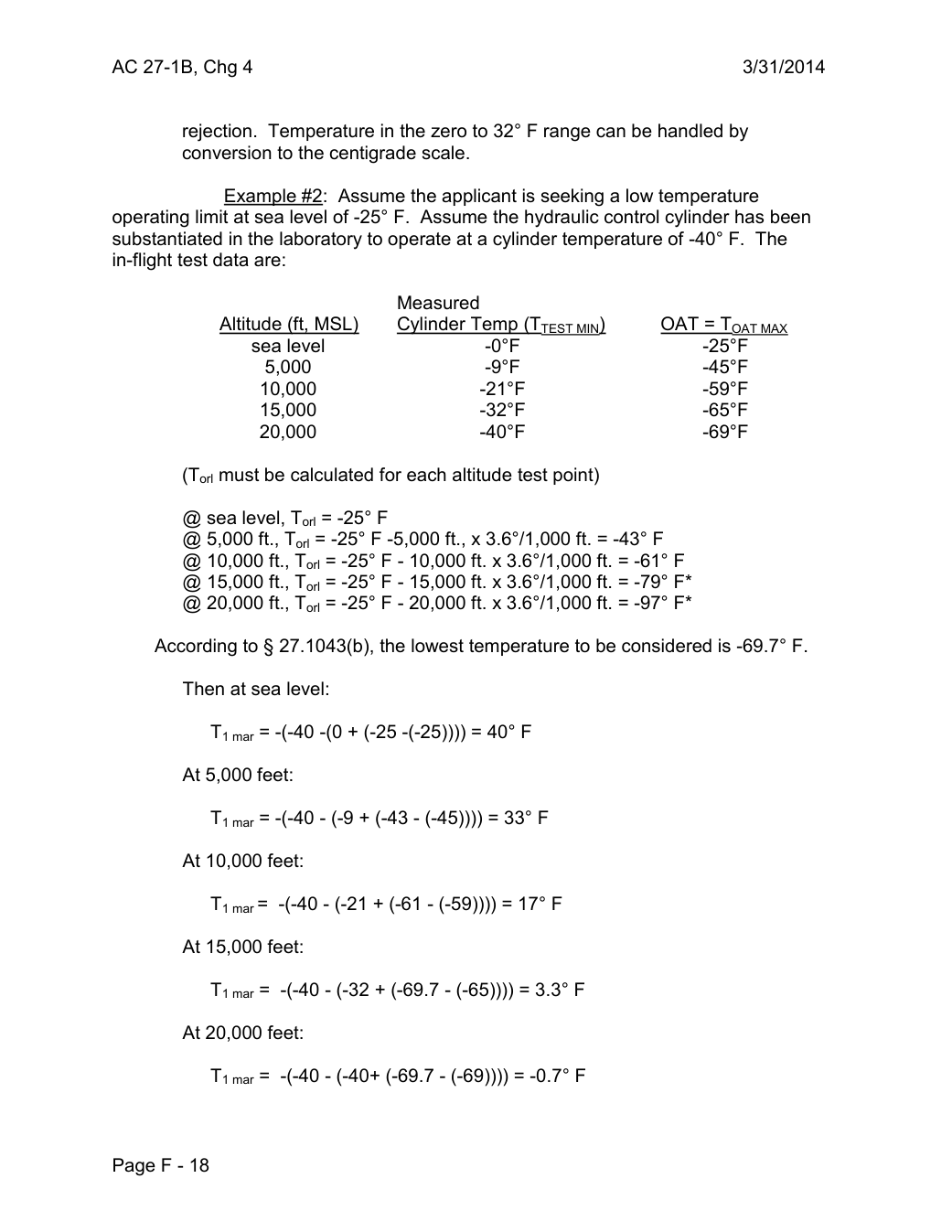
           Example #2: Assume the applicant is seeking a low temperature
operating limit at sea level of -25° F. Assume the hydraulic control cylinder has been
substantiated in the laboratory to operate at a cylinder temperature of -40° F. The
in-flight test data are:

                           Measured
              Altitude (ft, MSL)    Cylinder Temp (TTEST MIN)    OAT = TOAT MAX
              sea level                  -0°F                    -25°F
                5,000                    -9°F                    -45°F
               10,000                  -21°F                   -59°F
               15,000                  -32°F                   -65°F
               20,000                  -40°F                   -69°F

           (Torl must be calculated for each altitude test point)

    @ sea level, Torl = -25° F
    @ 5,000 ft., Torl = -25° F -5,000 ft., x 3.6°/1,000 ft. = -43° F
    @ 10,000 ft., Torl = -25° F - 10,000 ft. x 3.6°/1,000 ft. = -61° F
    @ 15,000 ft., Torl = -25° F - 15,000 ft. x 3.6°/1,000 ft. = -79° F*
    @ 20,000 ft., Torl = -25° F - 20,000 ft. x 3.6°/1,000 ft. = -97° F*

     According to § 27.1043(b), the lowest temperature to be considered is -69.7° F.

       Then at sea level:

           T1 mar = -(-40 -(0 + (-25 -(-25)))) = 40° F

        At 5,000 feet:

           T1 mar = -(-40 - (-9 + (-43 - (-45)))) = 33° F

        At 10,000 feet:

           T1 mar = -(-40 - (-21 + (-61 - (-59)))) = 17° F

        At 15,000 feet:

           T1 mar = -(-40 - (-32 + (-69.7 - (-65)))) = 3.3° F

        At 20,000 feet:

           T1 mar = -(-40 - (-40+ (-69.7 - (-69)))) = -0.7° F


Page F - 18