Certification of Normal Category Rotorcraft — Changes 1–9
Normal category rotorcraft guidance with Changes 1–9 incorporated. Search the complete AC or start with the system safety, flight controls and instrument-flight guidance.
This source includes guidance for different amendments of Part 27. Match the guidance to the aircraft’s agreed certification basis: the 27.1309 entries for Amendments 27-21, 27-46 and 27-51 are separate. The base AC was issued on 30 September 1999; Change 9 is dated 23 June 2023. The FAA catalogue’s 30 September 2008 date is not the date of the latest change.
The source, within reach.
Search within this AC, jump to a source page, or download the complete saved publication.
This extraction supports search. Read the original page for complete notation and layout.
AC 27-1B                                                                  9/30/99

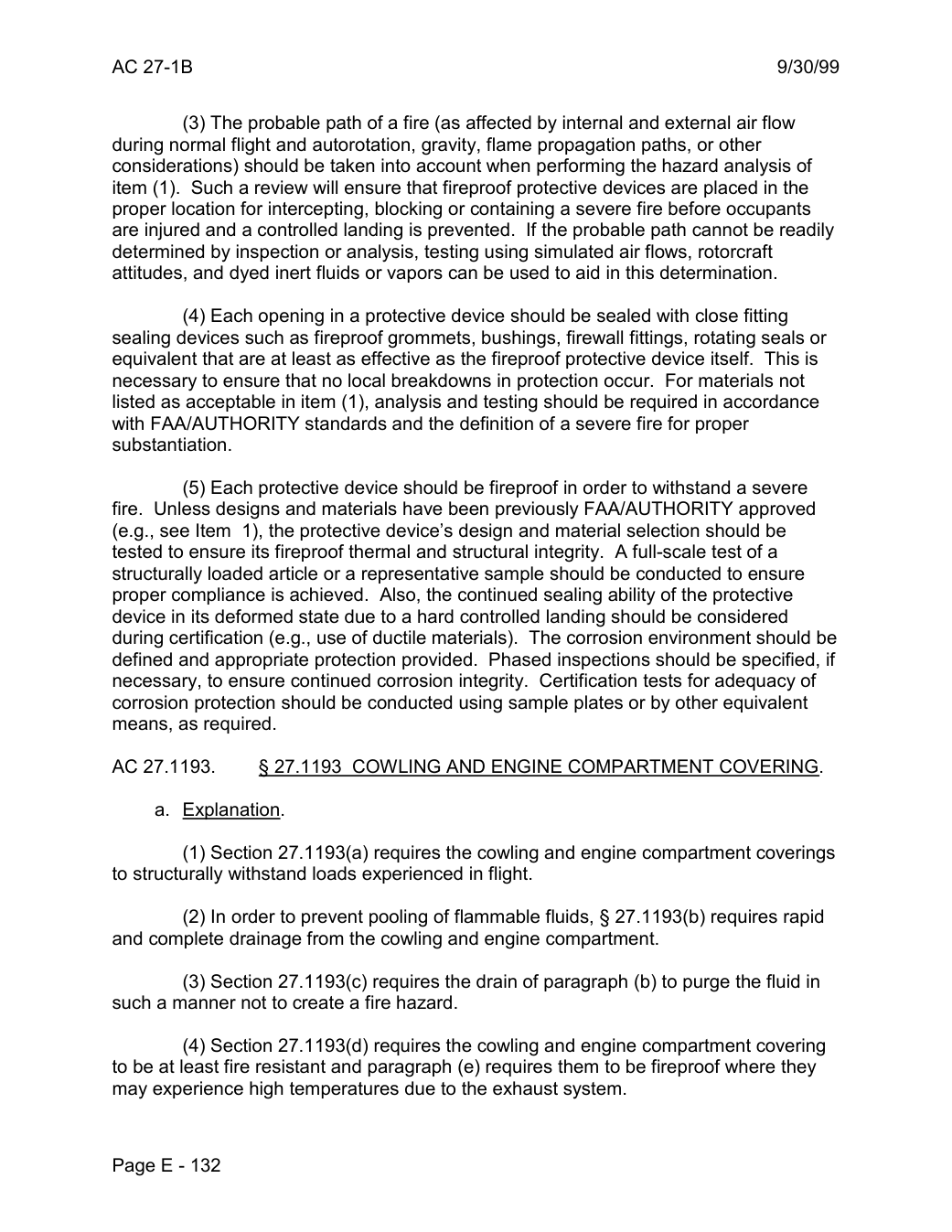
         (3) The probable path of a fire (as affected by internal and external air flow
during normal flight and autorotation, gravity, flame propagation paths, or other
considerations) should be taken into account when performing the hazard analysis of
item (1). Such a review will ensure that fireproof protective devices are placed in the
proper location for intercepting, blocking or containing a severe fire before occupants
are injured and a controlled landing is prevented.  If the probable path cannot be readily
determined by inspection or analysis, testing using simulated air flows, rotorcraft
attitudes, and dyed inert fluids or vapors can be used to aid in this determination.

         (4) Each opening in a protective device should be sealed with close fitting
sealing devices such as fireproof grommets, bushings, firewall fittings, rotating seals or
equivalent that are at least as effective as the fireproof protective device itself. This is
necessary to ensure that no local breakdowns in protection occur. For materials not
listed as acceptable in item (1), analysis and testing should be required in accordance
with FAA/AUTHORITY standards and the definition of a severe fire for proper
substantiation.

         (5) Each protective device should be fireproof in order to withstand a severe
fire. Unless designs and materials have been previously FAA/AUTHORITY approved
(e.g., see Item 1), the protective device’s design and material selection should be
tested to ensure its fireproof thermal and structural integrity. A full-scale test of a
structurally loaded article or a representative sample should be conducted to ensure
proper compliance is achieved. Also, the continued sealing ability of the protective
device in its deformed state due to a hard controlled landing should be considered
during certification (e.g., use of ductile materials). The corrosion environment should be
defined and appropriate protection provided. Phased inspections should be specified, if
necessary, to ensure continued corrosion integrity. Certification tests for adequacy of
corrosion protection should be conducted using sample plates or by other equivalent
means, as required.

AC 27.1193.    § 27.1193 COWLING AND ENGINE COMPARTMENT COVERING.

     a. Explanation.

         (1) Section 27.1193(a) requires the cowling and engine compartment coverings
to structurally withstand loads experienced in flight.

         (2) In order to prevent pooling of flammable fluids, § 27.1193(b) requires rapid
and complete drainage from the cowling and engine compartment.

         (3) Section 27.1193(c) requires the drain of paragraph (b) to purge the fluid in
such a manner not to create a fire hazard.

         (4) Section 27.1193(d) requires the cowling and engine compartment covering
to be at least fire resistant and paragraph (e) requires them to be fireproof where they
may experience high temperatures due to the exhaust system.


Page E - 132
Saved from the FAA on November 17, 2026. All original pages are retained. Engineering explanations are presented separately below.
Aerospace Consulting / Engineering perspective
Start with the certification basis and the function.
Identify the applicable amendment before selecting the safety guidance. Connect intended functions and operating conditions to failure conditions, architecture decisions, common-cause considerations, verification and limitations. For flight controls and IFR work, carry the relevant 27.672, 27.1329 and Appendix B assumptions into the system safety and compliance evidence.
1196 original pages. 0 pages have reviewed text reflows. Original-first pages retain the source layout, with extracted text available for finding words.
A focused review, an agreed assessment package or ongoing support alongside your team. We can agree the relevant inputs and scope in the initial conversation.
This opens your email application.
Start a conversation
Tell us about your programme, the system you are developing and the support you need.
We can agree a focused use-case review, a defined evidence package or ongoing programme support.
This opens your email application.
Specialist aerospace expertise
Aerospace Consulting is led by Hussein Khimji, an FAA Designated Engineering Representative in systems and equipment, with a focus on system safety, flight controls and avionics.
We work with aircraft developers and systems suppliers to connect technical decisions, safety assessments and certification evidence.
This is the proposed introduction. The full About page will add your approved biography and associate expertise.
Systems engineering & development assurance
Tell us about the aircraft or system, its intended function, stage of development and the support you need.