Certification of Normal Category Rotorcraft — Changes 1–9
Normal category rotorcraft guidance with Changes 1–9 incorporated. Search the complete AC or start with the system safety, flight controls and instrument-flight guidance.
This source includes guidance for different amendments of Part 27. Match the guidance to the aircraft’s agreed certification basis: the 27.1309 entries for Amendments 27-21, 27-46 and 27-51 are separate. The base AC was issued on 30 September 1999; Change 9 is dated 23 June 2023. The FAA catalogue’s 30 September 2008 date is not the date of the latest change.
The source, within reach.
Search within this AC, jump to a source page, or download the complete saved publication.
This extraction supports search. Read the original page for complete notation and layout.
AC 27-1B                                                                  9/30/99

     b. Procedures.

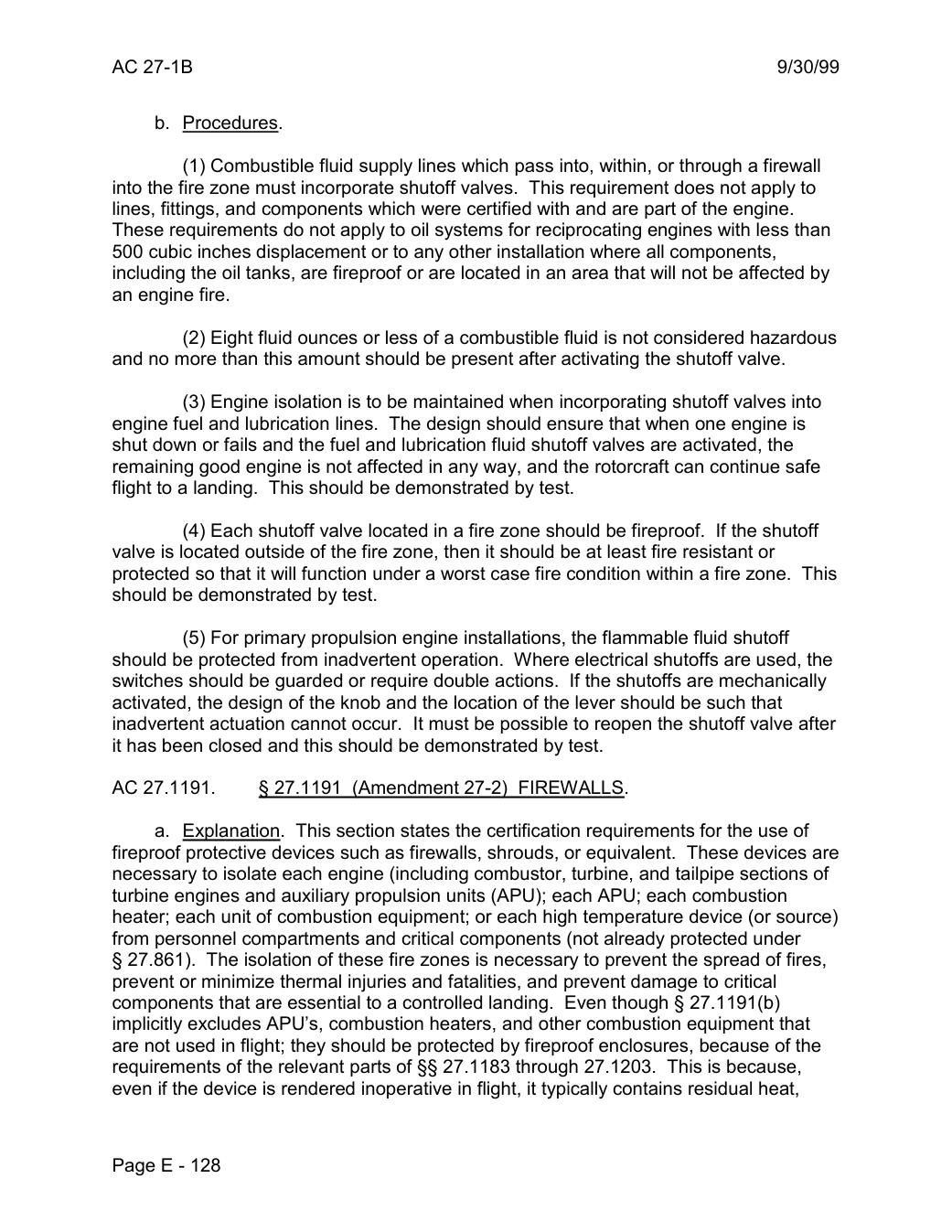
         (1) Combustible fluid supply lines which pass into, within, or through a firewall
into the fire zone must incorporate shutoff valves. This requirement does not apply to
lines, fittings, and components which were certified with and are part of the engine.
These requirements do not apply to oil systems for reciprocating engines with less than
500 cubic inches displacement or to any other installation where all components,
including the oil tanks, are fireproof or are located in an area that will not be affected by
an engine fire.

         (2) Eight fluid ounces or less of a combustible fluid is not considered hazardous
and no more than this amount should be present after activating the shutoff valve.

         (3) Engine isolation is to be maintained when incorporating shutoff valves into
engine fuel and lubrication lines. The design should ensure that when one engine is
shut down or fails and the fuel and lubrication fluid shutoff valves are activated, the
remaining good engine is not affected in any way, and the rotorcraft can continue safe
flight to a landing. This should be demonstrated by test.

         (4) Each shutoff valve located in a fire zone should be fireproof.  If the shutoff
valve is located outside of the fire zone, then it should be at least fire resistant or
protected so that it will function under a worst case fire condition within a fire zone. This
should be demonstrated by test.

         (5) For primary propulsion engine installations, the flammable fluid shutoff
should be protected from inadvertent operation. Where electrical shutoffs are used, the
switches should be guarded or require double actions.  If the shutoffs are mechanically
activated, the design of the knob and the location of the lever should be such that
inadvertent actuation cannot occur.  It must be possible to reopen the shutoff valve after
it has been closed and this should be demonstrated by test.

AC 27.1191.    § 27.1191 (Amendment 27-2) FIREWALLS.

     a. Explanation. This section states the certification requirements for the use of
fireproof protective devices such as firewalls, shrouds, or equivalent. These devices are
necessary to isolate each engine (including combustor, turbine, and tailpipe sections of
turbine engines and auxiliary propulsion units (APU); each APU; each combustion
heater; each unit of combustion equipment; or each high temperature device (or source)
from personnel compartments and critical components (not already protected under
§ 27.861). The isolation of these fire zones is necessary to prevent the spread of fires,
prevent or minimize thermal injuries and fatalities, and prevent damage to critical
components that are essential to a controlled landing. Even though § 27.1191(b)
implicitly excludes APU’s, combustion heaters, and other combustion equipment that
are not used in flight; they should be protected by fireproof enclosures, because of the
requirements of the relevant parts of §§ 27.1183 through 27.1203. This is because,
even if the device is rendered inoperative in flight, it typically contains residual heat,


Page E - 128
Saved from the FAA on November 17, 2026. All original pages are retained. Engineering explanations are presented separately below.
Aerospace Consulting / Engineering perspective
Start with the certification basis and the function.
Identify the applicable amendment before selecting the safety guidance. Connect intended functions and operating conditions to failure conditions, architecture decisions, common-cause considerations, verification and limitations. For flight controls and IFR work, carry the relevant 27.672, 27.1329 and Appendix B assumptions into the system safety and compliance evidence.
1196 original pages. 0 pages have reviewed text reflows. Original-first pages retain the source layout, with extracted text available for finding words.
A focused review, an agreed assessment package or ongoing support alongside your team. We can agree the relevant inputs and scope in the initial conversation.
This opens your email application.
Start a conversation
Tell us about your programme, the system you are developing and the support you need.
We can agree a focused use-case review, a defined evidence package or ongoing programme support.
This opens your email application.
Specialist aerospace expertise
Aerospace Consulting is led by Hussein Khimji, an FAA Designated Engineering Representative in systems and equipment, with a focus on system safety, flight controls and avionics.
We work with aircraft developers and systems suppliers to connect technical decisions, safety assessments and certification evidence.
This is the proposed introduction. The full About page will add your approved biography and associate expertise.
Systems engineering & development assurance
Tell us about the aircraft or system, its intended function, stage of development and the support you need.