Certification of Normal Category Rotorcraft — Changes 1–9
Normal category rotorcraft guidance with Changes 1–9 incorporated. Search the complete AC or start with the system safety, flight controls and instrument-flight guidance.
This source includes guidance for different amendments of Part 27. Match the guidance to the aircraft’s agreed certification basis: the 27.1309 entries for Amendments 27-21, 27-46 and 27-51 are separate. The base AC was issued on 30 September 1999; Change 9 is dated 23 June 2023. The FAA catalogue’s 30 September 2008 date is not the date of the latest change.
The source, within reach.
Search within this AC, jump to a source page, or download the complete saved publication.
This extraction supports search. Read the original page for complete notation and layout.
AC 27-1B                                                                  9/30/99

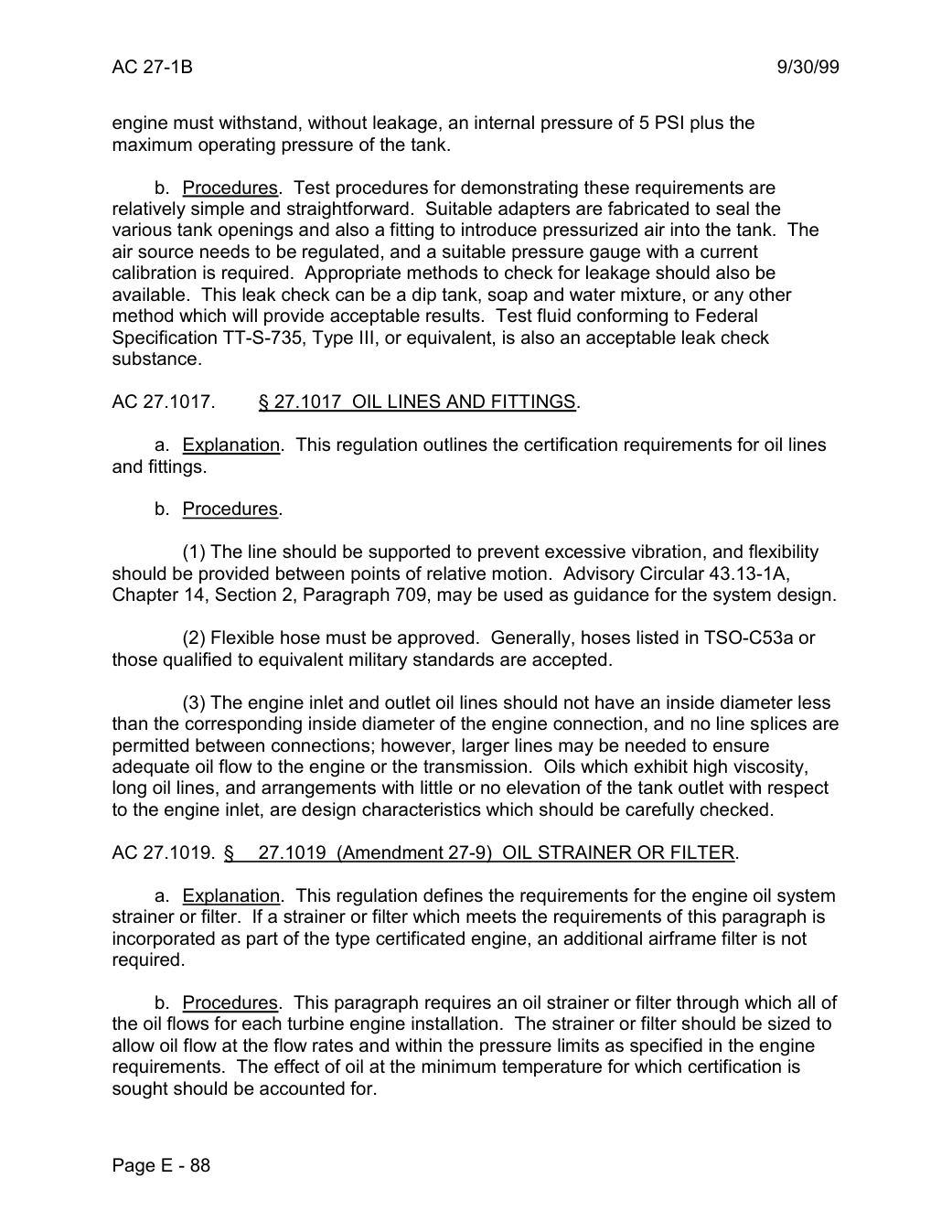
engine must withstand, without leakage, an internal pressure of 5 PSI plus the
maximum operating pressure of the tank.

     b. Procedures. Test procedures for demonstrating these requirements are
relatively simple and straightforward. Suitable adapters are fabricated to seal the
various tank openings and also a fitting to introduce pressurized air into the tank. The
air source needs to be regulated, and a suitable pressure gauge with a current
calibration is required. Appropriate methods to check for leakage should also be
available. This leak check can be a dip tank, soap and water mixture, or any other
method which will provide acceptable results. Test fluid conforming to Federal
Specification TT-S-735, Type III, or equivalent, is also an acceptable leak check
substance.

AC 27.1017.    § 27.1017 OIL LINES AND FITTINGS.

     a. Explanation. This regulation outlines the certification requirements for oil lines
and fittings.

     b. Procedures.

         (1) The line should be supported to prevent excessive vibration, and flexibility
should be provided between points of relative motion. Advisory Circular 43.13-1A,
Chapter 14, Section 2, Paragraph 709, may be used as guidance for the system design.

         (2) Flexible hose must be approved. Generally, hoses listed in TSO-C53a or
those qualified to equivalent military standards are accepted.

         (3) The engine inlet and outlet oil lines should not have an inside diameter less
than the corresponding inside diameter of the engine connection, and no line splices are
permitted between connections; however, larger lines may be needed to ensure
adequate oil flow to the engine or the transmission. Oils which exhibit high viscosity,
long oil lines, and arrangements with little or no elevation of the tank outlet with respect
to the engine inlet, are design characteristics which should be carefully checked.

AC 27.1019. §   27.1019 (Amendment 27-9) OIL STRAINER OR FILTER.

     a. Explanation. This regulation defines the requirements for the engine oil system
strainer or filter.  If a strainer or filter which meets the requirements of this paragraph is
incorporated as part of the type certificated engine, an additional airframe filter is not
required.

     b. Procedures. This paragraph requires an oil strainer or filter through which all of
the oil flows for each turbine engine installation. The strainer or filter should be sized to
allow oil flow at the flow rates and within the pressure limits as specified in the engine
requirements. The effect of oil at the minimum temperature for which certification is
sought should be accounted for.


Page E - 88
Saved from the FAA on November 17, 2026. All original pages are retained. Engineering explanations are presented separately below.
Aerospace Consulting / Engineering perspective
Start with the certification basis and the function.
Identify the applicable amendment before selecting the safety guidance. Connect intended functions and operating conditions to failure conditions, architecture decisions, common-cause considerations, verification and limitations. For flight controls and IFR work, carry the relevant 27.672, 27.1329 and Appendix B assumptions into the system safety and compliance evidence.
1196 original pages. 0 pages have reviewed text reflows. Original-first pages retain the source layout, with extracted text available for finding words.
A focused review, an agreed assessment package or ongoing support alongside your team. We can agree the relevant inputs and scope in the initial conversation.
This opens your email application.
Start a conversation
Tell us about your programme, the system you are developing and the support you need.
We can agree a focused use-case review, a defined evidence package or ongoing programme support.
This opens your email application.
Specialist aerospace expertise
Aerospace Consulting is led by Hussein Khimji, an FAA Designated Engineering Representative in systems and equipment, with a focus on system safety, flight controls and avionics.
We work with aircraft developers and systems suppliers to connect technical decisions, safety assessments and certification evidence.
This is the proposed introduction. The full About page will add your approved biography and associate expertise.
Systems engineering & development assurance
Tell us about the aircraft or system, its intended function, stage of development and the support you need.