Certification of Normal Category Rotorcraft — Changes 1–9
Normal category rotorcraft guidance with Changes 1–9 incorporated. Search the complete AC or start with the system safety, flight controls and instrument-flight guidance.
This source includes guidance for different amendments of Part 27. Match the guidance to the aircraft’s agreed certification basis: the 27.1309 entries for Amendments 27-21, 27-46 and 27-51 are separate. The base AC was issued on 30 September 1999; Change 9 is dated 23 June 2023. The FAA catalogue’s 30 September 2008 date is not the date of the latest change.
The source, within reach.
Search within this AC, jump to a source page, or download the complete saved publication.
This extraction supports search. Read the original page for complete notation and layout.
9/30/99                                             AC 27-1B

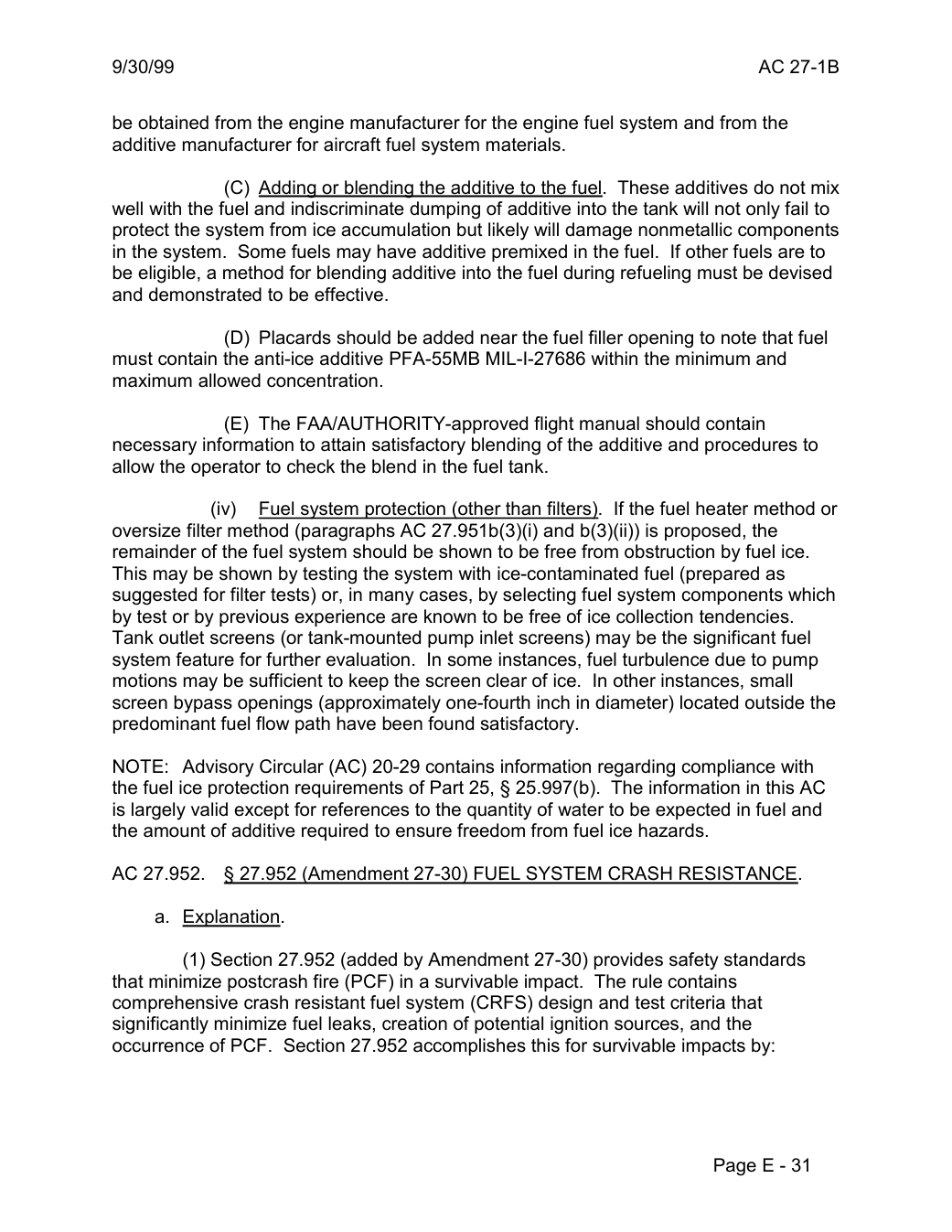
be obtained from the engine manufacturer for the engine fuel system and from the
additive manufacturer for aircraft fuel system materials.

             (C) Adding or blending the additive to the fuel. These additives do not mix
well with the fuel and indiscriminate dumping of additive into the tank will not only fail to
protect the system from ice accumulation but likely will damage nonmetallic components
in the system. Some fuels may have additive premixed in the fuel.  If other fuels are to
be eligible, a method for blending additive into the fuel during refueling must be devised
and demonstrated to be effective.

             (D) Placards should be added near the fuel filler opening to note that fuel
must contain the anti-ice additive PFA-55MB MIL-I-27686 within the minimum and
maximum allowed concentration.

              (E) The FAA/AUTHORITY-approved flight manual should contain
necessary information to attain satisfactory blending of the additive and procedures to
allow the operator to check the blend in the fuel tank.

               (iv)  Fuel system protection (other than filters).  If the fuel heater method or
oversize filter method (paragraphs AC 27.951b(3)(i) and b(3)(ii)) is proposed, the
remainder of the fuel system should be shown to be free from obstruction by fuel ice.
This may be shown by testing the system with ice-contaminated fuel (prepared as
suggested for filter tests) or, in many cases, by selecting fuel system components which
by test or by previous experience are known to be free of ice collection tendencies.
Tank outlet screens (or tank-mounted pump inlet screens) may be the significant fuel
system feature for further evaluation. In some instances, fuel turbulence due to pump
motions may be sufficient to keep the screen clear of ice. In other instances, small
screen bypass openings (approximately one-fourth inch in diameter) located outside the
predominant fuel flow path have been found satisfactory.

NOTE: Advisory Circular (AC) 20-29 contains information regarding compliance with
the fuel ice protection requirements of Part 25, § 25.997(b). The information in this AC
is largely valid except for references to the quantity of water to be expected in fuel and
the amount of additive required to ensure freedom from fuel ice hazards.

AC 27.952.  § 27.952 (Amendment 27-30) FUEL SYSTEM CRASH RESISTANCE.

     a. Explanation.

         (1) Section 27.952 (added by Amendment 27-30) provides safety standards
that minimize postcrash fire (PCF) in a survivable impact. The rule contains
comprehensive crash resistant fuel system (CRFS) design and test criteria that
significantly minimize fuel leaks, creation of potential ignition sources, and the
occurrence of PCF. Section 27.952 accomplishes this for survivable impacts by:


                                                       Page E - 31
Saved from the FAA on November 17, 2026. All original pages are retained. Engineering explanations are presented separately below.
Aerospace Consulting / Engineering perspective
Start with the certification basis and the function.
Identify the applicable amendment before selecting the safety guidance. Connect intended functions and operating conditions to failure conditions, architecture decisions, common-cause considerations, verification and limitations. For flight controls and IFR work, carry the relevant 27.672, 27.1329 and Appendix B assumptions into the system safety and compliance evidence.
1196 original pages. 0 pages have reviewed text reflows. Original-first pages retain the source layout, with extracted text available for finding words.
A focused review, an agreed assessment package or ongoing support alongside your team. We can agree the relevant inputs and scope in the initial conversation.
This opens your email application.
Start a conversation
Tell us about your programme, the system you are developing and the support you need.
We can agree a focused use-case review, a defined evidence package or ongoing programme support.
This opens your email application.
Specialist aerospace expertise
Aerospace Consulting is led by Hussein Khimji, an FAA Designated Engineering Representative in systems and equipment, with a focus on system safety, flight controls and avionics.
We work with aircraft developers and systems suppliers to connect technical decisions, safety assessments and certification evidence.
This is the proposed introduction. The full About page will add your approved biography and associate expertise.
Systems engineering & development assurance
Tell us about the aircraft or system, its intended function, stage of development and the support you need.