Certification of Normal Category Rotorcraft — Changes 1–9
Normal category rotorcraft guidance with Changes 1–9 incorporated. Search the complete AC or start with the system safety, flight controls and instrument-flight guidance.
This source includes guidance for different amendments of Part 27. Match the guidance to the aircraft’s agreed certification basis: the 27.1309 entries for Amendments 27-21, 27-46 and 27-51 are separate. The base AC was issued on 30 September 1999; Change 9 is dated 23 June 2023. The FAA catalogue’s 30 September 2008 date is not the date of the latest change.
The source, within reach.
Search within this AC, jump to a source page, or download the complete saved publication.
This extraction supports search. Read the original page for complete notation and layout.
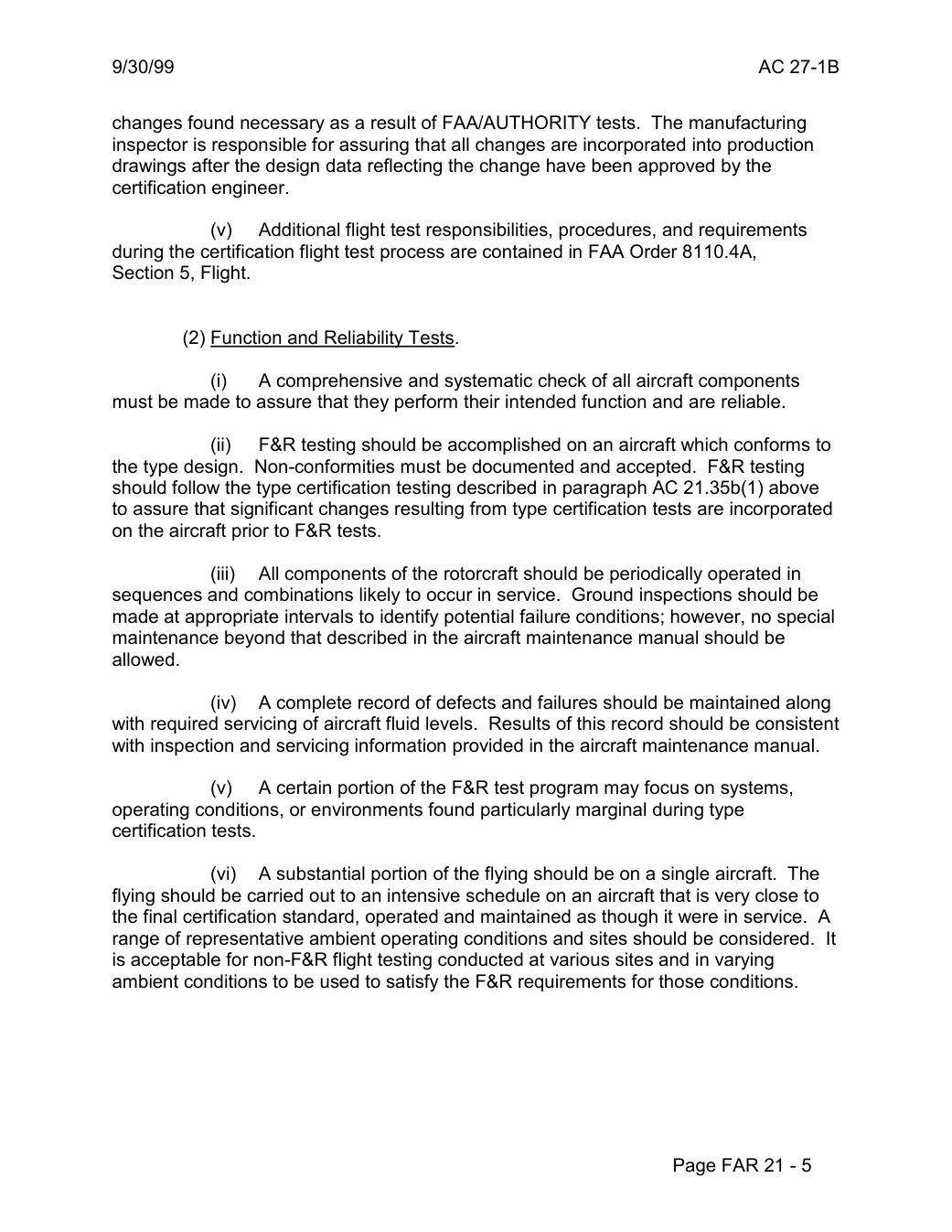
9/30/99                                             AC 27-1B

changes found necessary as a result of FAA/AUTHORITY tests. The manufacturing
inspector is responsible for assuring that all changes are incorporated into production
drawings after the design data reflecting the change have been approved by the
certification engineer.

              (v)   Additional flight test responsibilities, procedures, and requirements
during the certification flight test process are contained in FAA Order 8110.4A,
Section 5, Flight.


         (2) Function and Reliability Tests.

                  (i)   A comprehensive and systematic check of all aircraft components
must be made to assure that they perform their intended function and are reliable.

                   (ii)  F&R testing should be accomplished on an aircraft which conforms to
the type design. Non-conformities must be documented and accepted. F&R testing
should follow the type certification testing described in paragraph AC 21.35b(1) above
to assure that significant changes resulting from type certification tests are incorporated
on the aircraft prior to F&R tests.

                    (iii)   All components of the rotorcraft should be periodically operated in
sequences and combinations likely to occur in service. Ground inspections should be
made at appropriate intervals to identify potential failure conditions; however, no special
maintenance beyond that described in the aircraft maintenance manual should be
allowed.

               (iv)  A complete record of defects and failures should be maintained along
with required servicing of aircraft fluid levels. Results of this record should be consistent
with inspection and servicing information provided in the aircraft maintenance manual.

              (v)  A certain portion of the F&R test program may focus on systems,
operating conditions, or environments found particularly marginal during type
certification tests.

               (vi)  A substantial portion of the flying should be on a single aircraft. The
flying should be carried out to an intensive schedule on an aircraft that is very close to
the final certification standard, operated and maintained as though it were in service. A
range of representative ambient operating conditions and sites should be considered.  It
is acceptable for non-F&R flight testing conducted at various sites and in varying
ambient conditions to be used to satisfy the F&R requirements for those conditions.


                                                   Page FAR 21 - 5
Saved from the FAA on November 17, 2026. All original pages are retained. Engineering explanations are presented separately below.
Aerospace Consulting / Engineering perspective
Start with the certification basis and the function.
Identify the applicable amendment before selecting the safety guidance. Connect intended functions and operating conditions to failure conditions, architecture decisions, common-cause considerations, verification and limitations. For flight controls and IFR work, carry the relevant 27.672, 27.1329 and Appendix B assumptions into the system safety and compliance evidence.
1196 original pages. 0 pages have reviewed text reflows. Original-first pages retain the source layout, with extracted text available for finding words.
A focused review, an agreed assessment package or ongoing support alongside your team. We can agree the relevant inputs and scope in the initial conversation.
This opens your email application.
Start a conversation
Tell us about your programme, the system you are developing and the support you need.
We can agree a focused use-case review, a defined evidence package or ongoing programme support.
This opens your email application.
Specialist aerospace expertise
Aerospace Consulting is led by Hussein Khimji, an FAA Designated Engineering Representative in systems and equipment, with a focus on system safety, flight controls and avionics.
We work with aircraft developers and systems suppliers to connect technical decisions, safety assessments and certification evidence.
This is the proposed introduction. The full About page will add your approved biography and associate expertise.
Systems engineering & development assurance
Tell us about the aircraft or system, its intended function, stage of development and the support you need.