Certification of Normal Category Rotorcraft — Changes 1–9
Normal category rotorcraft guidance with Changes 1–9 incorporated. Search the complete AC or start with the system safety, flight controls and instrument-flight guidance.
This source includes guidance for different amendments of Part 27. Match the guidance to the aircraft’s agreed certification basis: the 27.1309 entries for Amendments 27-21, 27-46 and 27-51 are separate. The base AC was issued on 30 September 1999; Change 9 is dated 23 June 2023. The FAA catalogue’s 30 September 2008 date is not the date of the latest change.
The source, within reach.
Search within this AC, jump to a source page, or download the complete saved publication.
This extraction supports search. Read the original page for complete notation and layout.
9/30/99                                             AC 27-1B

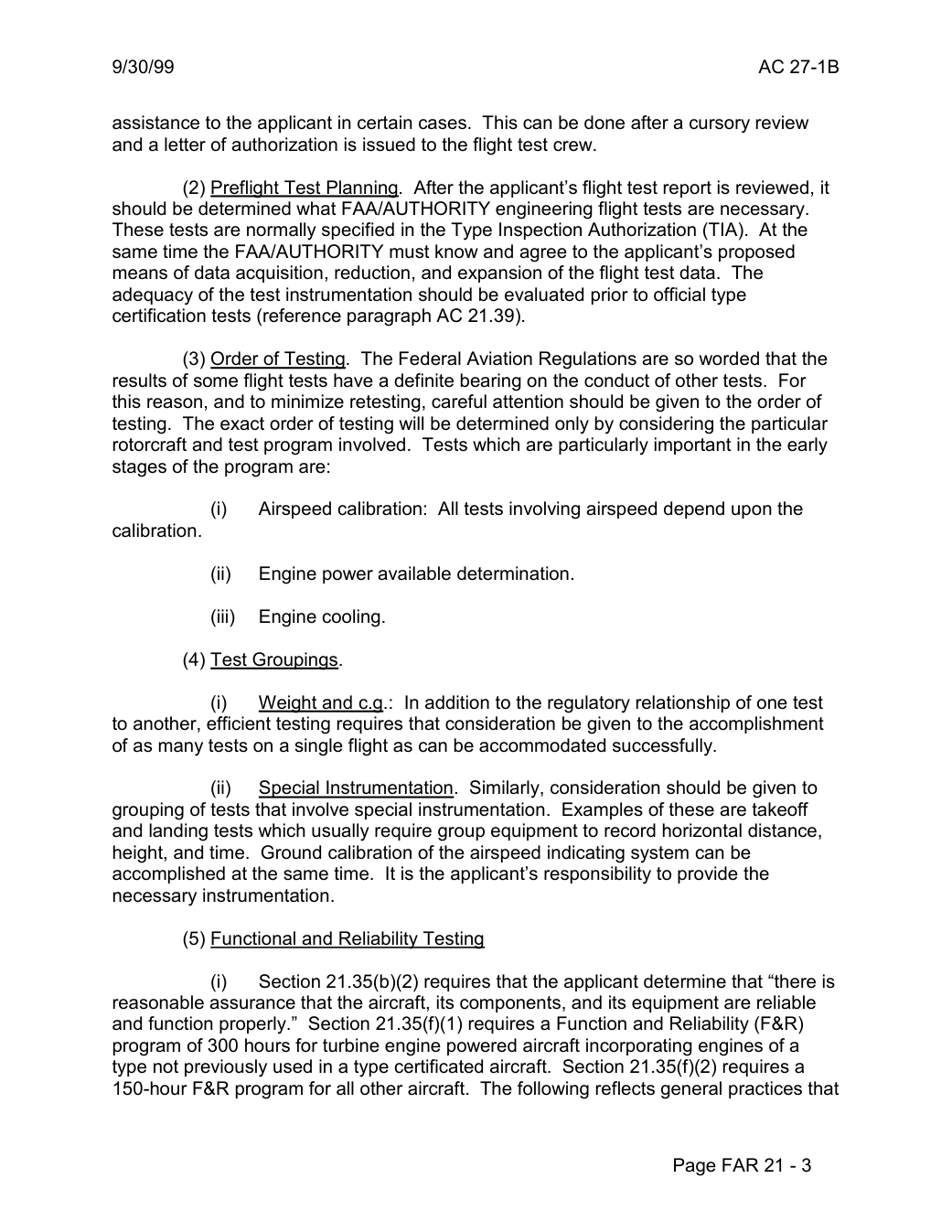
assistance to the applicant in certain cases. This can be done after a cursory review
and a letter of authorization is issued to the flight test crew.

         (2) Preflight Test Planning. After the applicant’s flight test report is reviewed, it
should be determined what FAA/AUTHORITY engineering flight tests are necessary.
These tests are normally specified in the Type Inspection Authorization (TIA). At the
same time the FAA/AUTHORITY must know and agree to the applicant’s proposed
means of data acquisition, reduction, and expansion of the flight test data. The
adequacy of the test instrumentation should be evaluated prior to official type
certification tests (reference paragraph AC 21.39).

         (3) Order of Testing. The Federal Aviation Regulations are so worded that the
results of some flight tests have a definite bearing on the conduct of other tests. For
this reason, and to minimize retesting, careful attention should be given to the order of
testing. The exact order of testing will be determined only by considering the particular
rotorcraft and test program involved. Tests which are particularly important in the early
stages of the program are:

                  (i)   Airspeed calibration: All tests involving airspeed depend upon the
calibration.

                   (ii)   Engine power available determination.

                    (iii)  Engine cooling.

         (4) Test Groupings.

                  (i)   Weight and c.g.: In addition to the regulatory relationship of one test
to another, efficient testing requires that consideration be given to the accomplishment
of as many tests on a single flight as can be accommodated successfully.

                   (ii)   Special Instrumentation. Similarly, consideration should be given to
grouping of tests that involve special instrumentation. Examples of these are takeoff
and landing tests which usually require group equipment to record horizontal distance,
height, and time. Ground calibration of the airspeed indicating system can be
accomplished at the same time.  It is the applicant’s responsibility to provide the
necessary instrumentation.

         (5) Functional and Reliability Testing

                  (i)    Section 21.35(b)(2) requires that the applicant determine that “there is
reasonable assurance that the aircraft, its components, and its equipment are reliable
and function properly.” Section 21.35(f)(1) requires a Function and Reliability (F&R)
program of 300 hours for turbine engine powered aircraft incorporating engines of a
type not previously used in a type certificated aircraft. Section 21.35(f)(2) requires a
150-hour F&R program for all other aircraft. The following reflects general practices that


                                                   Page FAR 21 - 3
Saved from the FAA on November 17, 2026. All original pages are retained. Engineering explanations are presented separately below.
Aerospace Consulting / Engineering perspective
Start with the certification basis and the function.
Identify the applicable amendment before selecting the safety guidance. Connect intended functions and operating conditions to failure conditions, architecture decisions, common-cause considerations, verification and limitations. For flight controls and IFR work, carry the relevant 27.672, 27.1329 and Appendix B assumptions into the system safety and compliance evidence.
1196 original pages. 0 pages have reviewed text reflows. Original-first pages retain the source layout, with extracted text available for finding words.
A focused review, an agreed assessment package or ongoing support alongside your team. We can agree the relevant inputs and scope in the initial conversation.
This opens your email application.
Start a conversation
Tell us about your programme, the system you are developing and the support you need.
We can agree a focused use-case review, a defined evidence package or ongoing programme support.
This opens your email application.
Specialist aerospace expertise
Aerospace Consulting is led by Hussein Khimji, an FAA Designated Engineering Representative in systems and equipment, with a focus on system safety, flight controls and avionics.
We work with aircraft developers and systems suppliers to connect technical decisions, safety assessments and certification evidence.
This is the proposed introduction. The full About page will add your approved biography and associate expertise.
Systems engineering & development assurance
Tell us about the aircraft or system, its intended function, stage of development and the support you need.