Certification of Normal Category Rotorcraft — Changes 1–9
Normal category rotorcraft guidance with Changes 1–9 incorporated. Search the complete AC or start with the system safety, flight controls and instrument-flight guidance.
This source includes guidance for different amendments of Part 27. Match the guidance to the aircraft’s agreed certification basis: the 27.1309 entries for Amendments 27-21, 27-46 and 27-51 are separate. The base AC was issued on 30 September 1999; Change 9 is dated 23 June 2023. The FAA catalogue’s 30 September 2008 date is not the date of the latest change.
The source, within reach.
Search within this AC, jump to a source page, or download the complete saved publication.
This extraction supports search. Read the original page for complete notation and layout.
9/30/99                                             AC 27-1B

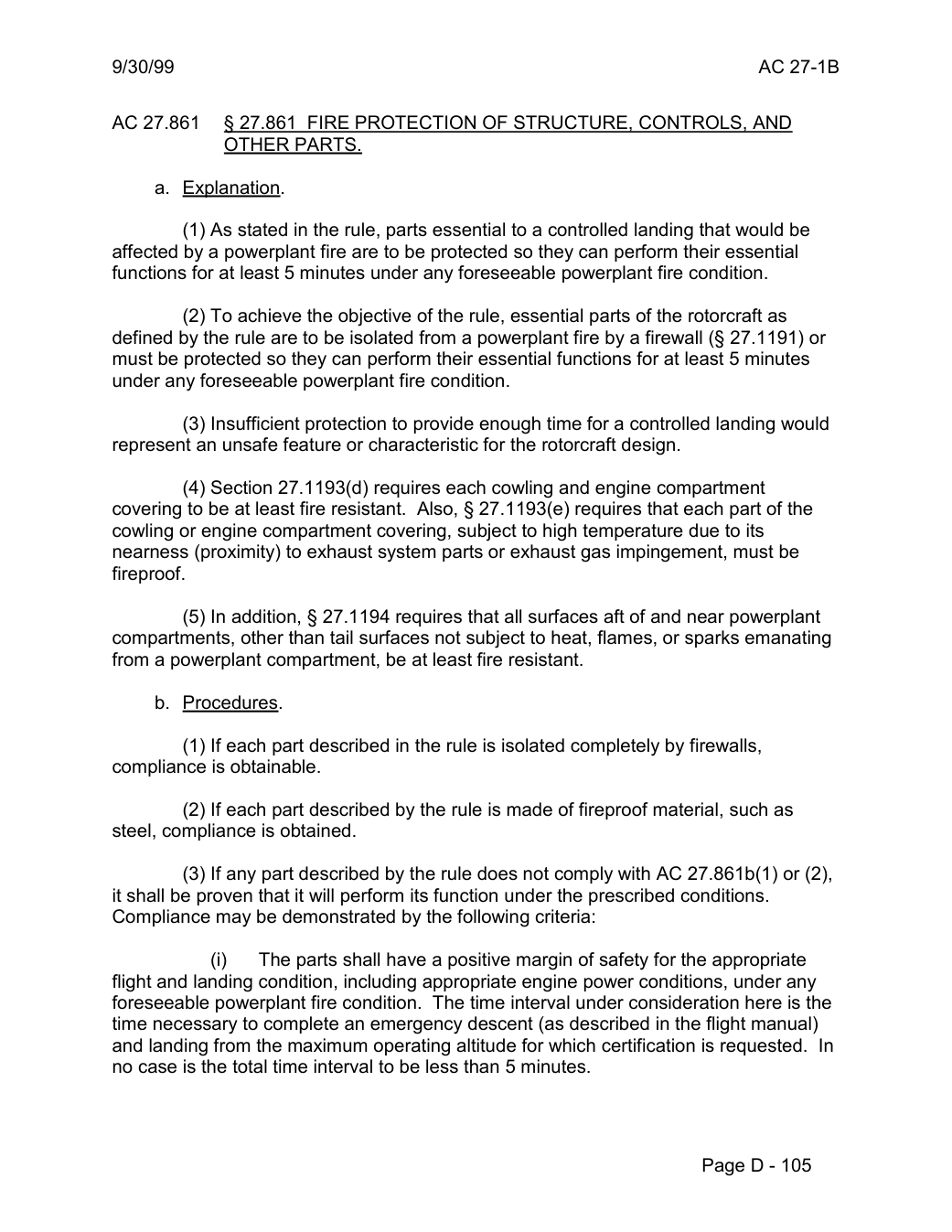
AC 27.861  § 27.861 FIRE PROTECTION OF STRUCTURE, CONTROLS, AND
         OTHER PARTS.

     a. Explanation.

         (1) As stated in the rule, parts essential to a controlled landing that would be
affected by a powerplant fire are to be protected so they can perform their essential
functions for at least 5 minutes under any foreseeable powerplant fire condition.

         (2) To achieve the objective of the rule, essential parts of the rotorcraft as
defined by the rule are to be isolated from a powerplant fire by a firewall (§ 27.1191) or
must be protected so they can perform their essential functions for at least 5 minutes
under any foreseeable powerplant fire condition.

         (3) Insufficient protection to provide enough time for a controlled landing would
represent an unsafe feature or characteristic for the rotorcraft design.

         (4) Section 27.1193(d) requires each cowling and engine compartment
covering to be at least fire resistant. Also, § 27.1193(e) requires that each part of the
cowling or engine compartment covering, subject to high temperature due to its
nearness (proximity) to exhaust system parts or exhaust gas impingement, must be
fireproof.

         (5) In addition, § 27.1194 requires that all surfaces aft of and near powerplant
compartments, other than tail surfaces not subject to heat, flames, or sparks emanating
from a powerplant compartment, be at least fire resistant.

     b. Procedures.

         (1) If each part described in the rule is isolated completely by firewalls,
compliance is obtainable.

         (2) If each part described by the rule is made of fireproof material, such as
steel, compliance is obtained.

         (3) If any part described by the rule does not comply with AC 27.861b(1) or (2),
it shall be proven that it will perform its function under the prescribed conditions.
Compliance may be demonstrated by the following criteria:

                  (i)   The parts shall have a positive margin of safety for the appropriate
flight and landing condition, including appropriate engine power conditions, under any
foreseeable powerplant fire condition. The time interval under consideration here is the
time necessary to complete an emergency descent (as described in the flight manual)
and landing from the maximum operating altitude for which certification is requested. In
no case is the total time interval to be less than 5 minutes.


                                                      Page D - 105
Saved from the FAA on November 17, 2026. All original pages are retained. Engineering explanations are presented separately below.
Aerospace Consulting / Engineering perspective
Start with the certification basis and the function.
Identify the applicable amendment before selecting the safety guidance. Connect intended functions and operating conditions to failure conditions, architecture decisions, common-cause considerations, verification and limitations. For flight controls and IFR work, carry the relevant 27.672, 27.1329 and Appendix B assumptions into the system safety and compliance evidence.
1196 original pages. 0 pages have reviewed text reflows. Original-first pages retain the source layout, with extracted text available for finding words.
A focused review, an agreed assessment package or ongoing support alongside your team. We can agree the relevant inputs and scope in the initial conversation.
This opens your email application.
Start a conversation
Tell us about your programme, the system you are developing and the support you need.
We can agree a focused use-case review, a defined evidence package or ongoing programme support.
This opens your email application.
Specialist aerospace expertise
Aerospace Consulting is led by Hussein Khimji, an FAA Designated Engineering Representative in systems and equipment, with a focus on system safety, flight controls and avionics.
We work with aircraft developers and systems suppliers to connect technical decisions, safety assessments and certification evidence.
This is the proposed introduction. The full About page will add your approved biography and associate expertise.
Systems engineering & development assurance
Tell us about the aircraft or system, its intended function, stage of development and the support you need.