Certification of Normal Category Rotorcraft — Changes 1–9
Normal category rotorcraft guidance with Changes 1–9 incorporated. Search the complete AC or start with the system safety, flight controls and instrument-flight guidance.
This source includes guidance for different amendments of Part 27. Match the guidance to the aircraft’s agreed certification basis: the 27.1309 entries for Amendments 27-21, 27-46 and 27-51 are separate. The base AC was issued on 30 September 1999; Change 9 is dated 23 June 2023. The FAA catalogue’s 30 September 2008 date is not the date of the latest change.
The source, within reach.
Search within this AC, jump to a source page, or download the complete saved publication.
This extraction supports search. Read the original page for complete notation and layout.
9/30/99                                             AC 27-1B


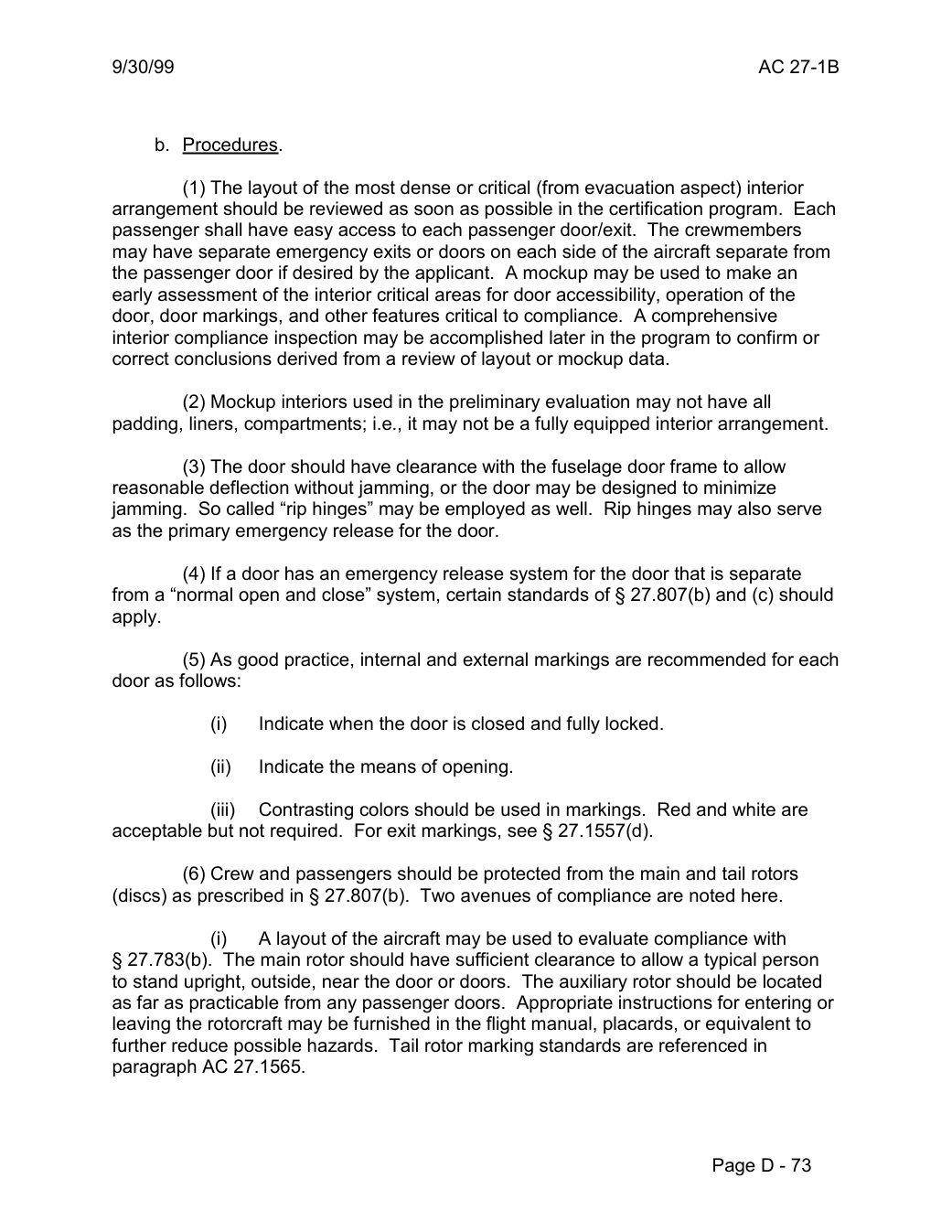
     b. Procedures.

         (1) The layout of the most dense or critical (from evacuation aspect) interior
arrangement should be reviewed as soon as possible in the certification program. Each
passenger shall have easy access to each passenger door/exit. The crewmembers
may have separate emergency exits or doors on each side of the aircraft separate from
the passenger door if desired by the applicant. A mockup may be used to make an
early assessment of the interior critical areas for door accessibility, operation of the
door, door markings, and other features critical to compliance. A comprehensive
interior compliance inspection may be accomplished later in the program to confirm or
correct conclusions derived from a review of layout or mockup data.

         (2) Mockup interiors used in the preliminary evaluation may not have all
padding, liners, compartments; i.e., it may not be a fully equipped interior arrangement.

         (3) The door should have clearance with the fuselage door frame to allow
reasonable deflection without jamming, or the door may be designed to minimize
jamming. So called “rip hinges” may be employed as well. Rip hinges may also serve
as the primary emergency release for the door.

         (4) If a door has an emergency release system for the door that is separate
from a “normal open and close” system, certain standards of § 27.807(b) and (c) should
apply.

         (5) As good practice, internal and external markings are recommended for each
door as follows:

                  (i)    Indicate when the door is closed and fully locked.

                   (ii)   Indicate the means of opening.

                    (iii)   Contrasting colors should be used in markings. Red and white are
acceptable but not required. For exit markings, see § 27.1557(d).

         (6) Crew and passengers should be protected from the main and tail rotors
(discs) as prescribed in § 27.807(b). Two avenues of compliance are noted here.

                  (i)   A layout of the aircraft may be used to evaluate compliance with
§ 27.783(b). The main rotor should have sufficient clearance to allow a typical person
to stand upright, outside, near the door or doors. The auxiliary rotor should be located
as far as practicable from any passenger doors. Appropriate instructions for entering or
leaving the rotorcraft may be furnished in the flight manual, placards, or equivalent to
further reduce possible hazards. Tail rotor marking standards are referenced in
paragraph AC 27.1565.


                                                       Page D - 73
Saved from the FAA on November 17, 2026. All original pages are retained. Engineering explanations are presented separately below.
Aerospace Consulting / Engineering perspective
Start with the certification basis and the function.
Identify the applicable amendment before selecting the safety guidance. Connect intended functions and operating conditions to failure conditions, architecture decisions, common-cause considerations, verification and limitations. For flight controls and IFR work, carry the relevant 27.672, 27.1329 and Appendix B assumptions into the system safety and compliance evidence.
1196 original pages. 0 pages have reviewed text reflows. Original-first pages retain the source layout, with extracted text available for finding words.
A focused review, an agreed assessment package or ongoing support alongside your team. We can agree the relevant inputs and scope in the initial conversation.
This opens your email application.
Start a conversation
Tell us about your programme, the system you are developing and the support you need.
We can agree a focused use-case review, a defined evidence package or ongoing programme support.
This opens your email application.
Specialist aerospace expertise
Aerospace Consulting is led by Hussein Khimji, an FAA Designated Engineering Representative in systems and equipment, with a focus on system safety, flight controls and avionics.
We work with aircraft developers and systems suppliers to connect technical decisions, safety assessments and certification evidence.
This is the proposed introduction. The full About page will add your approved biography and associate expertise.
Systems engineering & development assurance
Tell us about the aircraft or system, its intended function, stage of development and the support you need.