Certification of Normal Category Rotorcraft — Changes 1–9
Normal category rotorcraft guidance with Changes 1–9 incorporated. Search the complete AC or start with the system safety, flight controls and instrument-flight guidance.
This source includes guidance for different amendments of Part 27. Match the guidance to the aircraft’s agreed certification basis: the 27.1309 entries for Amendments 27-21, 27-46 and 27-51 are separate. The base AC was issued on 30 September 1999; Change 9 is dated 23 June 2023. The FAA catalogue’s 30 September 2008 date is not the date of the latest change.
The source, within reach.
Search within this AC, jump to a source page, or download the complete saved publication.
This extraction supports search. Read the original page for complete notation and layout.
AC 27-1B                                                                  9/30/99

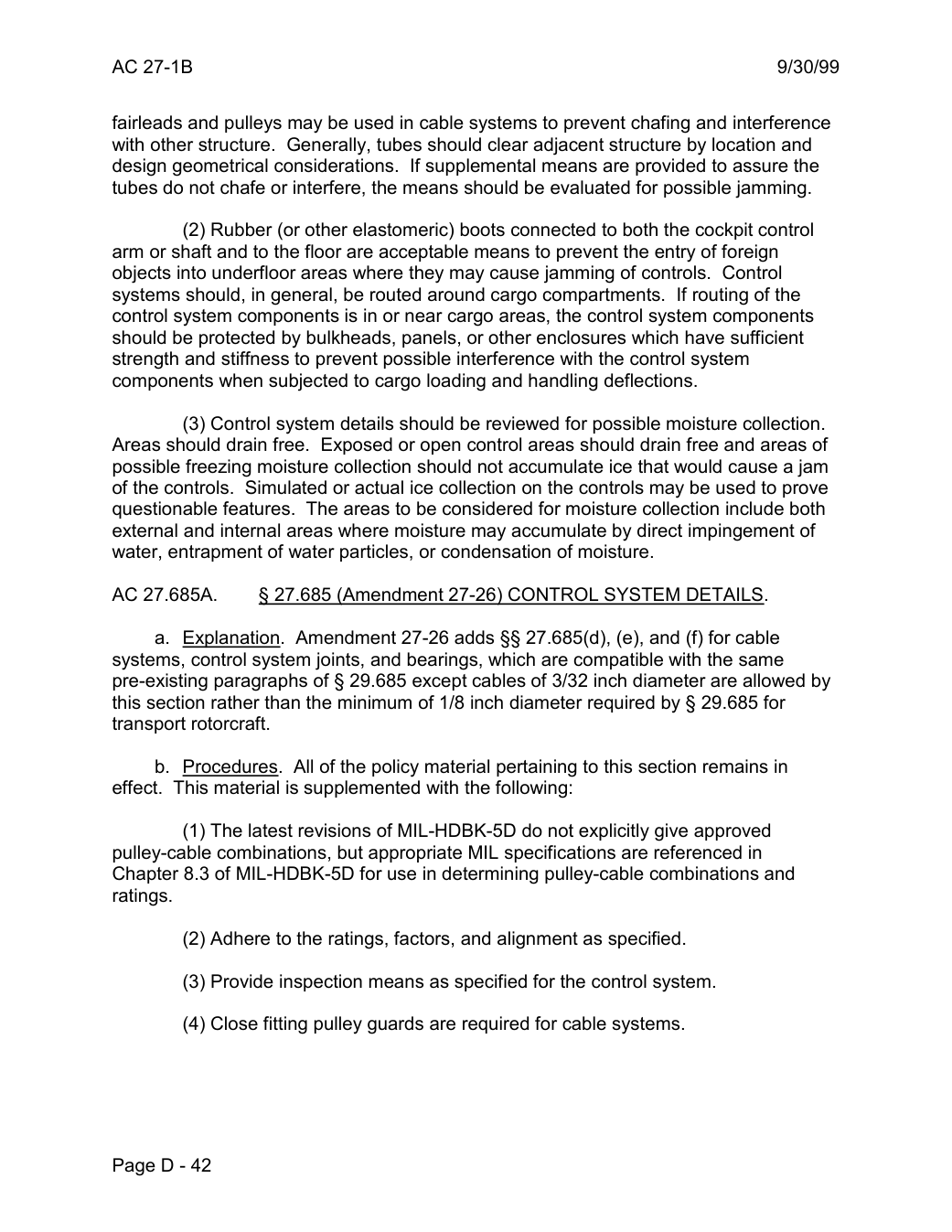
fairleads and pulleys may be used in cable systems to prevent chafing and interference
with other structure. Generally, tubes should clear adjacent structure by location and
design geometrical considerations.  If supplemental means are provided to assure the
tubes do not chafe or interfere, the means should be evaluated for possible jamming.

         (2) Rubber (or other elastomeric) boots connected to both the cockpit control
arm or shaft and to the floor are acceptable means to prevent the entry of foreign
objects into underfloor areas where they may cause jamming of controls. Control
systems should, in general, be routed around cargo compartments.  If routing of the
control system components is in or near cargo areas, the control system components
should be protected by bulkheads, panels, or other enclosures which have sufficient
strength and stiffness to prevent possible interference with the control system
components when subjected to cargo loading and handling deflections.

         (3) Control system details should be reviewed for possible moisture collection.
Areas should drain free. Exposed or open control areas should drain free and areas of
possible freezing moisture collection should not accumulate ice that would cause a jam
of the controls. Simulated or actual ice collection on the controls may be used to prove
questionable features. The areas to be considered for moisture collection include both
external and internal areas where moisture may accumulate by direct impingement of
water, entrapment of water particles, or condensation of moisture.

AC 27.685A.    § 27.685 (Amendment 27-26) CONTROL SYSTEM DETAILS.

     a. Explanation. Amendment 27-26 adds §§ 27.685(d), (e), and (f) for cable
systems, control system joints, and bearings, which are compatible with the same
pre-existing paragraphs of § 29.685 except cables of 3/32 inch diameter are allowed by
this section rather than the minimum of 1/8 inch diameter required by § 29.685 for
transport rotorcraft.

     b. Procedures. All of the policy material pertaining to this section remains in
effect. This material is supplemented with the following:

         (1) The latest revisions of MIL-HDBK-5D do not explicitly give approved
pulley-cable combinations, but appropriate MIL specifications are referenced in
Chapter 8.3 of MIL-HDBK-5D for use in determining pulley-cable combinations and
ratings.

         (2) Adhere to the ratings, factors, and alignment as specified.

         (3) Provide inspection means as specified for the control system.

         (4) Close fitting pulley guards are required for cable systems.


Page D - 42
Saved from the FAA on November 17, 2026. All original pages are retained. Engineering explanations are presented separately below.
Aerospace Consulting / Engineering perspective
Start with the certification basis and the function.
Identify the applicable amendment before selecting the safety guidance. Connect intended functions and operating conditions to failure conditions, architecture decisions, common-cause considerations, verification and limitations. For flight controls and IFR work, carry the relevant 27.672, 27.1329 and Appendix B assumptions into the system safety and compliance evidence.
1196 original pages. 0 pages have reviewed text reflows. Original-first pages retain the source layout, with extracted text available for finding words.
A focused review, an agreed assessment package or ongoing support alongside your team. We can agree the relevant inputs and scope in the initial conversation.
This opens your email application.
Start a conversation
Tell us about your programme, the system you are developing and the support you need.
We can agree a focused use-case review, a defined evidence package or ongoing programme support.
This opens your email application.
Specialist aerospace expertise
Aerospace Consulting is led by Hussein Khimji, an FAA Designated Engineering Representative in systems and equipment, with a focus on system safety, flight controls and avionics.
We work with aircraft developers and systems suppliers to connect technical decisions, safety assessments and certification evidence.
This is the proposed introduction. The full About page will add your approved biography and associate expertise.
Systems engineering & development assurance
Tell us about the aircraft or system, its intended function, stage of development and the support you need.