
Original FAA page, including its printed amendment and change markings. Extracted words support search; text reflow has not been reviewed.
AC 27-1B · C-94Open saved PDF here ↗
Extracted text for finding words
This extraction supports search. Read the original page for complete notation and layout.
AC 27-1B, Chg 4                                                     12/1/2011


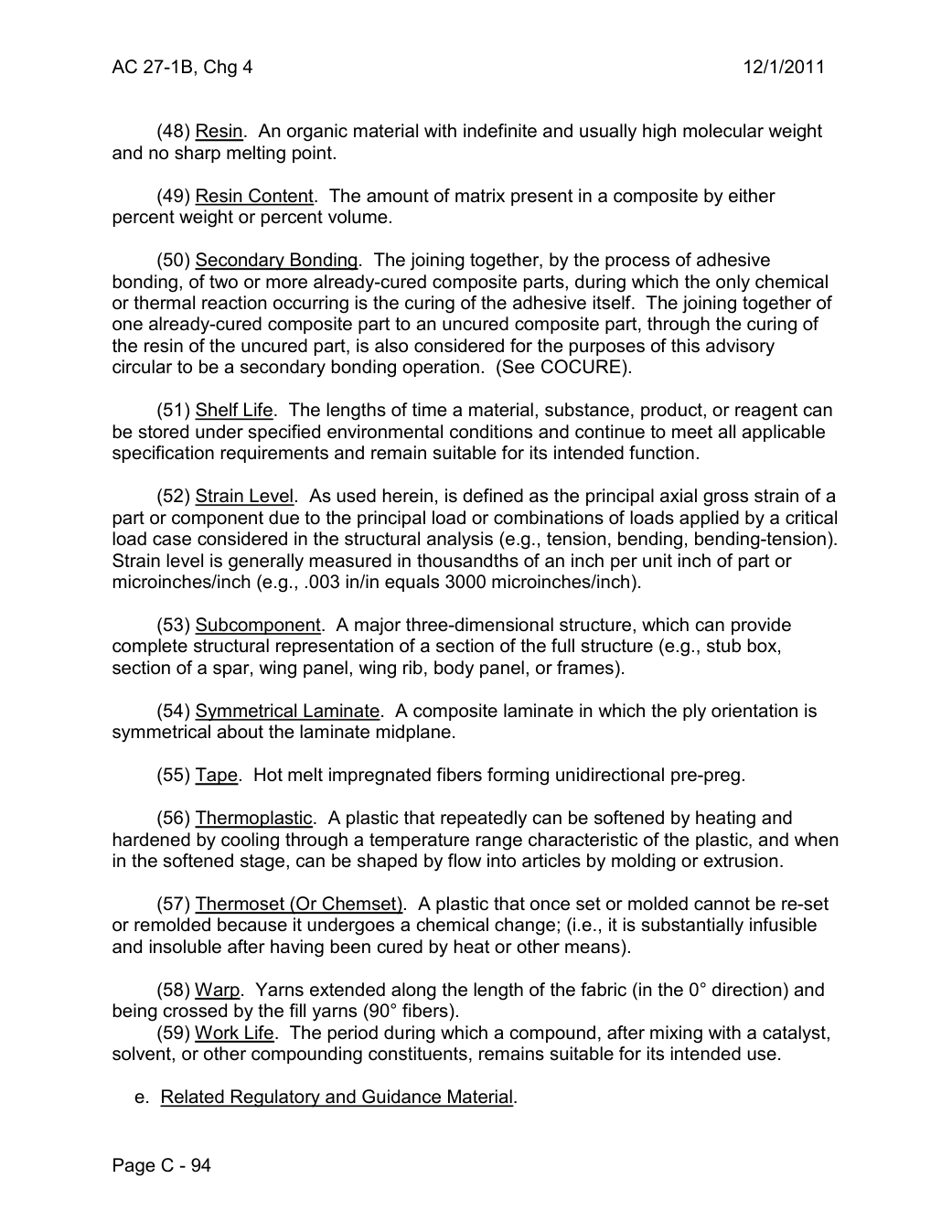
     (48) Resin. An organic material with indefinite and usually high molecular weight
and no sharp melting point.

     (49) Resin Content. The amount of matrix present in a composite by either
percent weight or percent volume.

     (50) Secondary Bonding. The joining together, by the process of adhesive
bonding, of two or more already-cured composite parts, during which the only chemical
or thermal reaction occurring is the curing of the adhesive itself. The joining together of
one already-cured composite part to an uncured composite part, through the curing of
the resin of the uncured part, is also considered for the purposes of this advisory
circular to be a secondary bonding operation. (See COCURE).

     (51) Shelf Life. The lengths of time a material, substance, product, or reagent can
be stored under specified environmental conditions and continue to meet all applicable
specification requirements and remain suitable for its intended function.

     (52) Strain Level. As used herein, is defined as the principal axial gross strain of a
part or component due to the principal load or combinations of loads applied by a critical
load case considered in the structural analysis (e.g., tension, bending, bending-tension).
Strain level is generally measured in thousandths of an inch per unit inch of part or
microinches/inch (e.g., .003 in/in equals 3000 microinches/inch).

     (53) Subcomponent. A major three-dimensional structure, which can provide
complete structural representation of a section of the full structure (e.g., stub box,
section of a spar, wing panel, wing rib, body panel, or frames).

     (54) Symmetrical Laminate. A composite laminate in which the ply orientation is
symmetrical about the laminate midplane.

     (55) Tape. Hot melt impregnated fibers forming unidirectional pre-preg.

     (56) Thermoplastic. A plastic that repeatedly can be softened by heating and
hardened by cooling through a temperature range characteristic of the plastic, and when
in the softened stage, can be shaped by flow into articles by molding or extrusion.

     (57) Thermoset (Or Chemset). A plastic that once set or molded cannot be re-set
or remolded because it undergoes a chemical change; (i.e., it is substantially infusible
and insoluble after having been cured by heat or other means).

     (58) Warp. Yarns extended along the length of the fabric (in the 0° direction) and
being crossed by the fill yarns (90° fibers).
     (59) Work Life. The period during which a compound, after mixing with a catalyst,
solvent, or other compounding constituents, remains suitable for its intended use.

   e. Related Regulatory and Guidance Material.


Page C - 94