Certification of Normal Category Rotorcraft — Changes 1–9
Normal category rotorcraft guidance with Changes 1–9 incorporated. Search the complete AC or start with the system safety, flight controls and instrument-flight guidance.
This source includes guidance for different amendments of Part 27. Match the guidance to the aircraft’s agreed certification basis: the 27.1309 entries for Amendments 27-21, 27-46 and 27-51 are separate. The base AC was issued on 30 September 1999; Change 9 is dated 23 June 2023. The FAA catalogue’s 30 September 2008 date is not the date of the latest change.
The source, within reach.
Search within this AC, jump to a source page, or download the complete saved publication.
This extraction supports search. Read the original page for complete notation and layout.
2/12/03                                        AC 27-1B, Chg 1


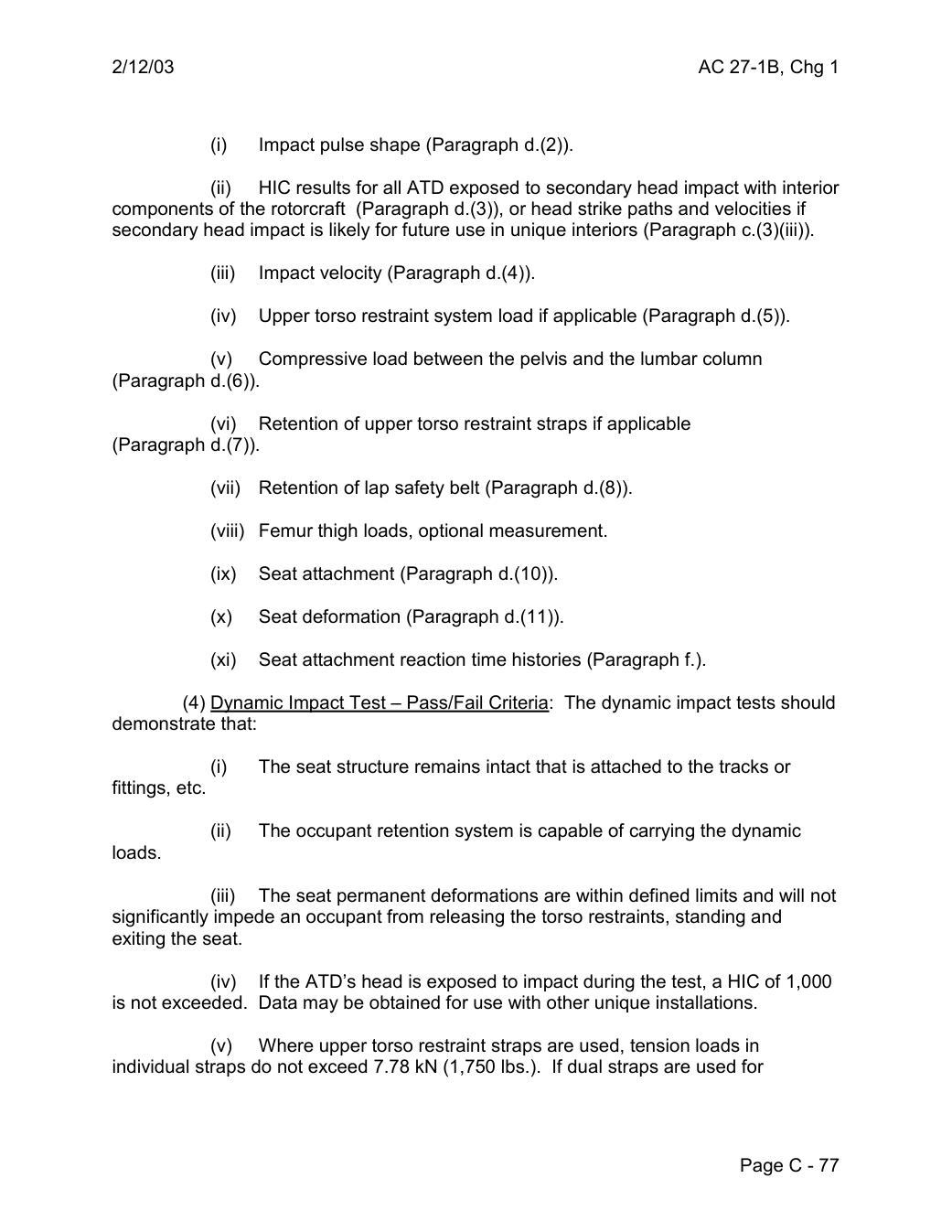
                  (i)   Impact pulse shape (Paragraph d.(2)).

                   (ii)   HIC results for all ATD exposed to secondary head impact with interior
components of the rotorcraft (Paragraph d.(3)), or head strike paths and velocities if
secondary head impact is likely for future use in unique interiors (Paragraph c.(3)(iii)).

                    (iii)   Impact velocity (Paragraph d.(4)).

               (iv)  Upper torso restraint system load if applicable (Paragraph d.(5)).

              (v)   Compressive load between the pelvis and the lumbar column
(Paragraph d.(6)).

               (vi)   Retention of upper torso restraint straps if applicable
(Paragraph d.(7)).

                (vii)  Retention of lap safety belt (Paragraph d.(8)).

                 (viii) Femur thigh loads, optional measurement.

               (ix)  Seat attachment (Paragraph d.(10)).

              (x)   Seat deformation (Paragraph d.(11)).

               (xi)  Seat attachment reaction time histories (Paragraph f.).

         (4) Dynamic Impact Test – Pass/Fail Criteria: The dynamic impact tests should
demonstrate that:

                  (i)   The seat structure remains intact that is attached to the tracks or
fittings, etc.

                   (ii)   The occupant retention system is capable of carrying the dynamic
loads.

                    (iii)  The seat permanent deformations are within defined limits and will not
significantly impede an occupant from releasing the torso restraints, standing and
exiting the seat.

               (iv)    If the ATD’s head is exposed to impact during the test, a HIC of 1,000
is not exceeded. Data may be obtained for use with other unique installations.

              (v)  Where upper torso restraint straps are used, tension loads in
individual straps do not exceed 7.78 kN (1,750 lbs.).  If dual straps are used for


                                                          Page C - 77
Saved from the FAA on November 17, 2026. All original pages are retained. Engineering explanations are presented separately below.
Aerospace Consulting / Engineering perspective
Start with the certification basis and the function.
Identify the applicable amendment before selecting the safety guidance. Connect intended functions and operating conditions to failure conditions, architecture decisions, common-cause considerations, verification and limitations. For flight controls and IFR work, carry the relevant 27.672, 27.1329 and Appendix B assumptions into the system safety and compliance evidence.
1196 original pages. 0 pages have reviewed text reflows. Original-first pages retain the source layout, with extracted text available for finding words.
A focused review, an agreed assessment package or ongoing support alongside your team. We can agree the relevant inputs and scope in the initial conversation.
This opens your email application.
Start a conversation
Tell us about your programme, the system you are developing and the support you need.
We can agree a focused use-case review, a defined evidence package or ongoing programme support.
This opens your email application.
Specialist aerospace expertise
Aerospace Consulting is led by Hussein Khimji, an FAA Designated Engineering Representative in systems and equipment, with a focus on system safety, flight controls and avionics.
We work with aircraft developers and systems suppliers to connect technical decisions, safety assessments and certification evidence.
This is the proposed introduction. The full About page will add your approved biography and associate expertise.
Systems engineering & development assurance
Tell us about the aircraft or system, its intended function, stage of development and the support you need.