Certification of Normal Category Rotorcraft — Changes 1–9
Normal category rotorcraft guidance with Changes 1–9 incorporated. Search the complete AC or start with the system safety, flight controls and instrument-flight guidance.
This source includes guidance for different amendments of Part 27. Match the guidance to the aircraft’s agreed certification basis: the 27.1309 entries for Amendments 27-21, 27-46 and 27-51 are separate. The base AC was issued on 30 September 1999; Change 9 is dated 23 June 2023. The FAA catalogue’s 30 September 2008 date is not the date of the latest change.
The source, within reach.
Search within this AC, jump to a source page, or download the complete saved publication.
This extraction supports search. Read the original page for complete notation and layout.
AC 27-1B, Chg 1                                                           2/12/03

               (1) Accurately measures the axial force but is insensitive to moments and
forces other than that being measured;

               (2) Maintains the intended alignment of the spinal column and the pelvis,
the correct seated height, and the correct weight distribution of the ATD; and

               (3) Does not alter the other performance characteristics of the ATD.


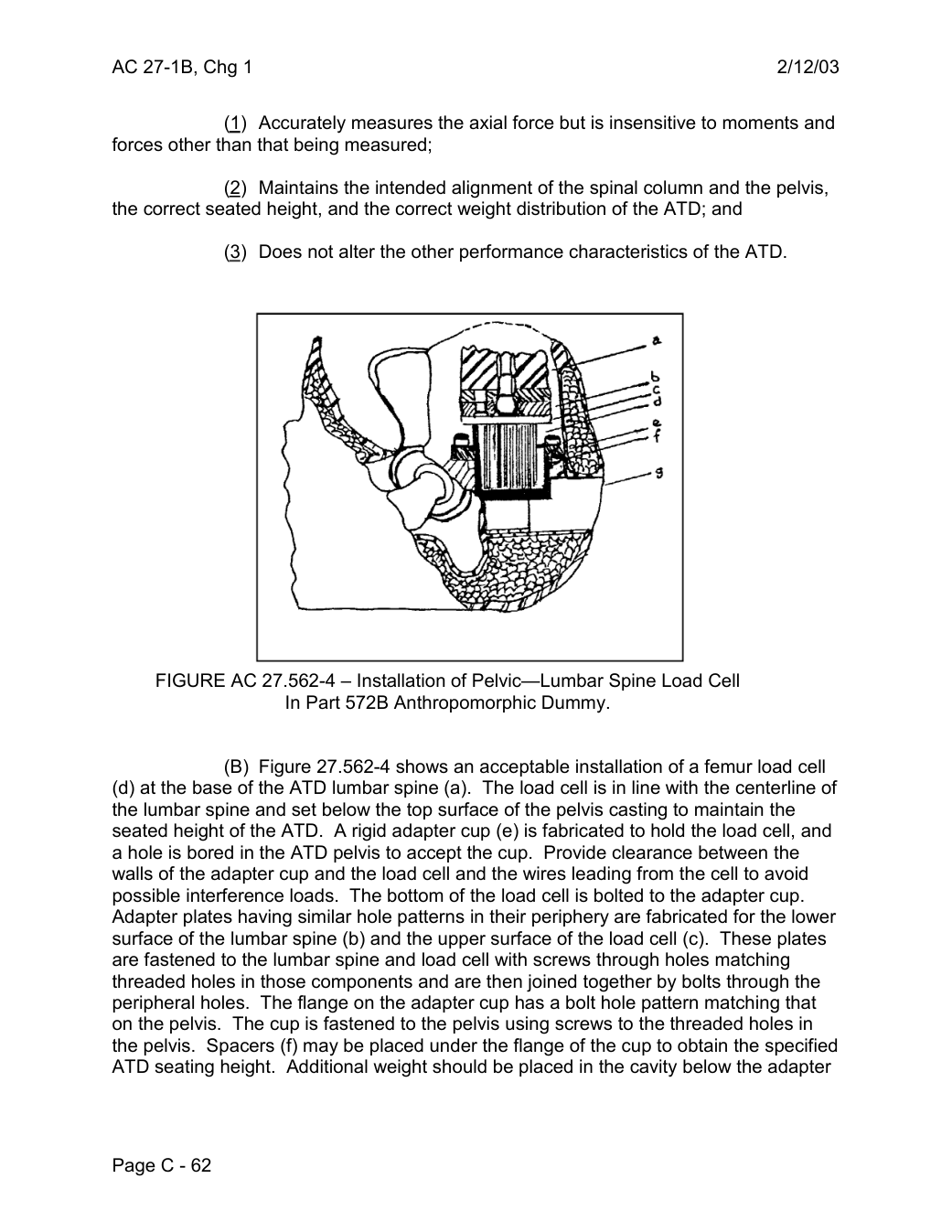
    FIGURE AC 27.562-4 – Installation of Pelvic—Lumbar Spine Load Cell
                      In Part 572B Anthropomorphic Dummy.


              (B) Figure 27.562-4 shows an acceptable installation of a femur load cell
(d) at the base of the ATD lumbar spine (a). The load cell is in line with the centerline of
the lumbar spine and set below the top surface of the pelvis casting to maintain the
seated height of the ATD. A rigid adapter cup (e) is fabricated to hold the load cell, and
a hole is bored in the ATD pelvis to accept the cup. Provide clearance between the
walls of the adapter cup and the load cell and the wires leading from the cell to avoid
possible interference loads. The bottom of the load cell is bolted to the adapter cup.
Adapter plates having similar hole patterns in their periphery are fabricated for the lower
surface of the lumbar spine (b) and the upper surface of the load cell (c). These plates
are fastened to the lumbar spine and load cell with screws through holes matching
threaded holes in those components and are then joined together by bolts through the
peripheral holes. The flange on the adapter cup has a bolt hole pattern matching that
on the pelvis. The cup is fastened to the pelvis using screws to the threaded holes in
the pelvis. Spacers (f) may be placed under the flange of the cup to obtain the specified
ATD seating height. Additional weight should be placed in the cavity below the adapter


Page C - 62
Saved from the FAA on November 17, 2026. All original pages are retained. Engineering explanations are presented separately below.
Aerospace Consulting / Engineering perspective
Start with the certification basis and the function.
Identify the applicable amendment before selecting the safety guidance. Connect intended functions and operating conditions to failure conditions, architecture decisions, common-cause considerations, verification and limitations. For flight controls and IFR work, carry the relevant 27.672, 27.1329 and Appendix B assumptions into the system safety and compliance evidence.
1196 original pages. 0 pages have reviewed text reflows. Original-first pages retain the source layout, with extracted text available for finding words.
A focused review, an agreed assessment package or ongoing support alongside your team. We can agree the relevant inputs and scope in the initial conversation.
This opens your email application.
Start a conversation
Tell us about your programme, the system you are developing and the support you need.
We can agree a focused use-case review, a defined evidence package or ongoing programme support.
This opens your email application.
Specialist aerospace expertise
Aerospace Consulting is led by Hussein Khimji, an FAA Designated Engineering Representative in systems and equipment, with a focus on system safety, flight controls and avionics.
We work with aircraft developers and systems suppliers to connect technical decisions, safety assessments and certification evidence.
This is the proposed introduction. The full About page will add your approved biography and associate expertise.
Systems engineering & development assurance
Tell us about the aircraft or system, its intended function, stage of development and the support you need.