Certification of Normal Category Rotorcraft — Changes 1–9
Normal category rotorcraft guidance with Changes 1–9 incorporated. Search the complete AC or start with the system safety, flight controls and instrument-flight guidance.
This source includes guidance for different amendments of Part 27. Match the guidance to the aircraft’s agreed certification basis: the 27.1309 entries for Amendments 27-21, 27-46 and 27-51 are separate. The base AC was issued on 30 September 1999; Change 9 is dated 23 June 2023. The FAA catalogue’s 30 September 2008 date is not the date of the latest change.
The source, within reach.
Search within this AC, jump to a source page, or download the complete saved publication.
This extraction supports search. Read the original page for complete notation and layout.
9/30/99                                             AC 27-1B

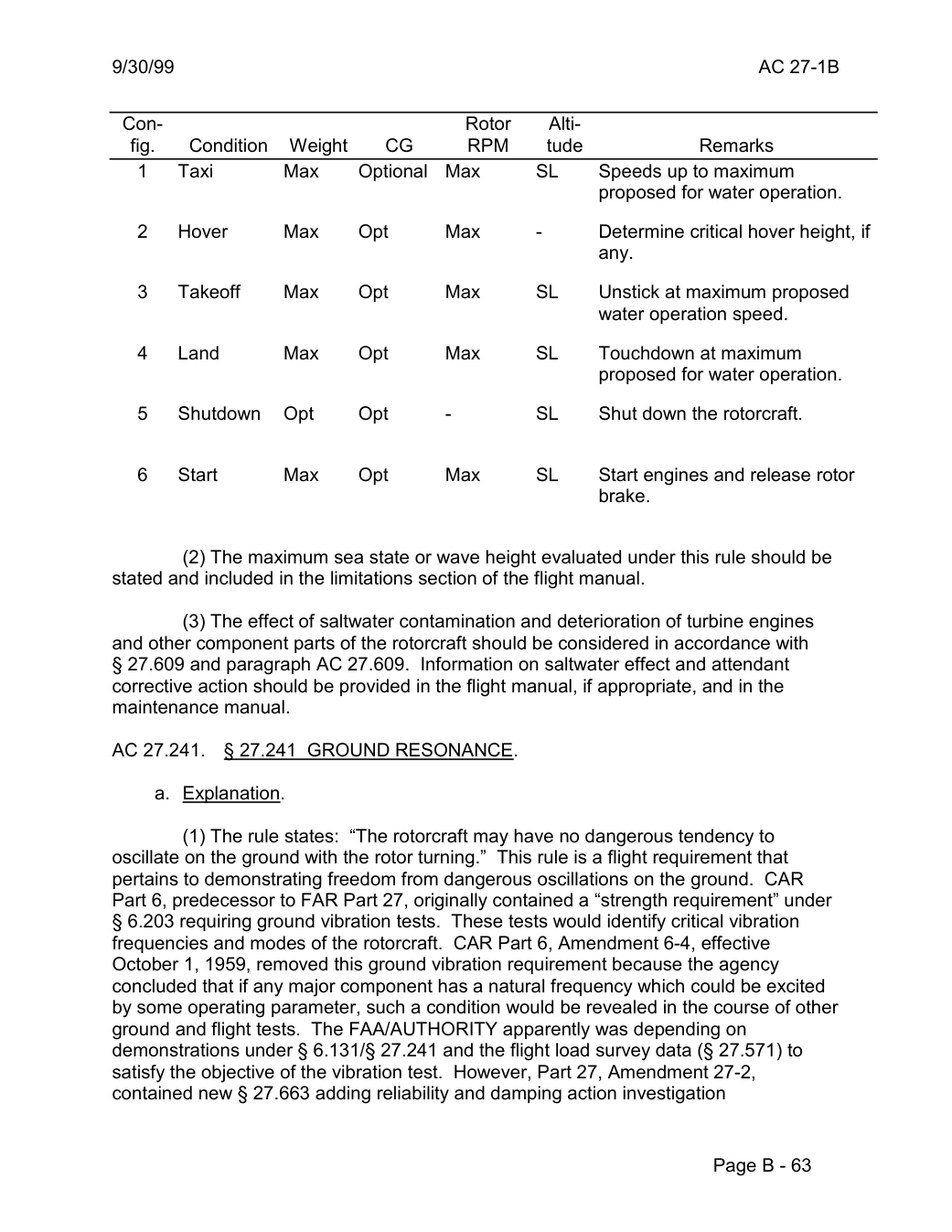
 Con-                                 Rotor      Alti-
   fig.    Condition  Weight   CG    RPM    tude           Remarks
  1   Taxi      Max     Optional Max     SL    Speeds up to maximum
                                                  proposed for water operation.

  2   Hover     Max    Opt     Max         -      Determine critical hover height, if
                                                       any.

  3   Takeoff    Max    Opt     Max     SL     Unstick at maximum proposed
                                                     water operation speed.

  4   Land     Max    Opt     Max     SL    Touchdown at maximum
                                                  proposed for water operation.

  5   Shutdown  Opt    Opt         -       SL    Shut down the rotorcraft.

  6    Start      Max    Opt     Max     SL     Start engines and release rotor
                                                        brake.

         (2) The maximum sea state or wave height evaluated under this rule should be
stated and included in the limitations section of the flight manual.

         (3) The effect of saltwater contamination and deterioration of turbine engines
and other component parts of the rotorcraft should be considered in accordance with
§ 27.609 and paragraph AC 27.609. Information on saltwater effect and attendant
corrective action should be provided in the flight manual, if appropriate, and in the
maintenance manual.

AC 27.241.  § 27.241 GROUND RESONANCE.

     a. Explanation.

         (1) The rule states: “The rotorcraft may have no dangerous tendency to
oscillate on the ground with the rotor turning.” This rule is a flight requirement that
pertains to demonstrating freedom from dangerous oscillations on the ground. CAR
Part 6, predecessor to FAR Part 27, originally contained a “strength requirement” under
§ 6.203 requiring ground vibration tests. These tests would identify critical vibration
frequencies and modes of the rotorcraft. CAR Part 6, Amendment 6-4, effective
October 1, 1959, removed this ground vibration requirement because the agency
concluded that if any major component has a natural frequency which could be excited
by some operating parameter, such a condition would be revealed in the course of other
ground and flight tests. The FAA/AUTHORITY apparently was depending on
demonstrations under § 6.131/§ 27.241 and the flight load survey data (§ 27.571) to
satisfy the objective of the vibration test. However, Part 27, Amendment 27-2,
contained new § 27.663 adding reliability and damping action investigation


                                                       Page B - 63
Saved from the FAA on November 17, 2026. All original pages are retained. Engineering explanations are presented separately below.
Aerospace Consulting / Engineering perspective
Start with the certification basis and the function.
Identify the applicable amendment before selecting the safety guidance. Connect intended functions and operating conditions to failure conditions, architecture decisions, common-cause considerations, verification and limitations. For flight controls and IFR work, carry the relevant 27.672, 27.1329 and Appendix B assumptions into the system safety and compliance evidence.
1196 original pages. 0 pages have reviewed text reflows. Original-first pages retain the source layout, with extracted text available for finding words.
A focused review, an agreed assessment package or ongoing support alongside your team. We can agree the relevant inputs and scope in the initial conversation.
This opens your email application.
Start a conversation
Tell us about your programme, the system you are developing and the support you need.
We can agree a focused use-case review, a defined evidence package or ongoing programme support.
This opens your email application.
Specialist aerospace expertise
Aerospace Consulting is led by Hussein Khimji, an FAA Designated Engineering Representative in systems and equipment, with a focus on system safety, flight controls and avionics.
We work with aircraft developers and systems suppliers to connect technical decisions, safety assessments and certification evidence.
This is the proposed introduction. The full About page will add your approved biography and associate expertise.
Systems engineering & development assurance
Tell us about the aircraft or system, its intended function, stage of development and the support you need.