Certification of Normal Category Rotorcraft — Changes 1–9
Normal category rotorcraft guidance with Changes 1–9 incorporated. Search the complete AC or start with the system safety, flight controls and instrument-flight guidance.
This source includes guidance for different amendments of Part 27. Match the guidance to the aircraft’s agreed certification basis: the 27.1309 entries for Amendments 27-21, 27-46 and 27-51 are separate. The base AC was issued on 30 September 1999; Change 9 is dated 23 June 2023. The FAA catalogue’s 30 September 2008 date is not the date of the latest change.
The source, within reach.
Search within this AC, jump to a source page, or download the complete saved publication.
This extraction supports search. Read the original page for complete notation and layout.
9/30/99                                            AC 27-1B

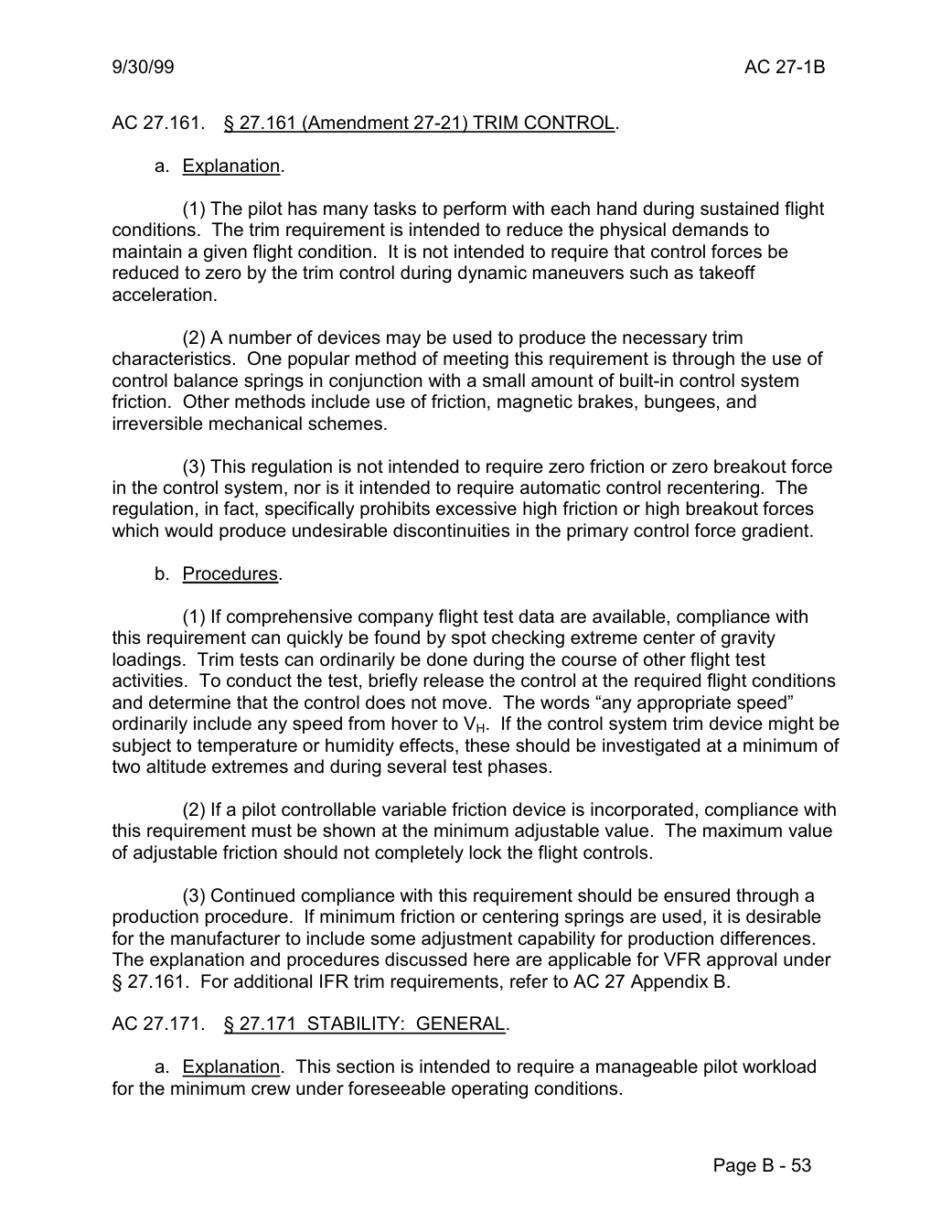
AC 27.161.  § 27.161 (Amendment 27-21) TRIM CONTROL.

     a. Explanation.

         (1) The pilot has many tasks to perform with each hand during sustained flight
conditions. The trim requirement is intended to reduce the physical demands to
maintain a given flight condition.  It is not intended to require that control forces be
reduced to zero by the trim control during dynamic maneuvers such as takeoff
acceleration.

         (2) A number of devices may be used to produce the necessary trim
characteristics. One popular method of meeting this requirement is through the use of
control balance springs in conjunction with a small amount of built-in control system
friction. Other methods include use of friction, magnetic brakes, bungees, and
irreversible mechanical schemes.

         (3) This regulation is not intended to require zero friction or zero breakout force
in the control system, nor is it intended to require automatic control recentering. The
regulation, in fact, specifically prohibits excessive high friction or high breakout forces
which would produce undesirable discontinuities in the primary control force gradient.

     b. Procedures.

         (1) If comprehensive company flight test data are available, compliance with
this requirement can quickly be found by spot checking extreme center of gravity
loadings. Trim tests can ordinarily be done during the course of other flight test
activities. To conduct the test, briefly release the control at the required flight conditions
and determine that the control does not move. The words “any appropriate speed”
ordinarily include any speed from hover to VH.  If the control system trim device might be
subject to temperature or humidity effects, these should be investigated at a minimum of
two altitude extremes and during several test phases.

         (2) If a pilot controllable variable friction device is incorporated, compliance with
this requirement must be shown at the minimum adjustable value. The maximum value
of adjustable friction should not completely lock the flight controls.

         (3) Continued compliance with this requirement should be ensured through a
production procedure.  If minimum friction or centering springs are used, it is desirable
for the manufacturer to include some adjustment capability for production differences.
The explanation and procedures discussed here are applicable for VFR approval under
§ 27.161. For additional IFR trim requirements, refer to AC 27 Appendix B.

AC 27.171.  § 27.171 STABILITY: GENERAL.

     a. Explanation. This section is intended to require a manageable pilot workload
for the minimum crew under foreseeable operating conditions.


                                                       Page B - 53
Saved from the FAA on November 17, 2026. All original pages are retained. Engineering explanations are presented separately below.
Aerospace Consulting / Engineering perspective
Start with the certification basis and the function.
Identify the applicable amendment before selecting the safety guidance. Connect intended functions and operating conditions to failure conditions, architecture decisions, common-cause considerations, verification and limitations. For flight controls and IFR work, carry the relevant 27.672, 27.1329 and Appendix B assumptions into the system safety and compliance evidence.
1196 original pages. 0 pages have reviewed text reflows. Original-first pages retain the source layout, with extracted text available for finding words.
A focused review, an agreed assessment package or ongoing support alongside your team. We can agree the relevant inputs and scope in the initial conversation.
This opens your email application.
Start a conversation
Tell us about your programme, the system you are developing and the support you need.
We can agree a focused use-case review, a defined evidence package or ongoing programme support.
This opens your email application.
Specialist aerospace expertise
Aerospace Consulting is led by Hussein Khimji, an FAA Designated Engineering Representative in systems and equipment, with a focus on system safety, flight controls and avionics.
We work with aircraft developers and systems suppliers to connect technical decisions, safety assessments and certification evidence.
This is the proposed introduction. The full About page will add your approved biography and associate expertise.
Systems engineering & development assurance
Tell us about the aircraft or system, its intended function, stage of development and the support you need.