
Original FAA page, including its printed amendment and change markings. Extracted words support search; text reflow has not been reviewed.
AC 27-1B · Apdx A-17Open saved PDF here ↗
Extracted text for finding words
This extraction supports search. Read the original page for complete notation and layout.
2/12/03                                          AC 27-1B, Chg 1

                                      (MANUAL IDENTIFICATION)
                        CHAPTER 1
                   INTRODUCTION (continued)
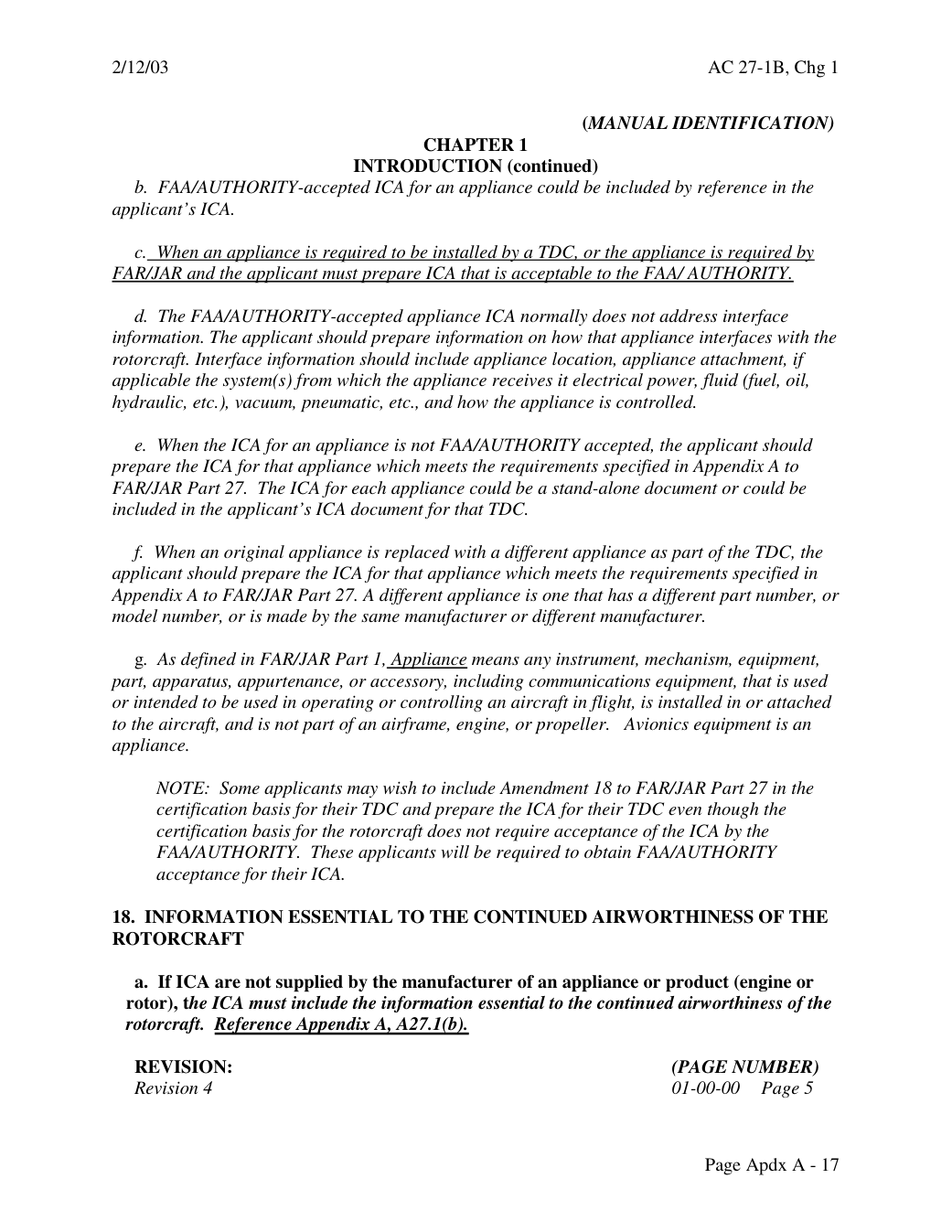
   b. FAA/AUTHORITY-accepted ICA for an appliance could be included by reference in the
applicant’s ICA.

   c. When an appliance is required to be installed by a TDC, or the appliance is required by
FAR/JAR and the applicant must prepare ICA that is acceptable to the FAA/ AUTHORITY.

   d. The FAA/AUTHORITY-accepted appliance ICA normally does not address interface
information. The applicant should prepare information on how that appliance interfaces with the
rotorcraft. Interface information should include appliance location, appliance attachment, if
applicable the system(s) from which the appliance receives it electrical power, fluid (fuel, oil,
hydraulic, etc.), vacuum, pneumatic, etc., and how the appliance is controlled.

   e. When the ICA for an appliance is not FAA/AUTHORITY accepted, the applicant should
prepare the ICA for that appliance which meets the requirements specified in Appendix A to
FAR/JAR Part 27. The ICA for each appliance could be a stand-alone document or could be
included in the applicant’s ICA document for that TDC.

     f. When an original appliance is replaced with a different appliance as part of the TDC, the
applicant should prepare the ICA for that appliance which meets the requirements specified in
Appendix A to FAR/JAR Part 27. A different appliance is one that has a different part number, or
model number, or is made by the same manufacturer or different manufacturer.

   g. As defined in FAR/JAR Part 1, Appliance means any instrument, mechanism, equipment,
part, apparatus, appurtenance, or accessory, including communications equipment, that is used
or intended to be used in operating or controlling an aircraft in flight, is installed in or attached
to the aircraft, and is not part of an airframe, engine, or propeller.  Avionics equipment is an
appliance.

    NOTE: Some applicants may wish to include Amendment 18 to FAR/JAR Part 27 in the
      certification basis for their TDC and prepare the ICA for their TDC even though the
      certification basis for the rotorcraft does not require acceptance of the ICA by the
    FAA/AUTHORITY. These applicants will be required to obtain FAA/AUTHORITY
     acceptance for their ICA.

18. INFORMATION ESSENTIAL TO THE CONTINUED AIRWORTHINESS OF THE
ROTORCRAFT

   a. If ICA are not supplied by the manufacturer of an appliance or product (engine or
  rotor), the ICA must include the information essential to the continued airworthiness of the
  rotorcraft. Reference Appendix A, A27.1(b).

  REVISION:                                       (PAGE NUMBER)
   Revision 4                                                      01-00-00  Page 5


                                                                  Page Apdx A - 17