Certification of Normal Category Rotorcraft — Changes 1–9
Normal category rotorcraft guidance with Changes 1–9 incorporated. Search the complete AC or start with the system safety, flight controls and instrument-flight guidance.
This source includes guidance for different amendments of Part 27. Match the guidance to the aircraft’s agreed certification basis: the 27.1309 entries for Amendments 27-21, 27-46 and 27-51 are separate. The base AC was issued on 30 September 1999; Change 9 is dated 23 June 2023. The FAA catalogue’s 30 September 2008 date is not the date of the latest change.
The source, within reach.
Search within this AC, jump to a source page, or download the complete saved publication.
This extraction supports search. Read the original page for complete notation and layout.
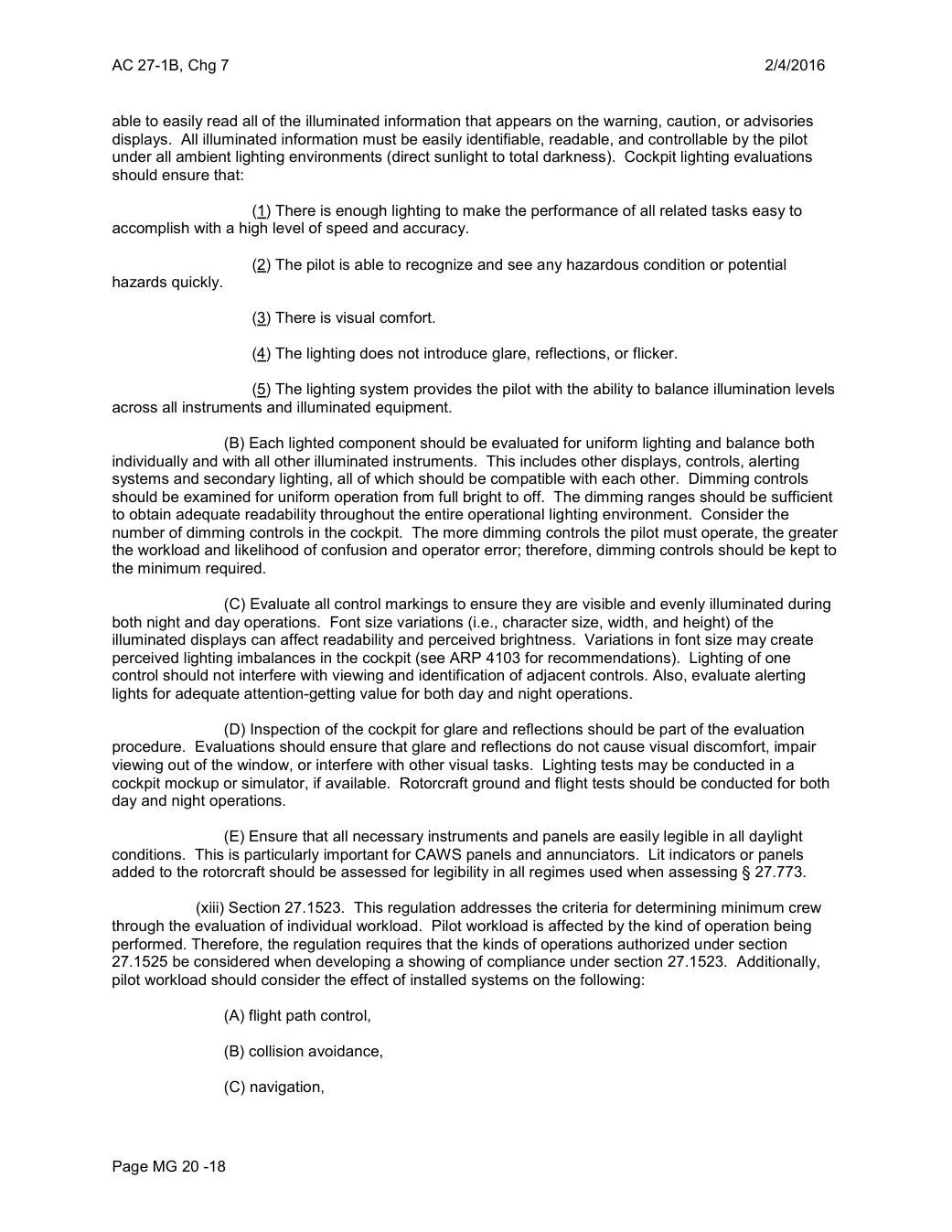
AC 27-1B, Chg 7                                                                       2/4/2016


able to easily read all of the illuminated information that appears on the warning, caution, or advisories
displays.  All illuminated information must be easily identifiable, readable, and controllable by the pilot
under all ambient lighting environments (direct sunlight to total darkness). Cockpit lighting evaluations
should ensure that:

                      (1) There is enough lighting to make the performance of all related tasks easy to
accomplish with a high level of speed and accuracy.

                      (2) The pilot is able to recognize and see any hazardous condition or potential
hazards quickly.

                      (3) There is visual comfort.

                      (4) The lighting does not introduce glare, reflections, or flicker.

                      (5) The lighting system provides the pilot with the ability to balance illumination levels
across all instruments and illuminated equipment.

                (B) Each lighted component should be evaluated for uniform lighting and balance both
individually and with all other illuminated instruments. This includes other displays, controls, alerting
systems and secondary lighting, all of which should be compatible with each other. Dimming controls
should be examined for uniform operation from full bright to off. The dimming ranges should be sufficient
to obtain adequate readability throughout the entire operational lighting environment. Consider the
number of dimming controls in the cockpit. The more dimming controls the pilot must operate, the greater
the workload and likelihood of confusion and operator error; therefore, dimming controls should be kept to
the minimum required.

                (C) Evaluate all control markings to ensure they are visible and evenly illuminated during
both night and day operations. Font size variations (i.e., character size, width, and height) of the
illuminated displays can affect readability and perceived brightness. Variations in font size may create
perceived lighting imbalances in the cockpit (see ARP 4103 for recommendations). Lighting of one
control should not interfere with viewing and identification of adjacent controls. Also, evaluate alerting
lights for adequate attention-getting value for both day and night operations.

                (D) Inspection of the cockpit for glare and reflections should be part of the evaluation
procedure. Evaluations should ensure that glare and reflections do not cause visual discomfort, impair
viewing out of the window, or interfere with other visual tasks. Lighting tests may be conducted in a
cockpit mockup or simulator, if available. Rotorcraft ground and flight tests should be conducted for both
day and night operations.

                (E) Ensure that all necessary instruments and panels are easily legible in all daylight
conditions. This is particularly important for CAWS panels and annunciators.  Lit indicators or panels
added to the rotorcraft should be assessed for legibility in all regimes used when assessing § 27.773.

                  (xiii) Section 27.1523. This regulation addresses the criteria for determining minimum crew
through the evaluation of individual workload. Pilot workload is affected by the kind of operation being
performed. Therefore, the regulation requires that the kinds of operations authorized under section
27.1525 be considered when developing a showing of compliance under section 27.1523. Additionally,
pilot workload should consider the effect of installed systems on the following:

                (A) flight path control,

                (B) collision avoidance,

                (C) navigation,


Page MG 20 -18
Saved from the FAA on November 17, 2026. All original pages are retained. Engineering explanations are presented separately below.
Aerospace Consulting / Engineering perspective
Start with the certification basis and the function.
Identify the applicable amendment before selecting the safety guidance. Connect intended functions and operating conditions to failure conditions, architecture decisions, common-cause considerations, verification and limitations. For flight controls and IFR work, carry the relevant 27.672, 27.1329 and Appendix B assumptions into the system safety and compliance evidence.
1196 original pages. 0 pages have reviewed text reflows. Original-first pages retain the source layout, with extracted text available for finding words.
A focused review, an agreed assessment package or ongoing support alongside your team. We can agree the relevant inputs and scope in the initial conversation.
This opens your email application.
Start a conversation
Tell us about your programme, the system you are developing and the support you need.
We can agree a focused use-case review, a defined evidence package or ongoing programme support.
This opens your email application.
Specialist aerospace expertise
Aerospace Consulting is led by Hussein Khimji, an FAA Designated Engineering Representative in systems and equipment, with a focus on system safety, flight controls and avionics.
We work with aircraft developers and systems suppliers to connect technical decisions, safety assessments and certification evidence.
This is the proposed introduction. The full About page will add your approved biography and associate expertise.
Systems engineering & development assurance
Tell us about the aircraft or system, its intended function, stage of development and the support you need.