Certification of Normal Category Rotorcraft — Changes 1–9
Normal category rotorcraft guidance with Changes 1–9 incorporated. Search the complete AC or start with the system safety, flight controls and instrument-flight guidance.
This source includes guidance for different amendments of Part 27. Match the guidance to the aircraft’s agreed certification basis: the 27.1309 entries for Amendments 27-21, 27-46 and 27-51 are separate. The base AC was issued on 30 September 1999; Change 9 is dated 23 June 2023. The FAA catalogue’s 30 September 2008 date is not the date of the latest change.
The source, within reach.
Search within this AC, jump to a source page, or download the complete saved publication.
This extraction supports search. Read the original page for complete notation and layout.
2/4/2016                                                  AC 27-1B, Chg 7


                (B) Numerical display of information is useful for static information that does not change
or for pilot-selected discrete parameters. Additionally, if the parameter does not need to convey
information regarding rates of change or position relative to a limit, then it may be acceptable to display it
numerically.

                     (iii) Failure indications of loss of information should be clear, unambiguous, and not
misleading. For example, it has been effective to use a red “X” with failure indication or the graying out of
a failed parameter with failure indication. Removal of the indication upon failure without other symbology
can cause confusion. Regardless of the method used to indicate a failed parameter, it should be
intuitively obvious that the information is neither available nor misleads the pilot.

                (iv) The format should inform the pilot with indications of flight guidance, attitude, airspeed,
and altimeter information sources. For systems with redundant sources, where the system monitors and
compares data between the systems, indications should alert the pilot of a mismatch and an indication to
the use of whether the data sources are “offside” or “onside.” Switch position alone should not be used to
indicate selection of the system.

         (2) Colors.

                  (i) Develop the color philosophy early and apply it consistently throughout the instrument
displays. SAE ARP4102-7 contains information regarding color schemes.

                    (ii) Color should not be the sole method of coding to account for pilot color vision deficiencies.
Use of redundant coding such as shape, outline, flashing, reverse video, or auditory is encouraged.
However, flashing use should be limited.  If applied, the use of flash coding should be consistent. For
example, flashing should not be a caution for one parameter and a warning for another.

                     (iii) Colors used to alert pilots must follow the requirements in § 27.1322. Also, consider
AC 25.1322-1 regarding color use guidance. However, coordinate with applicable certificating authority
prior to adopting AC 25.1322-1 guidance.

                (A) The color red must be reserved for alerting functions requiring immediate pilot
awareness and action. Red is required to be used when marking limits on instruments and gauges. See
section 27.1543 and subsequent sections of this AC for further guidance on the use of colors.
Additionally, red may not be used to alert the pilot that a system is functioning normally in an emergency
situation.

                      (1) Red should not be used as an outline for instruments or gauges, or to define
areas or “windows” on displays.

                      (2) Graphical displays of powerplant parameters should not present red bands or
arcs. The marking of limits must comply with § 27.1547.

                (B) The color scheme on moving map displays, navigation displays, and terrain displays
should be the same. This is important to decrease pilot confusion and the possibility of providing
misleading information.

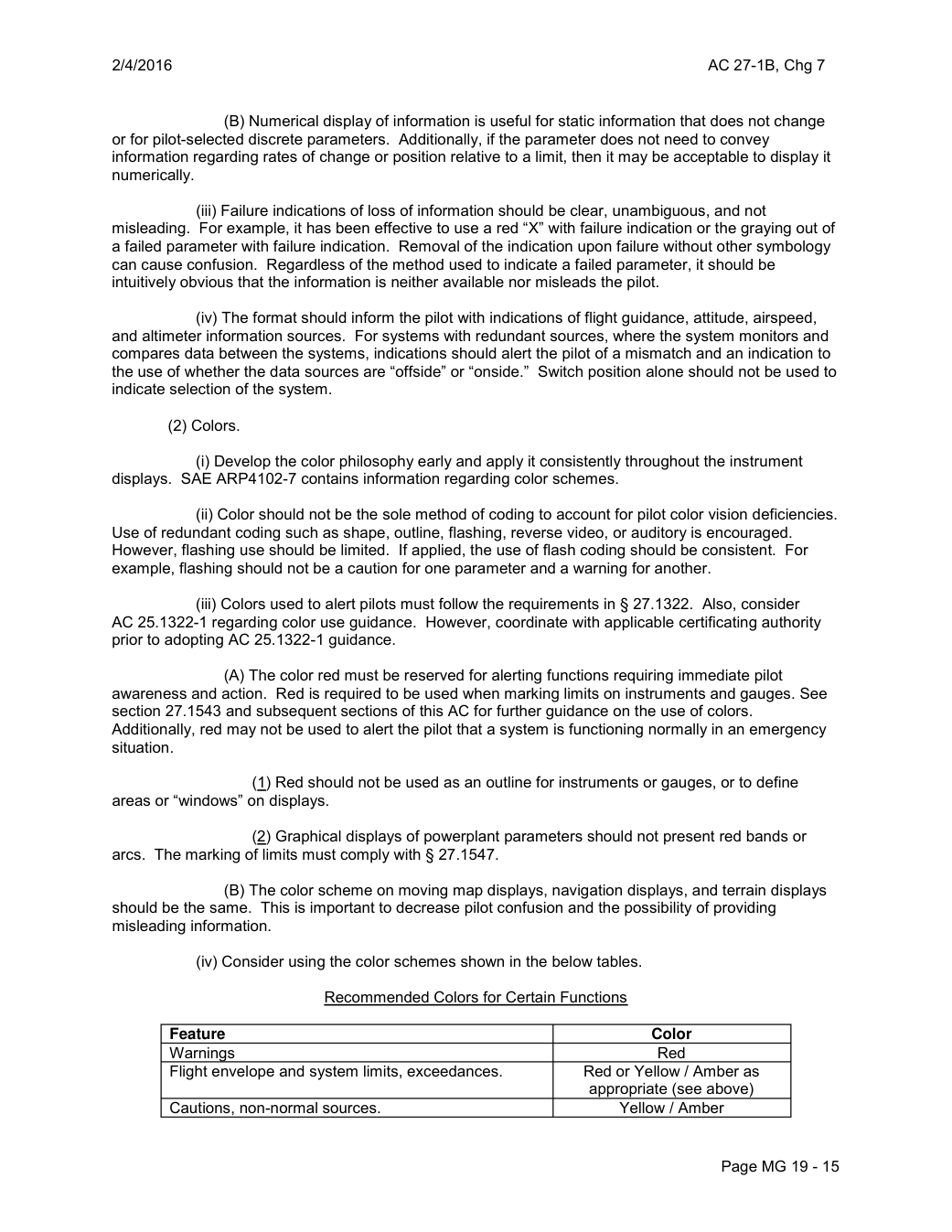
                (iv) Consider using the color schemes shown in the below tables.

                      Recommended Colors for Certain Functions

       Feature                                                     Color
       Warnings                                             Red
         Flight envelope and system limits, exceedances.         Red or Yellow / Amber as
                                                                   appropriate (see above)
        Cautions, non-normal sources.                               Yellow / Amber


                                                                   Page MG 19 - 15
Saved from the FAA on November 17, 2026. All original pages are retained. Engineering explanations are presented separately below.
Aerospace Consulting / Engineering perspective
Start with the certification basis and the function.
Identify the applicable amendment before selecting the safety guidance. Connect intended functions and operating conditions to failure conditions, architecture decisions, common-cause considerations, verification and limitations. For flight controls and IFR work, carry the relevant 27.672, 27.1329 and Appendix B assumptions into the system safety and compliance evidence.
1196 original pages. 0 pages have reviewed text reflows. Original-first pages retain the source layout, with extracted text available for finding words.
A focused review, an agreed assessment package or ongoing support alongside your team. We can agree the relevant inputs and scope in the initial conversation.
This opens your email application.
Start a conversation
Tell us about your programme, the system you are developing and the support you need.
We can agree a focused use-case review, a defined evidence package or ongoing programme support.
This opens your email application.
Specialist aerospace expertise
Aerospace Consulting is led by Hussein Khimji, an FAA Designated Engineering Representative in systems and equipment, with a focus on system safety, flight controls and avionics.
We work with aircraft developers and systems suppliers to connect technical decisions, safety assessments and certification evidence.
This is the proposed introduction. The full About page will add your approved biography and associate expertise.
Systems engineering & development assurance
Tell us about the aircraft or system, its intended function, stage of development and the support you need.