Certification of Normal Category Rotorcraft — Changes 1–9
Normal category rotorcraft guidance with Changes 1–9 incorporated. Search the complete AC or start with the system safety, flight controls and instrument-flight guidance.
This source includes guidance for different amendments of Part 27. Match the guidance to the aircraft’s agreed certification basis: the 27.1309 entries for Amendments 27-21, 27-46 and 27-51 are separate. The base AC was issued on 30 September 1999; Change 9 is dated 23 June 2023. The FAA catalogue’s 30 September 2008 date is not the date of the latest change.
The source, within reach.
Search within this AC, jump to a source page, or download the complete saved publication.
This extraction supports search. Read the original page for complete notation and layout.
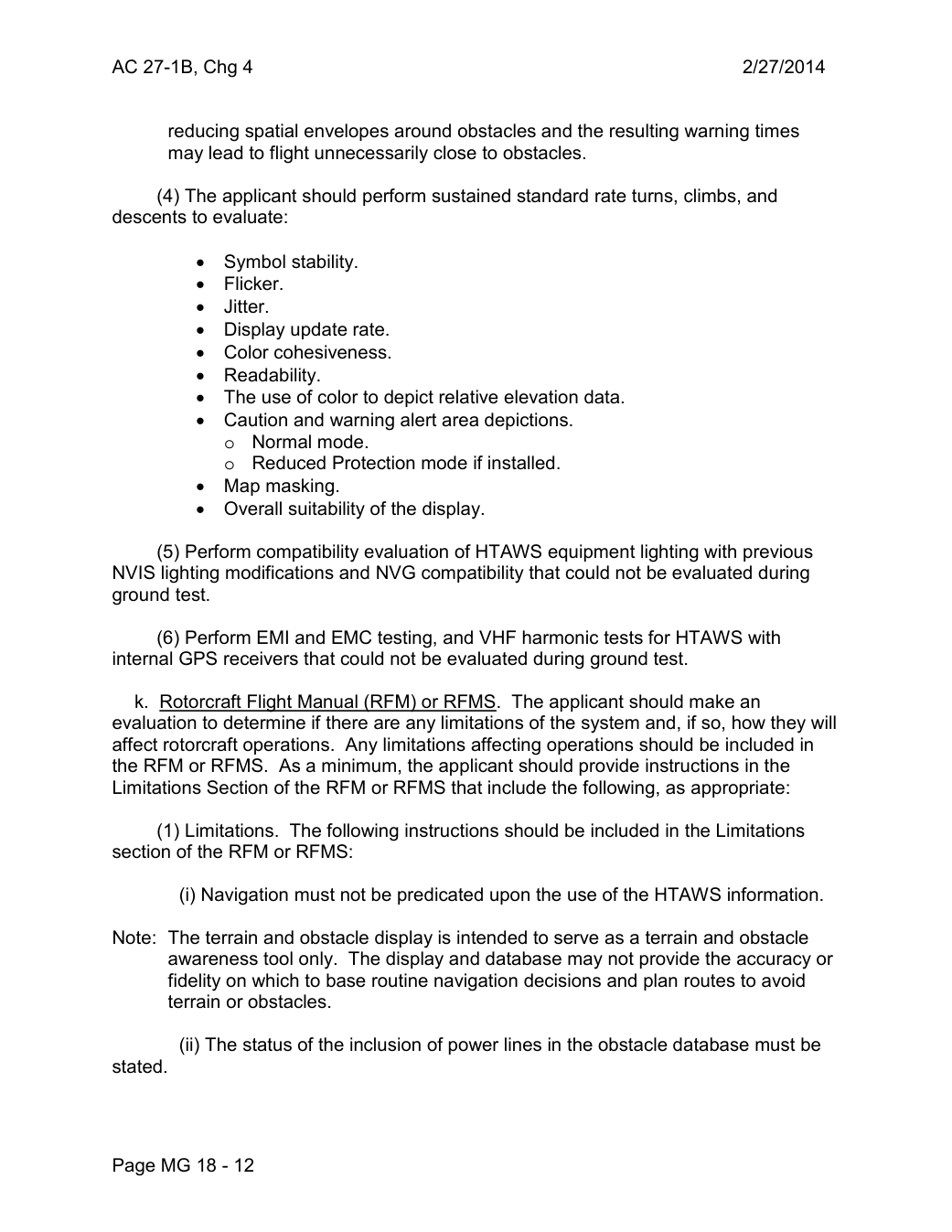
AC 27-1B, Chg 4                                                     2/27/2014


      reducing spatial envelopes around obstacles and the resulting warning times
     may lead to flight unnecessarily close to obstacles.

      (4) The applicant should perform sustained standard rate turns, climbs, and
descents to evaluate:

          •  Symbol stability.
          •   Flicker.
          •   Jitter.
          •  Display update rate.
          •  Color cohesiveness.
          •  Readability.
          •  The use of color to depict relative elevation data.
          •  Caution and warning alert area depictions.
          o  Normal mode.
          o  Reduced Protection mode if installed.
          •  Map masking.
          •  Overall suitability of the display.

      (5) Perform compatibility evaluation of HTAWS equipment lighting with previous
NVIS lighting modifications and NVG compatibility that could not be evaluated during
ground test.

      (6) Perform EMI and EMC testing, and VHF harmonic tests for HTAWS with
internal GPS receivers that could not be evaluated during ground test.

   k. Rotorcraft Flight Manual (RFM) or RFMS. The applicant should make an
evaluation to determine if there are any limitations of the system and, if so, how they will
affect rotorcraft operations. Any limitations affecting operations should be included in
the RFM or RFMS. As a minimum, the applicant should provide instructions in the
Limitations Section of the RFM or RFMS that include the following, as appropriate:

      (1) Limitations. The following instructions should be included in the Limitations
section of the RFM or RFMS:

            (i) Navigation must not be predicated upon the use of the HTAWS information.

Note: The terrain and obstacle display is intended to serve as a terrain and obstacle
      awareness tool only. The display and database may not provide the accuracy or
        fidelity on which to base routine navigation decisions and plan routes to avoid
       terrain or obstacles.

             (ii) The status of the inclusion of power lines in the obstacle database must be
stated.


Page MG 18 - 12
Saved from the FAA on November 17, 2026. All original pages are retained. Engineering explanations are presented separately below.
Aerospace Consulting / Engineering perspective
Start with the certification basis and the function.
Identify the applicable amendment before selecting the safety guidance. Connect intended functions and operating conditions to failure conditions, architecture decisions, common-cause considerations, verification and limitations. For flight controls and IFR work, carry the relevant 27.672, 27.1329 and Appendix B assumptions into the system safety and compliance evidence.
1196 original pages. 0 pages have reviewed text reflows. Original-first pages retain the source layout, with extracted text available for finding words.
A focused review, an agreed assessment package or ongoing support alongside your team. We can agree the relevant inputs and scope in the initial conversation.
This opens your email application.
Start a conversation
Tell us about your programme, the system you are developing and the support you need.
We can agree a focused use-case review, a defined evidence package or ongoing programme support.
This opens your email application.
Specialist aerospace expertise
Aerospace Consulting is led by Hussein Khimji, an FAA Designated Engineering Representative in systems and equipment, with a focus on system safety, flight controls and avionics.
We work with aircraft developers and systems suppliers to connect technical decisions, safety assessments and certification evidence.
This is the proposed introduction. The full About page will add your approved biography and associate expertise.
Systems engineering & development assurance
Tell us about the aircraft or system, its intended function, stage of development and the support you need.