
CS-29
Large Rotorcraft
Amendment 12 Source checked 2026-11-28
Scope, source and reading notes
Complete Easy Access Rules consolidation of CS-29 Amendment 12.
Aerospace Consulting reference note: Certification specifications and related compliance guidance for large rotorcraft, including the Amendment 12 vibration health monitoring provisions.
The complete selected publication is available in reading text and as the original PDF. Reading text is extracted from the official PDF; page layout is simplified, and figures and tables should be checked in the original page view.
Search covers extracted text. Words contained only in graphics may not be searchable. The original publication is available below.
Official source recordOriginal PDF on this siteSource: EASA. Reproduced with source acknowledgment; source edition and status are shown above. SHA-256: 37c3d4af295ea3ec222370e326c63753dabcbf00735cf671f3ad86e9d46cba66
(2) Example 2
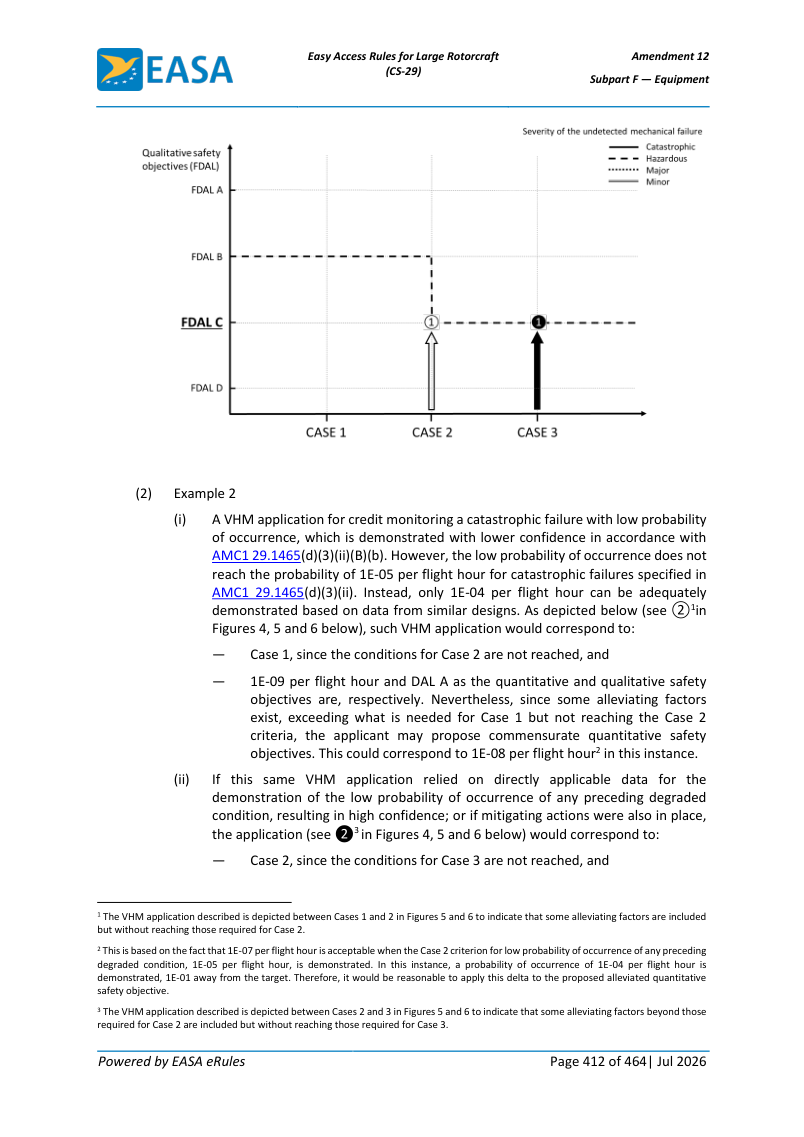
(i) A VHM application for credit monitoring a catastrophic failure with low probability of occurrence, which is demonstrated with lower confidence in accordance with AMC1 29.1465(d)(3)(ii)(B)(b). However, the low probability of occurrence does not reach the probability of 1E-05 per flight hour for catastrophic failures specified in AMC1 29.1465(d)(3)(ii). Instead, only 1E-04 per flight hour can be adequately demonstrated based on data from similar designs. As depicted below (see ②1in Figures 4, 5 and 6 below), such VHM application would correspond to:
— Case 1, since the conditions for Case 2 are not reached, and
— 1E-09 per flight hour and DAL A as the quantitative and qualitative safety objectives are, respectively. Nevertheless, since some alleviating factors exist, exceeding what is needed for Case 1 but not reaching the Case 2 criteria, the applicant may propose commensurate quantitative safety objectives. This could correspond to 1E-08 per flight hour2 in this instance.
(ii) If this same VHM application relied on directly applicable data for the demonstration of the low probability of occurrence of any preceding degraded condition, resulting in high confidence; or if mitigating actions were also in place, the application (see ❷3 in Figures 4, 5 and 6 below) would correspond to:
— Case 2, since the conditions for Case 3 are not reached, and
1 The VHM application described is depicted between Cases 1 and 2 in Figures 5 and 6 to indicate that some alleviating factors are included but without reaching those required for Case 2.
2 This is based on the fact that 1E-07 per flight hour is acceptable when the Case 2 criterion for low probability of occurrence of any preceding degraded condition, 1E-05 per flight hour, is demonstrated. In this instance, a probability of occurrence of 1E-04 per flight hour is demonstrated, 1E-01 away from the target. Therefore, it would be reasonable to apply this delta to the proposed alleviated quantitative safety objective.
3 The VHM application described is depicted between Cases 2 and 3 in Figures 5 and 6 to indicate that some alleviating factors beyond those required for Case 2 are included but without reaching those required for Case 3.
View figures, tables and original page layout
Connected references
Source-backed citations and subject-based engineering context are labelled separately. These links do not establish equivalence or project acceptance.
Related technical context
Engineering contextEvidence and scope
CS-29 and AC 29-2C — published scope
Aerospace Consulting navigation suggestion based on the subject and stated scope of the two publications.
This connection does not establish regulatory equivalence, acceptance of a newer edition, or applicability of a project-specific precedent to another programme.
Supporting source