
CS-29
Large Rotorcraft
Amendment 12 Source checked 2026-11-28
Scope, source and reading notes
Complete Easy Access Rules consolidation of CS-29 Amendment 12.
Aerospace Consulting reference note: Certification specifications and related compliance guidance for large rotorcraft, including the Amendment 12 vibration health monitoring provisions.
The complete selected publication is available in reading text and as the original PDF. Reading text is extracted from the official PDF; page layout is simplified, and figures and tables should be checked in the original page view.
Search covers extracted text. Words contained only in graphics may not be searchable. The original publication is available below.
Official source recordOriginal PDF on this siteSource: EASA. Reproduced with source acknowledgment; source edition and status are shown above. SHA-256: 37c3d4af295ea3ec222370e326c63753dabcbf00735cf671f3ad86e9d46cba66
(ii) the data acquired from the vibration signal is automatically gathered in specifically defined regimes at an appropriate rate and quantity for the VHM signal processing to produce robust data for fault detection; and
(iii) if the mission profile does not allow for regular acquisition of complete data sets, then the data acquisition regimes are capable of reconfiguration appropriate to particular flight operations or provisions are included in the ICA to ensure an adequate frequency of data acquisition.
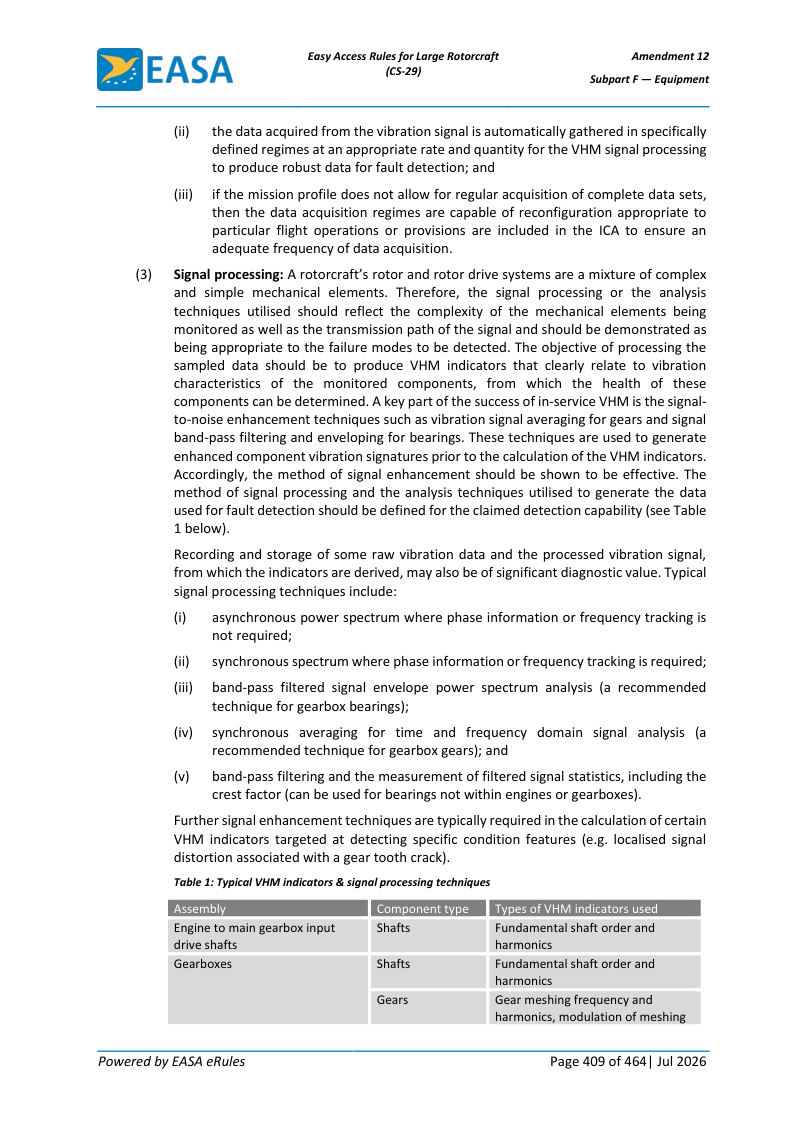
(3) Signal processing: A rotorcraft’s rotor and rotor drive systems are a mixture of complex and simple mechanical elements. Therefore, the signal processing or the analysis techniques utilised should reflect the complexity of the mechanical elements being monitored as well as the transmission path of the signal and should be demonstrated as being appropriate to the failure modes to be detected. The objective of processing the sampled data should be to produce VHM indicators that clearly relate to vibration characteristics of the monitored components, from which the health of these components can be determined. A key part of the success of in-service VHM is the signal- to-noise enhancement techniques such as vibration signal averaging for gears and signal band-pass filtering and enveloping for bearings. These techniques are used to generate enhanced component vibration signatures prior to the calculation of the VHM indicators. Accordingly, the method of signal enhancement should be shown to be effective. The method of signal processing and the analysis techniques utilised to generate the data used for fault detection should be defined for the claimed detection capability (see Table 1 below).
Recording and storage of some raw vibration data and the processed vibration signal, from which the indicators are derived, may also be of significant diagnostic value. Typical signal processing techniques include:
(i) asynchronous power spectrum where phase information or frequency tracking is not required;
(ii) synchronous spectrum where phase information or frequency tracking is required;
(iii) band-pass filtered signal envelope power spectrum analysis (a recommended technique for gearbox bearings);
(iv) synchronous averaging for time and frequency domain signal analysis (a recommended technique for gearbox gears); and
(v) band-pass filtering and the measurement of filtered signal statistics, including the crest factor (can be used for bearings not within engines or gearboxes).
Further signal enhancement techniques are typically required in the calculation of certain VHM indicators targeted at detecting specific condition features (e.g. localised signal distortion associated with a gear tooth crack).
Table 1: Typical VHM indicators & signal processing techniques
Assembly Component type Types of VHM indicators used Engine to main gearbox input drive shafts
Shafts Fundamental shaft order and harmonics Gearboxes Shafts Fundamental shaft order and harmonics Gears Gear meshing frequency and harmonics, modulation of meshing
View figures, tables and original page layout
Connected references
Source-backed citations and subject-based engineering context are labelled separately. These links do not establish equivalence or project acceptance.
Related technical context
Engineering contextEvidence and scope
CS-29 and AC 29-2C — published scope
Aerospace Consulting navigation suggestion based on the subject and stated scope of the two publications.
This connection does not establish regulatory equivalence, acceptance of a newer edition, or applicability of a project-specific precedent to another programme.
Supporting source