
CS-29
Large Rotorcraft
Amendment 12 Source checked 2026-11-28
Scope, source and reading notes
Complete Easy Access Rules consolidation of CS-29 Amendment 12.
Aerospace Consulting reference note: Certification specifications and related compliance guidance for large rotorcraft, including the Amendment 12 vibration health monitoring provisions.
The complete selected publication is available in reading text and as the original PDF. Reading text is extracted from the official PDF; page layout is simplified, and figures and tables should be checked in the original page view.
Search covers extracted text. Words contained only in graphics may not be searchable. The original publication is available below.
Official source recordOriginal PDF on this siteSource: EASA. Reproduced with source acknowledgment; source edition and status are shown above. SHA-256: 37c3d4af295ea3ec222370e326c63753dabcbf00735cf671f3ad86e9d46cba66
using any signal post-processing techniques, and no significant issue affects the quality of the sound recording;
3. When considering the CAM, the recording is representative of the actual ambient sound, conversations and alerts as if an observer were listening in the cockpit, and no significant issue affects the quality of the signal; and
4. No ‘medium’ or ‘major’ issue is identified on any channel (see Table 1 below for examples).
FAIR: A significant issue affects the signal source being considered. However, the
related signal can still be analysed without signal post-processing, or by using signal post-processing techniques provided by standard audio analysis tools (e.g. audio level adjustment, notch filter, etc.). The severity of the identified issues is not rated higher than ‘medium’ (see Table 1 below for examples).
POOR: The signal source being considered is not intelligible or not identifiable, and
this cannot be corrected even with the use of signal post-processing techniques. The severity of the identified issues is not necessarily rated as ‘major’; it may also be rated as ‘medium’ depending on the consequence for the required signal sources (see Table 1 below for examples); and
v. the audio quality rating of a CVR channel required by CS 29.1457(c) should be the same as the worst audio quality rating among the signal sources to be recorded on this channel.
e. The performance of the CVR system should be considered acceptable by the applicant only if, for none of the signal sources required by CS 29.1457(c) or by the applicable operating rules, the audio quality of the recording was rated as ‘POOR’. In addition, if the CVR system is part of a new aircraft type, the performance of the CVR system should be considered acceptable by the applicant only if for all of the signal sources required by CS 25.1457(c) and by the applicable operating rules, the quality of the audio recording was rated as ‘GOOD’.
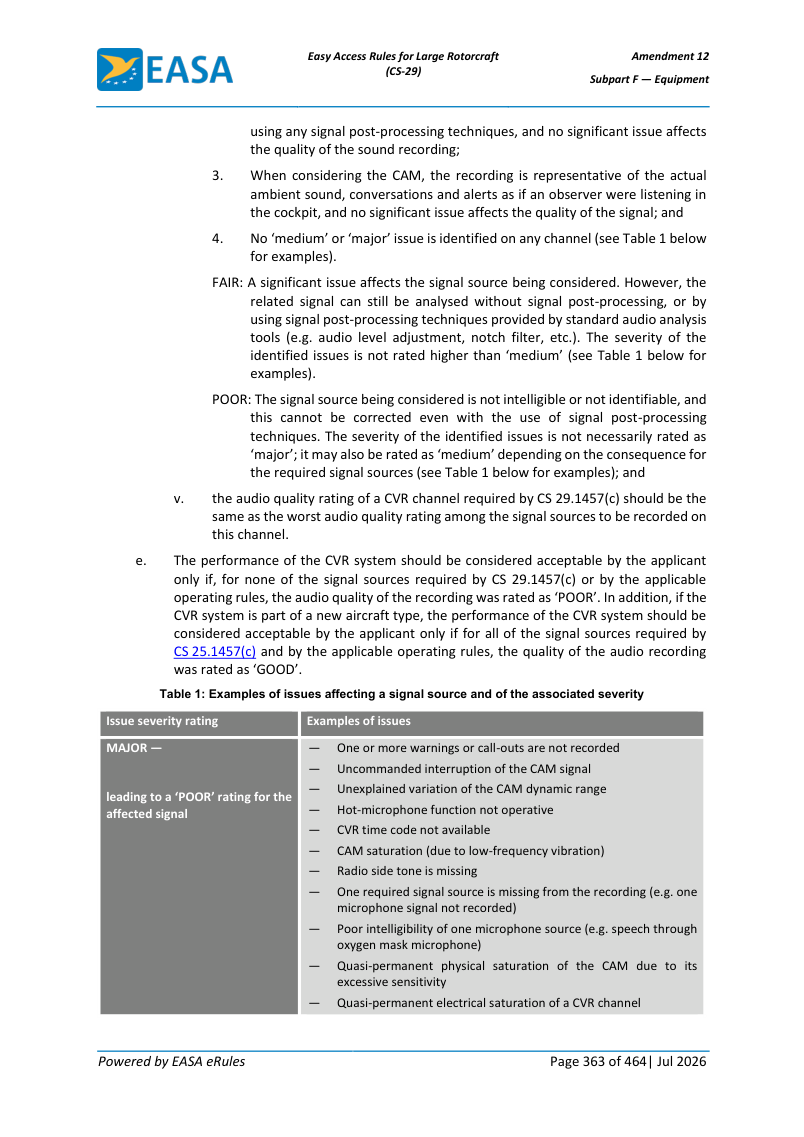
Table 1: Examples of issues affecting a signal source and of the associated severity
Issue severity rating Examples of issues
MAJOR —
— One or more warnings or call-outs are not recorded
— Uncommanded interruption of the CAM signal
— Unexplained variation of the CAM dynamic range
— Hot-microphone function not operative
leading to a ‘POOR’ rating for the affected signal
— CVR time code not available
— CAM saturation (due to low-frequency vibration)
— Radio side tone is missing
— One required signal source is missing from the recording (e.g. one microphone signal not recorded)
— Poor intelligibility of one microphone source (e.g. speech through oxygen mask microphone)
— Quasi-permanent physical saturation of the CAM due to its excessive sensitivity
— Quasi-permanent electrical saturation of a CVR channel
View figures, tables and original page layout
Connected references
Source-backed citations and subject-based engineering context are labelled separately. These links do not establish equivalence or project acceptance.
Related technical context
Engineering contextEvidence and scope
CS-29 and AC 29-2C — published scope
Aerospace Consulting navigation suggestion based on the subject and stated scope of the two publications.
This connection does not establish regulatory equivalence, acceptance of a newer edition, or applicability of a project-specific precedent to another programme.
Supporting source