
CS-29
Large Rotorcraft
Amendment 12 Source checked 2026-11-28
Scope, source and reading notes
Complete Easy Access Rules consolidation of CS-29 Amendment 12.
Aerospace Consulting reference note: Certification specifications and related compliance guidance for large rotorcraft, including the Amendment 12 vibration health monitoring provisions.
The complete selected publication is available in reading text and as the original PDF. Reading text is extracted from the official PDF; page layout is simplified, and figures and tables should be checked in the original page view.
Search covers extracted text. Words contained only in graphics may not be searchable. The original publication is available below.
Official source recordOriginal PDF on this siteSource: EASA. Reproduced with source acknowledgment; source edition and status are shown above. SHA-256: 37c3d4af295ea3ec222370e326c63753dabcbf00735cf671f3ad86e9d46cba66
The field of coverage must extend in each direction within at least 30° above and 30° below the horizontal plane of the rotorcraft, except that there may be solid angles of obstructed visibility totalling not more than 0.5 steradians.
(c) Flashing characteristics. The arrangement of the system, that is, the number of light sources, beam width, speed of rotation, and other characteristics, must give an effective flash frequency of not less than 40, nor more than 100, cycles per minute. The effective flash frequency is the frequency at which the rotorcraft's complete anti-collision light system is observed from a distance, and applies to each sector of light including any overlaps that exist when the system consists of more than one light source. In overlaps, flash frequencies may exceed 100, but not 180, cycles per minute.
(d) Colour. Each anti-collision light must be aviation red and must meet the applicable requirements of CS 29.1397.
(e) Light intensity. The minimum light intensities in any vertical plane, measured with the red filter (if used) and expressed in terms of ‘effective’ intensities, must meet the requirements of sub- paragraph (f). The following relation must be assumed:
𝐼𝑒=
∫ 𝐼(𝑡)𝑑𝑡 𝑡2 𝑡1 0 ∙2 + (𝑡2 −𝑡1)
where:
𝐼𝑒 = effective intensity (candelas).
𝐼(𝑡) = instantaneous intensity as a function of time.
𝑡2 −𝑡1 = flash time interval (seconds).
Normally, the maximum value of effective intensity is obtained when t2 and t1 are chosen so that the effective intensity is equal to the instantaneous intensity at t2 and t1.
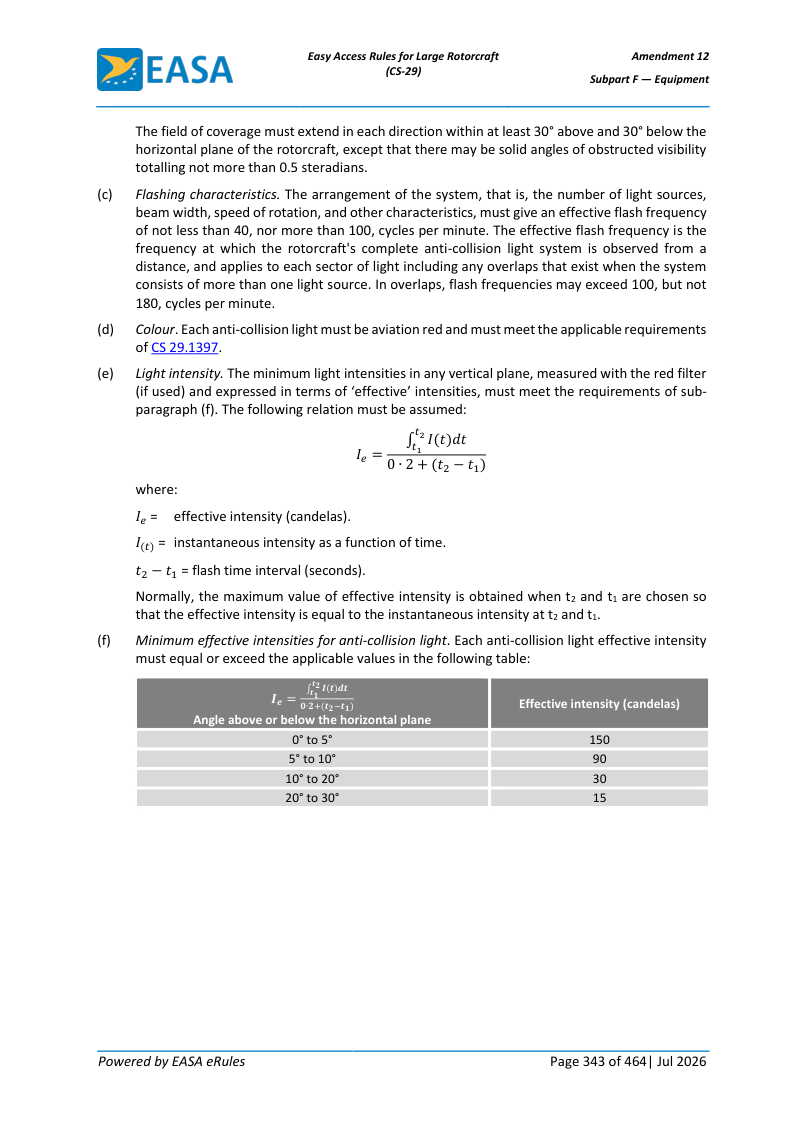
(f) Minimum effective intensities for anti-collision light. Each anti-collision light effective intensity must equal or exceed the applicable values in the following table:
𝑰𝒆=
Effective intensity (candelas)
∫ 𝑰(𝒕)𝒅𝒕 𝒕𝟐 𝒕𝟏 𝟎∙𝟐+(𝒕𝟐−𝒕𝟏)
Angle above or below the horizontal plane
0° to 5° 150 5° to 10° 90 10° to 20° 30 20° to 30° 15
View figures, tables and original page layout
Connected references
Source-backed citations and subject-based engineering context are labelled separately. These links do not establish equivalence or project acceptance.
Related technical context
Engineering contextEvidence and scope
CS-29 and AC 29-2C — published scope
Aerospace Consulting navigation suggestion based on the subject and stated scope of the two publications.
This connection does not establish regulatory equivalence, acceptance of a newer edition, or applicability of a project-specific precedent to another programme.
Supporting source