
CS-29
Large Rotorcraft
Amendment 12 Source checked 2026-11-28
Scope, source and reading notes
Complete Easy Access Rules consolidation of CS-29 Amendment 12.
Aerospace Consulting reference note: Certification specifications and related compliance guidance for large rotorcraft, including the Amendment 12 vibration health monitoring provisions.
The complete selected publication is available in reading text and as the original PDF. Reading text is extracted from the official PDF; page layout is simplified, and figures and tables should be checked in the original page view.
Search covers extracted text. Words contained only in graphics may not be searchable. The original publication is available below.
Official source recordOriginal PDF on this siteSource: EASA. Reproduced with source acknowledgment; source edition and status are shown above. SHA-256: 37c3d4af295ea3ec222370e326c63753dabcbf00735cf671f3ad86e9d46cba66
2) RELATION BETWEEN CS 29.1302 AND OTHER SPECIFICATIONS, AND ASSUMPTIONS
2.1 The relation of CS 29.1302 to other specifications
a) CS-29 Book 2 establishes that the AMC for CS-29 is the respective FAA AC 29-2 revision adopted by EASA with the changes/additions included within Book 2. AC 29-2 includes the Miscellaneous Guidance MG-20 ‘Human Factors’. MG-20 aims to assist the applicant in understanding the HFs implications of the CS-29 paragraphs. In order to achieve this objective, MG-20 provides a list of all CS-29 HFs-related specifications, including those relevant to the performance and handling qualities, and helps to address within the certification plan some of the specifications that deal with the system design with additional guidance. However, MG-20 does not include specific guidance on how to perform a comprehensive HFs assessment as required by 29.1302. Therefore, adherence to the guidance material included within AC 29-2 and the associated MG- 20 is not sufficient to demonstrate compliance with CS 29.1302.
(b) This AMC provides dedicated guidance for demonstrating compliance with CS 29.1302. To help the applicant reach the objectives of CS 29.1302, some additional guidance related to other specifications associated with the installed equipment that the crew members use to operate the rotorcraft is also provided in Section 4. Table 1 below contains a list of these specifications related to cockpit design and crew member interfaces for which this AMC provides additional design guidance. Note that this AMC does not provide a comprehensive means of compliance for any of the specifications beyond CS 29.1302.
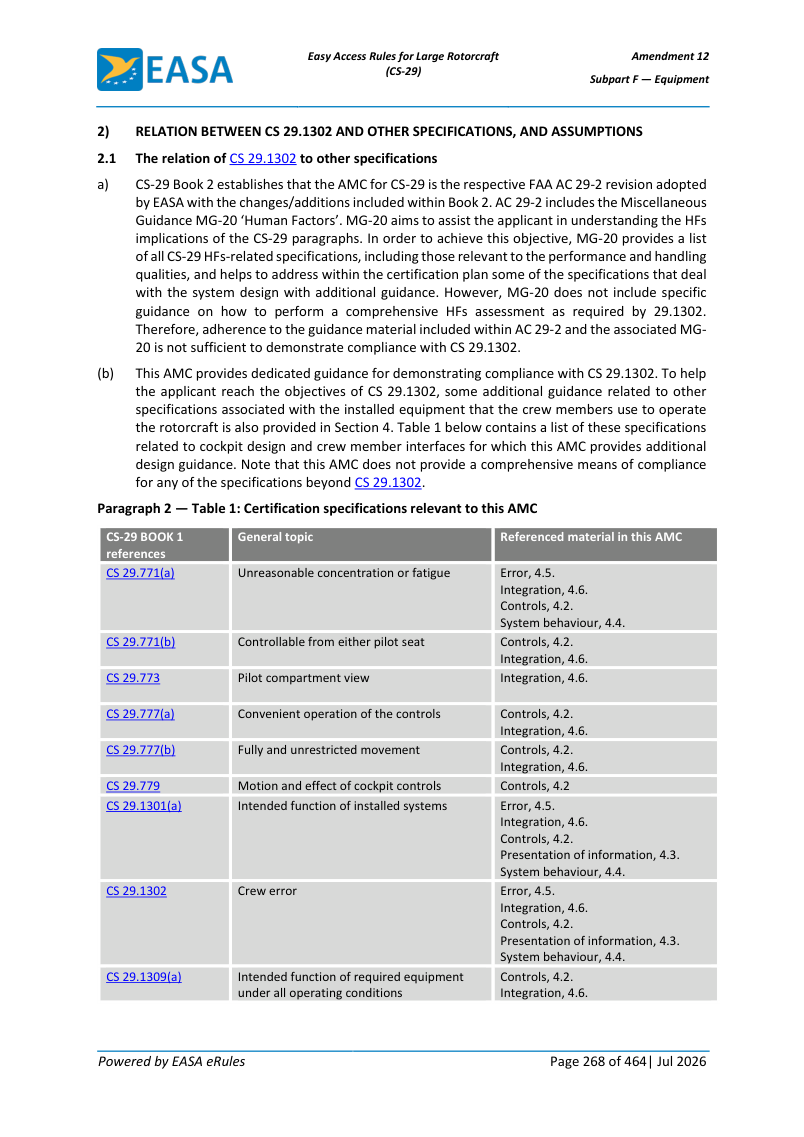
Paragraph 2 — Table 1: Certification specifications relevant to this AMC
General topic Referenced material in this AMC
CS-29 BOOK 1 references
Pilot compartment view Integration, 4.6.
CS 29.771(a) Unreasonable concentration or fatigue Error, 4.5. Integration, 4.6. Controls, 4.2. System behaviour, 4.4. CS 29.771(b) Controllable from either pilot seat Controls, 4.2. Integration, 4.6. CS 29.773
CS 29.777(a) Convenient operation of the controls Controls, 4.2. Integration, 4.6. CS 29.777(b) Fully and unrestricted movement Controls, 4.2. Integration, 4.6. CS 29.779 Motion and effect of cockpit controls Controls, 4.2 CS 29.1301(a) Intended function of installed systems Error, 4.5. Integration, 4.6. Controls, 4.2. Presentation of information, 4.3. System behaviour, 4.4. CS 29.1302 Crew error Error, 4.5. Integration, 4.6. Controls, 4.2. Presentation of information, 4.3. System behaviour, 4.4. CS 29.1309(a) Intended function of required equipment under all operating conditions
Controls, 4.2. Integration, 4.6.
View figures, tables and original page layout
Connected references
Source-backed citations and subject-based engineering context are labelled separately. These links do not establish equivalence or project acceptance.
Related technical context
Engineering contextEvidence and scope
CS-29 and AC 29-2C — published scope
Aerospace Consulting navigation suggestion based on the subject and stated scope of the two publications.
This connection does not establish regulatory equivalence, acceptance of a newer edition, or applicability of a project-specific precedent to another programme.
Supporting source