
AC 27-1B
Certification of Normal Category Rotorcraft — Changes 1–9
27-1B · Changes 1–9 incorporated Source checked 2026-11-28
Scope, source and reading notes
This source includes guidance for different amendments of Part 27. Match the guidance to the aircraft’s agreed certification basis: the 27.1309 entries for Amendments 27-21, 27-46 and 27-51 are separate. The base AC was issued on 30 September 1999; Change 9 is dated 23 June 2023. The FAA catalogue’s 30 September 2008 date is not the date of the latest change.
Aerospace Consulting reference note: Complete normal-category rotorcraft guidance, including system safety, equipment, flight guidance and IFR certification.
The complete selected publication is available in reading text and as the original PDF. Reading text is extracted from the official PDF; page layout is simplified, and figures and tables should be checked in the original page view.
Search covers extracted text. Words contained only in graphics may not be searchable. The original publication is available below.
Official source recordOriginal PDF on this siteSource: FAA. Reproduced with source acknowledgment; source edition and status are shown above. SHA-256: 2dfac16a3644dc18997069cca78746c10726e4b70d3aba996fc87843ffe68a2b
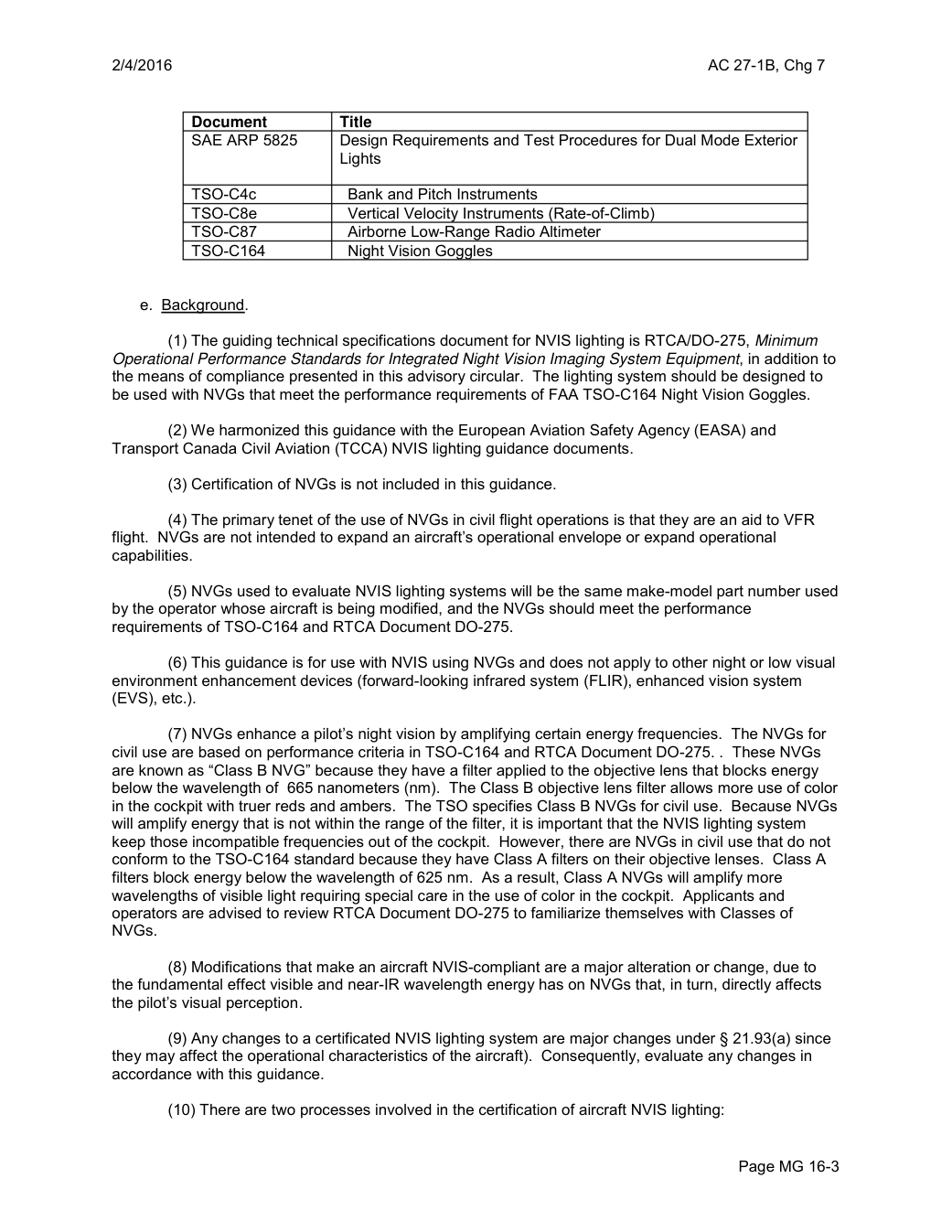
Document Title SAE ARP 5825 Design Requirements and Test Procedures for Dual Mode Exterior Lights
TSO-C4c Bank and Pitch Instruments TSO-C8e Vertical Velocity Instruments (Rate-of-Climb) TSO-C87 Airborne Low-Range Radio Altimeter TSO-C164 Night Vision Goggles
e. Background.
(1) The guiding technical specifications document for NVIS lighting is RTCA/DO-275, Minimum Operational Performance Standards for Integrated Night Vision Imaging System Equipment, in addition to the means of compliance presented in this advisory circular. The lighting system should be designed to be used with NVGs that meet the performance requirements of FAA TSO-C164 Night Vision Goggles.
(2) We harmonized this guidance with the European Aviation Safety Agency (EASA) and Transport Canada Civil Aviation (TCCA) NVIS lighting guidance documents.
(3) Certification of NVGs is not included in this guidance.
(4) The primary tenet of the use of NVGs in civil flight operations is that they are an aid to VFR flight. NVGs are not intended to expand an aircraft’s operational envelope or expand operational capabilities.
(5) NVGs used to evaluate NVIS lighting systems will be the same make-model part number used by the operator whose aircraft is being modified, and the NVGs should meet the performance requirements of TSO-C164 and RTCA Document DO-275.
(6) This guidance is for use with NVIS using NVGs and does not apply to other night or low visual environment enhancement devices (forward-looking infrared system (FLIR), enhanced vision system (EVS), etc.).
(7) NVGs enhance a pilot’s night vision by amplifying certain energy frequencies. The NVGs for civil use are based on performance criteria in TSO-C164 and RTCA Document DO-275. . These NVGs are known as “Class B NVG” because they have a filter applied to the objective lens that blocks energy below the wavelength of 665 nanometers (nm). The Class B objective lens filter allows more use of color in the cockpit with truer reds and ambers. The TSO specifies Class B NVGs for civil use. Because NVGs will amplify energy that is not within the range of the filter, it is important that the NVIS lighting system keep those incompatible frequencies out of the cockpit. However, there are NVGs in civil use that do not conform to the TSO-C164 standard because they have Class A filters on their objective lenses. Class A filters block energy below the wavelength of 625 nm. As a result, Class A NVGs will amplify more wavelengths of visible light requiring special care in the use of color in the cockpit. Applicants and operators are advised to review RTCA Document DO-275 to familiarize themselves with Classes of NVGs.
(8) Modifications that make an aircraft NVIS-compliant are a major alteration or change, due to the fundamental effect visible and near-IR wavelength energy has on NVGs that, in turn, directly affects the pilot’s visual perception.
(9) Any changes to a certificated NVIS lighting system are major changes under § 21.93(a) since they may affect the operational characteristics of the aircraft). Consequently, evaluate any changes in accordance with this guidance.
(10) There are two processes involved in the certification of aircraft NVIS lighting:
View figures, tables and original page layout
Connected references
Source-backed citations and subject-based engineering context are labelled separately. These links do not establish equivalence or project acceptance.
Related technical context
Engineering contextEvidence and scope
AC 27-1B and AC 29-2C — published scope
Aerospace Consulting navigation suggestion based on the subject and stated scope of the two publications.
This connection does not establish regulatory equivalence, acceptance of a newer edition, or applicability of a project-specific precedent to another programme.
Supporting sourceRelated technical context
Engineering contextEvidence and scope
CS-27 and AC 27-1B — published scope
Aerospace Consulting navigation suggestion based on the subject and stated scope of the two publications.
This connection does not establish regulatory equivalence, acceptance of a newer edition, or applicability of a project-specific precedent to another programme.
Supporting source