
AC 27-1B
Certification of Normal Category Rotorcraft — Changes 1–9
27-1B · Changes 1–9 incorporated Source checked 2026-11-28
Scope, source and reading notes
This source includes guidance for different amendments of Part 27. Match the guidance to the aircraft’s agreed certification basis: the 27.1309 entries for Amendments 27-21, 27-46 and 27-51 are separate. The base AC was issued on 30 September 1999; Change 9 is dated 23 June 2023. The FAA catalogue’s 30 September 2008 date is not the date of the latest change.
Aerospace Consulting reference note: Complete normal-category rotorcraft guidance, including system safety, equipment, flight guidance and IFR certification.
The complete selected publication is available in reading text and as the original PDF. Reading text is extracted from the official PDF; page layout is simplified, and figures and tables should be checked in the original page view.
Search covers extracted text. Words contained only in graphics may not be searchable. The original publication is available below.
Official source recordOriginal PDF on this siteSource: FAA. Reproduced with source acknowledgment; source edition and status are shown above. SHA-256: 2dfac16a3644dc18997069cca78746c10726e4b70d3aba996fc87843ffe68a2b
(3) Critical bonded joints that have high static margins of safety (e.g., some rotor blades) may be accepted based on satisfactory service history of like or similar components.
(E) The fatigue load spectrum developed for fatigue testing and analysis purposes should be representative of the anticipated service usage. Low amplitude load levels that can be shown not to contribute to fatigue damage may be omitted (truncated). Reducing maximum load levels (clipping) is generally not accepted.
(F) Environmental effects (temperature and humidity representative of the expected service usage) on the static and fatigue behavior and damage growth should be considered. Unless tested in the environment, appropriate environmental knock down factors for the static and the fatigue test articles should be derived and applied in the evaluation.
(G) Variability in fatigue behavior should be covered by appropriate load or life scatter factors and these factors should take into account the number of specimens tested.
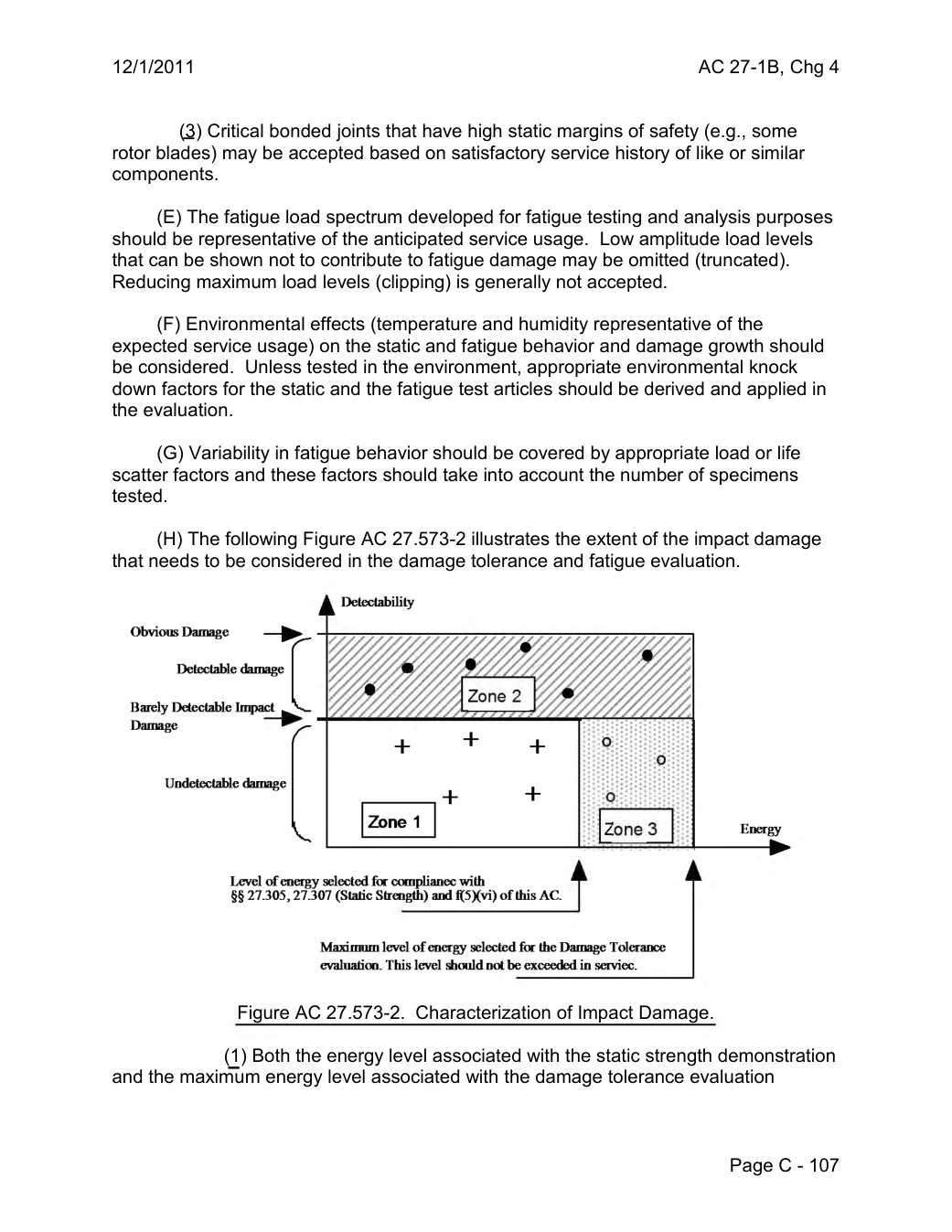
(H) The following Figure AC 27.573-2 illustrates the extent of the impact damage that needs to be considered in the damage tolerance and fatigue evaluation.
Obvious Damage ~
Detectable damage [
. . . . . . . .
Detectability ~ /~ ■
Barely Detectable Impac~ Damage
+
+ +
Undetectable damage
+
Energy
----+ I Zone 1 I
Level of energy selected for complianec with
§§ 27-305, 27-307 (Static Strength) and fl5)(vi) of this AC.
Maximum level of energy selected for the Damage Tolerance evaluation. This level should not be exceeded in serviec.
Figure AC 27.573-2. Characterization of Impact Damage.
(1) Both the energy level associated with the static strength demonstration and the maximum energy level associated with the damage tolerance evaluation
View figures, tables and original page layout
Connected references
Source-backed citations and subject-based engineering context are labelled separately. These links do not establish equivalence or project acceptance.
Related technical context
Engineering contextEvidence and scope
AC 27-1B and AC 29-2C — published scope
Aerospace Consulting navigation suggestion based on the subject and stated scope of the two publications.
This connection does not establish regulatory equivalence, acceptance of a newer edition, or applicability of a project-specific precedent to another programme.
Supporting sourceRelated technical context
Engineering contextEvidence and scope
CS-27 and AC 27-1B — published scope
Aerospace Consulting navigation suggestion based on the subject and stated scope of the two publications.
This connection does not establish regulatory equivalence, acceptance of a newer edition, or applicability of a project-specific precedent to another programme.
Supporting source