
AC 27-1B
Certification of Normal Category Rotorcraft — Changes 1–9
27-1B · Changes 1–9 incorporated Source checked 2026-11-28
Scope, source and reading notes
This source includes guidance for different amendments of Part 27. Match the guidance to the aircraft’s agreed certification basis: the 27.1309 entries for Amendments 27-21, 27-46 and 27-51 are separate. The base AC was issued on 30 September 1999; Change 9 is dated 23 June 2023. The FAA catalogue’s 30 September 2008 date is not the date of the latest change.
Aerospace Consulting reference note: Complete normal-category rotorcraft guidance, including system safety, equipment, flight guidance and IFR certification.
The complete selected publication is available in reading text and as the original PDF. Reading text is extracted from the official PDF; page layout is simplified, and figures and tables should be checked in the original page view.
Search covers extracted text. Words contained only in graphics may not be searchable. The original publication is available below.
Official source recordOriginal PDF on this siteSource: FAA. Reproduced with source acknowledgment; source edition and status are shown above. SHA-256: 2dfac16a3644dc18997069cca78746c10726e4b70d3aba996fc87843ffe68a2b
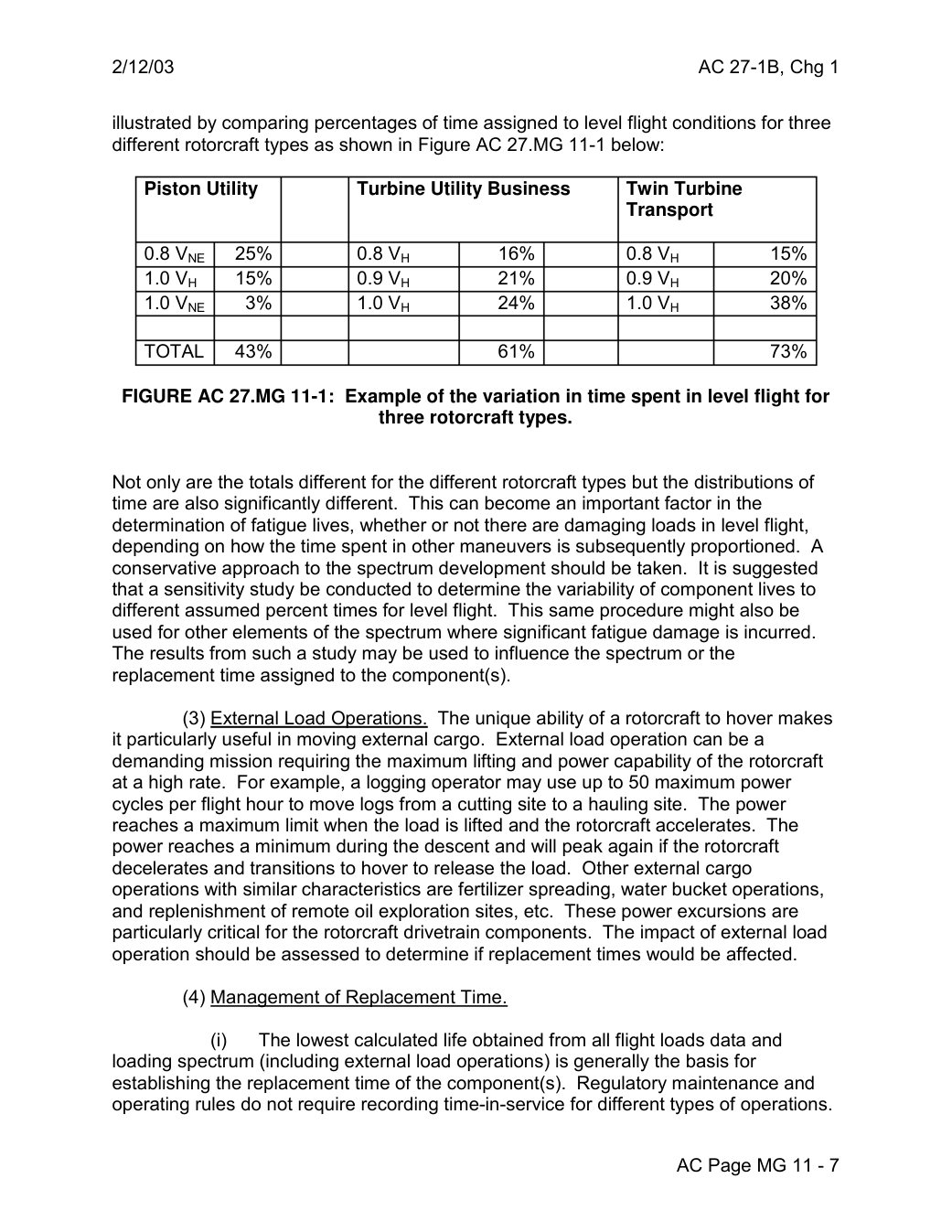
illustrated by comparing percentages of time assigned to level flight conditions for three different rotorcraft types as shown in Figure AC 27.MG 11-1 below:
Piston Utility Turbine Utility Business Twin Turbine Transport
0.8 VNE 25% 0.8 VH 16% 0.8 VH 15% 1.0 VH 15% 0.9 VH 21% 0.9 VH 20% 1.0 VNE 3% 1.0 VH 24% 1.0 VH 38%
TOTAL 43% 61% 73%
FIGURE AC 27.MG 11-1: Example of the variation in time spent in level flight for three rotorcraft types.
Not only are the totals different for the different rotorcraft types but the distributions of time are also significantly different. This can become an important factor in the determination of fatigue lives, whether or not there are damaging loads in level flight, depending on how the time spent in other maneuvers is subsequently proportioned. A conservative approach to the spectrum development should be taken. It is suggested that a sensitivity study be conducted to determine the variability of component lives to different assumed percent times for level flight. This same procedure might also be used for other elements of the spectrum where significant fatigue damage is incurred. The results from such a study may be used to influence the spectrum or the replacement time assigned to the component(s).
(3) External Load Operations. The unique ability of a rotorcraft to hover makes it particularly useful in moving external cargo. External load operation can be a demanding mission requiring the maximum lifting and power capability of the rotorcraft at a high rate. For example, a logging operator may use up to 50 maximum power cycles per flight hour to move logs from a cutting site to a hauling site. The power reaches a maximum limit when the load is lifted and the rotorcraft accelerates. The power reaches a minimum during the descent and will peak again if the rotorcraft decelerates and transitions to hover to release the load. Other external cargo operations with similar characteristics are fertilizer spreading, water bucket operations, and replenishment of remote oil exploration sites, etc. These power excursions are particularly critical for the rotorcraft drivetrain components. The impact of external load operation should be assessed to determine if replacement times would be affected.
(4) Management of Replacement Time.
(i) The lowest calculated life obtained from all flight loads data and loading spectrum (including external load operations) is generally the basis for establishing the replacement time of the component(s). Regulatory maintenance and operating rules do not require recording time-in-service for different types of operations.
View figures, tables and original page layout
Connected references
Source-backed citations and subject-based engineering context are labelled separately. These links do not establish equivalence or project acceptance.
Related technical context
Engineering contextEvidence and scope
AC 27-1B and AC 29-2C — published scope
Aerospace Consulting navigation suggestion based on the subject and stated scope of the two publications.
This connection does not establish regulatory equivalence, acceptance of a newer edition, or applicability of a project-specific precedent to another programme.
Supporting sourceRelated technical context
Engineering contextEvidence and scope
CS-27 and AC 27-1B — published scope
Aerospace Consulting navigation suggestion based on the subject and stated scope of the two publications.
This connection does not establish regulatory equivalence, acceptance of a newer edition, or applicability of a project-specific precedent to another programme.
Supporting source