
AC 27-1B
Certification of Normal Category Rotorcraft — Changes 1–9
27-1B · Changes 1–9 incorporated Source checked 2026-11-28
Scope, source and reading notes
This source includes guidance for different amendments of Part 27. Match the guidance to the aircraft’s agreed certification basis: the 27.1309 entries for Amendments 27-21, 27-46 and 27-51 are separate. The base AC was issued on 30 September 1999; Change 9 is dated 23 June 2023. The FAA catalogue’s 30 September 2008 date is not the date of the latest change.
Aerospace Consulting reference note: Complete normal-category rotorcraft guidance, including system safety, equipment, flight guidance and IFR certification.
The complete selected publication is available in reading text and as the original PDF. Reading text is extracted from the official PDF; page layout is simplified, and figures and tables should be checked in the original page view.
Search covers extracted text. Words contained only in graphics may not be searchable. The original publication is available below.
Official source recordOriginal PDF on this siteSource: FAA. Reproduced with source acknowledgment; source edition and status are shown above. SHA-256: 2dfac16a3644dc18997069cca78746c10726e4b70d3aba996fc87843ffe68a2b
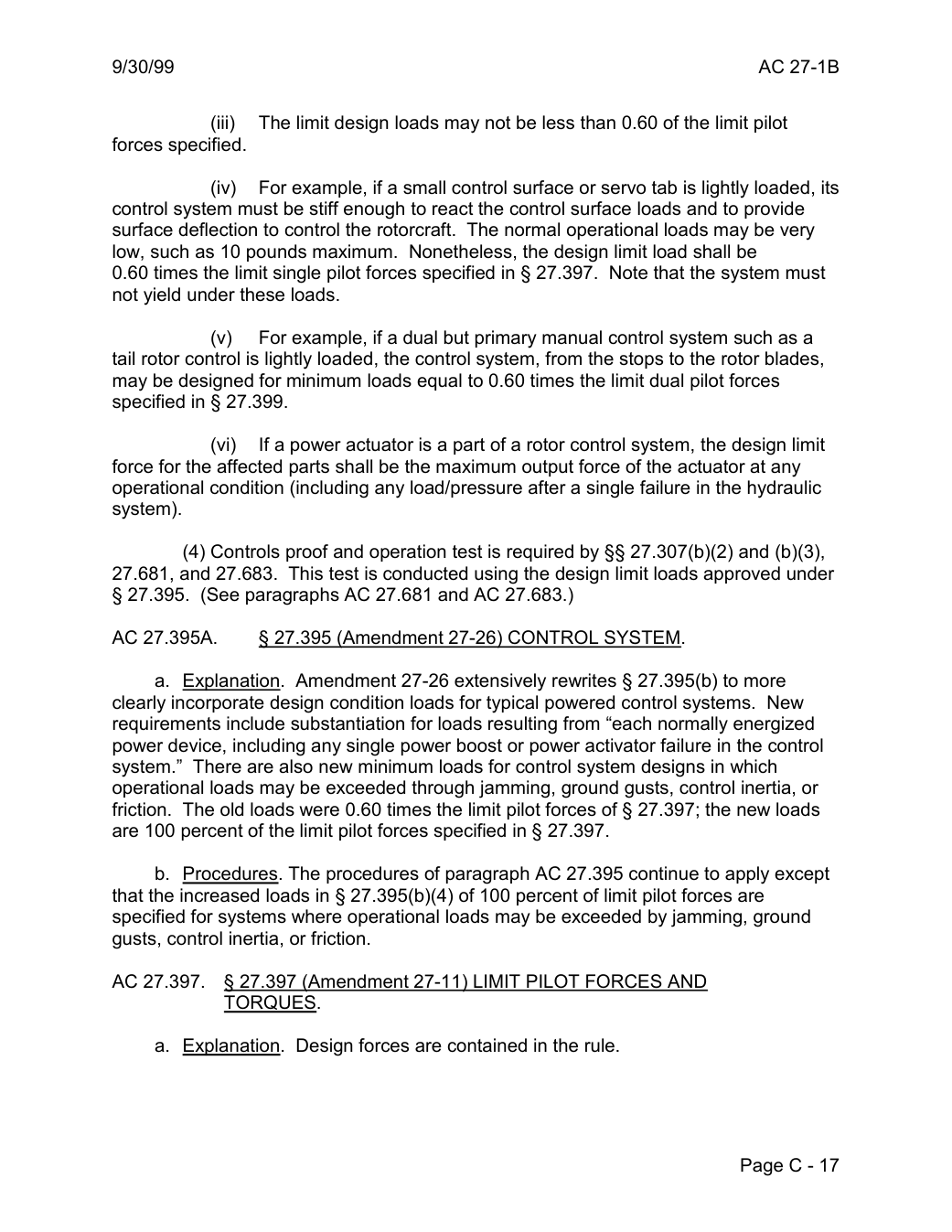
(iii) The limit design loads may not be less than 0.60 of the limit pilot forces specified.
(iv) For example, if a small control surface or servo tab is lightly loaded, its control system must be stiff enough to react the control surface loads and to provide surface deflection to control the rotorcraft. The normal operational loads may be very low, such as 10 pounds maximum. Nonetheless, the design limit load shall be 0.60 times the limit single pilot forces specified in § 27.397. Note that the system must not yield under these loads.
(v) For example, if a dual but primary manual control system such as a tail rotor control is lightly loaded, the control system, from the stops to the rotor blades, may be designed for minimum loads equal to 0.60 times the limit dual pilot forces specified in § 27.399.
(vi) If a power actuator is a part of a rotor control system, the design limit force for the affected parts shall be the maximum output force of the actuator at any operational condition (including any load/pressure after a single failure in the hydraulic system).
(4) Controls proof and operation test is required by §§ 27.307(b)(2) and (b)(3), 27.681, and 27.683. This test is conducted using the design limit loads approved under § 27.395. (See paragraphs AC 27.681 and AC 27.683.)
AC 27.395A. § 27.395 (Amendment 27-26) CONTROL SYSTEM.
a. Explanation. Amendment 27-26 extensively rewrites § 27.395(b) to more clearly incorporate design condition loads for typical powered control systems. New requirements include substantiation for loads resulting from “each normally energized power device, including any single power boost or power activator failure in the control system.” There are also new minimum loads for control system designs in which operational loads may be exceeded through jamming, ground gusts, control inertia, or friction. The old loads were 0.60 times the limit pilot forces of § 27.397; the new loads are 100 percent of the limit pilot forces specified in § 27.397.
b. Procedures. The procedures of paragraph AC 27.395 continue to apply except that the increased loads in § 27.395(b)(4) of 100 percent of limit pilot forces are specified for systems where operational loads may be exceeded by jamming, ground gusts, control inertia, or friction.
AC 27.397. § 27.397 (Amendment 27-11) LIMIT PILOT FORCES AND TORQUES.
a. Explanation. Design forces are contained in the rule.
View figures, tables and original page layout
Connected references
Source-backed citations and subject-based engineering context are labelled separately. These links do not establish equivalence or project acceptance.
Related technical context
Engineering contextEvidence and scope
AC 27-1B and AC 29-2C — published scope
Aerospace Consulting navigation suggestion based on the subject and stated scope of the two publications.
This connection does not establish regulatory equivalence, acceptance of a newer edition, or applicability of a project-specific precedent to another programme.
Supporting sourceRelated technical context
Engineering contextEvidence and scope
CS-27 and AC 27-1B — published scope
Aerospace Consulting navigation suggestion based on the subject and stated scope of the two publications.
This connection does not establish regulatory equivalence, acceptance of a newer edition, or applicability of a project-specific precedent to another programme.
Supporting source