
AC 27-1B
Certification of Normal Category Rotorcraft — Changes 1–9
27-1B · Changes 1–9 incorporated Source checked 2026-11-28
Scope, source and reading notes
This source includes guidance for different amendments of Part 27. Match the guidance to the aircraft’s agreed certification basis: the 27.1309 entries for Amendments 27-21, 27-46 and 27-51 are separate. The base AC was issued on 30 September 1999; Change 9 is dated 23 June 2023. The FAA catalogue’s 30 September 2008 date is not the date of the latest change.
Aerospace Consulting reference note: Complete normal-category rotorcraft guidance, including system safety, equipment, flight guidance and IFR certification.
The complete selected publication is available in reading text and as the original PDF. Reading text is extracted from the official PDF; page layout is simplified, and figures and tables should be checked in the original page view.
Search covers extracted text. Words contained only in graphics may not be searchable. The original publication is available below.
Official source recordOriginal PDF on this siteSource: FAA. Reproduced with source acknowledgment; source edition and status are shown above. SHA-256: 2dfac16a3644dc18997069cca78746c10726e4b70d3aba996fc87843ffe68a2b
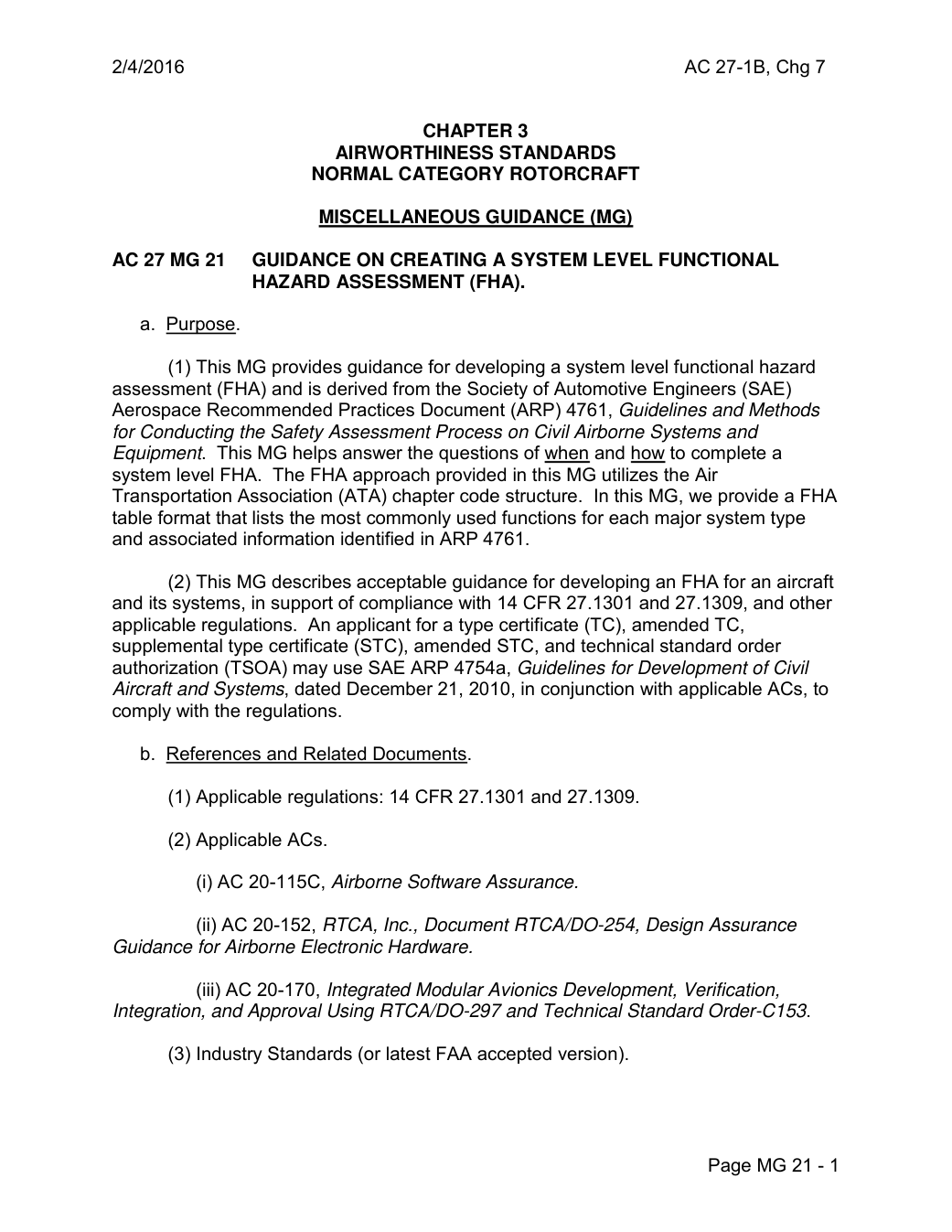
CHAPTER 3 AIRWORTHINESS STANDARDS NORMAL CATEGORY ROTORCRAFT
MISCELLANEOUS GUIDANCE (MG)
AC 27 MG 21 GUIDANCE ON CREATING A SYSTEM LEVEL FUNCTIONAL HAZARD ASSESSMENT (FHA).
a. Purpose.
(1) This MG provides guidance for developing a system level functional hazard assessment (FHA) and is derived from the Society of Automotive Engineers (SAE) Aerospace Recommended Practices Document (ARP) 4761, Guidelines and Methods for Conducting the Safety Assessment Process on Civil Airborne Systems and Equipment. This MG helps answer the questions of when and how to complete a system level FHA. The FHA approach provided in this MG utilizes the Air Transportation Association (ATA) chapter code structure. In this MG, we provide a FHA table format that lists the most commonly used functions for each major system type and associated information identified in ARP 4761.
(2) This MG describes acceptable guidance for developing an FHA for an aircraft and its systems, in support of compliance with 14 CFR 27.1301 and 27.1309, and other applicable regulations. An applicant for a type certificate (TC), amended TC, supplemental type certificate (STC), amended STC, and technical standard order authorization (TSOA) may use SAE ARP 4754a, Guidelines for Development of Civil Aircraft and Systems, dated December 21, 2010, in conjunction with applicable ACs, to comply with the regulations.
b. References and Related Documents.
(1) Applicable regulations: 14 CFR 27.1301 and 27.1309.
(2) Applicable ACs.
(i) AC 20-115C, Airborne Software Assurance.
(ii) AC 20-152, RTCA, Inc., Document RTCA/DO-254, Design Assurance Guidance for Airborne Electronic Hardware.
(iii) AC 20-170, Integrated Modular Avionics Development, Verification, Integration, and Approval Using RTCA/DO-297 and Technical Standard Order-C153.
(3) Industry Standards (or latest FAA accepted version).
View figures, tables and original page layout
Connected references
Source-backed citations and subject-based engineering context are labelled separately. These links do not establish equivalence or project acceptance.
Related technical context
Engineering contextEvidence and scope
AC 27-1B and AC 29-2C — published scope
Aerospace Consulting navigation suggestion based on the subject and stated scope of the two publications.
This connection does not establish regulatory equivalence, acceptance of a newer edition, or applicability of a project-specific precedent to another programme.
Supporting sourceRelated technical context
Engineering contextEvidence and scope
CS-27 and AC 27-1B — published scope
Aerospace Consulting navigation suggestion based on the subject and stated scope of the two publications.
This connection does not establish regulatory equivalence, acceptance of a newer edition, or applicability of a project-specific precedent to another programme.
Supporting source