
AC 27-1B
Certification of Normal Category Rotorcraft — Changes 1–9
27-1B · Changes 1–9 incorporated Source checked 2026-11-28
Scope, source and reading notes
This source includes guidance for different amendments of Part 27. Match the guidance to the aircraft’s agreed certification basis: the 27.1309 entries for Amendments 27-21, 27-46 and 27-51 are separate. The base AC was issued on 30 September 1999; Change 9 is dated 23 June 2023. The FAA catalogue’s 30 September 2008 date is not the date of the latest change.
Aerospace Consulting reference note: Complete normal-category rotorcraft guidance, including system safety, equipment, flight guidance and IFR certification.
The complete selected publication is available in reading text and as the original PDF. Reading text is extracted from the official PDF; page layout is simplified, and figures and tables should be checked in the original page view.
Search covers extracted text. Words contained only in graphics may not be searchable. The original publication is available below.
Official source recordOriginal PDF on this siteSource: FAA. Reproduced with source acknowledgment; source edition and status are shown above. SHA-256: 2dfac16a3644dc18997069cca78746c10726e4b70d3aba996fc87843ffe68a2b
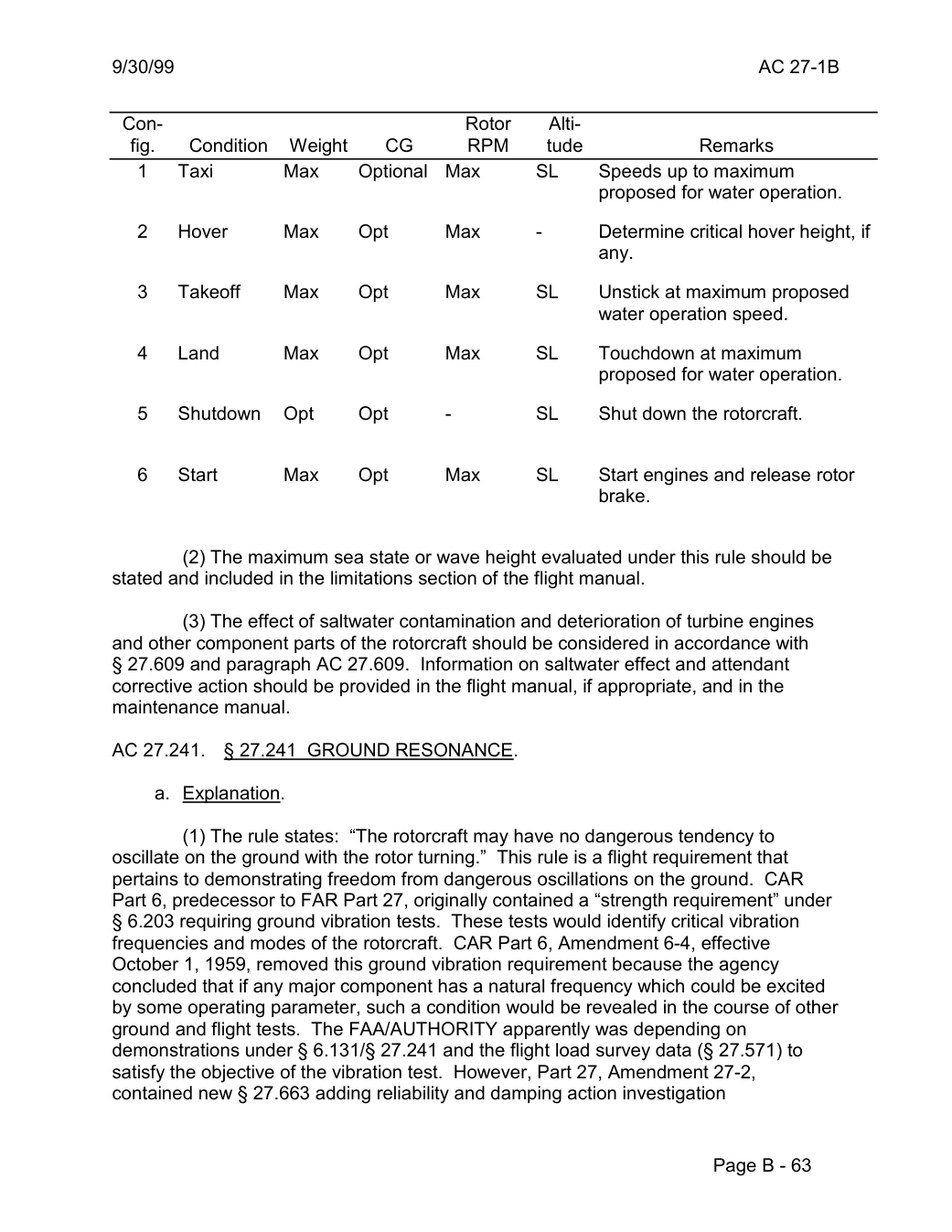
Con-
Rotor
fig.
1
Condition Taxi
Weight Max
CG Optional
RPM Max
Alti- tude SL
Remarks Speeds up to maximum proposed for water operation.
2 Hover Max Opt Max - Determine critical hover height, if any.
3 Takeoff Max Opt Max SL Unstick at maximum proposed water operation speed.
4 Land Max Opt Max SL Touchdown at maximum proposed for water operation.
5 Shutdown Opt Opt - SL Shut down the rotorcraft.
6 Start Max Opt Max SL Start engines and release rotor brake.
(2) The maximum sea state or wave height evaluated under this rule should be stated and included in the limitations section of the flight manual.
(3) The effect of saltwater contamination and deterioration of turbine engines and other component parts of the rotorcraft should be considered in accordance with § 27.609 and paragraph AC 27.609. Information on saltwater effect and attendant corrective action should be provided in the flight manual, if appropriate, and in the maintenance manual.
AC 27.241. § 27.241 GROUND RESONANCE.
a. Explanation.
(1) The rule states: “The rotorcraft may have no dangerous tendency to oscillate on the ground with the rotor turning.” This rule is a flight requirement that pertains to demonstrating freedom from dangerous oscillations on the ground. CAR Part 6, predecessor to FAR Part 27, originally contained a “strength requirement” under § 6.203 requiring ground vibration tests. These tests would identify critical vibration frequencies and modes of the rotorcraft. CAR Part 6, Amendment 6-4, effective October 1, 1959, removed this ground vibration requirement because the agency concluded that if any major component has a natural frequency which could be excited by some operating parameter, such a condition would be revealed in the course of other ground and flight tests. The FAA/AUTHORITY apparently was depending on demonstrations under § 6.131/§ 27.241 and the flight load survey data (§ 27.571) to satisfy the objective of the vibration test. However, Part 27, Amendment 27-2, contained new § 27.663 adding reliability and damping action investigation
View figures, tables and original page layout
Connected references
Source-backed citations and subject-based engineering context are labelled separately. These links do not establish equivalence or project acceptance.
Related technical context
Engineering contextEvidence and scope
AC 27-1B and AC 29-2C — published scope
Aerospace Consulting navigation suggestion based on the subject and stated scope of the two publications.
This connection does not establish regulatory equivalence, acceptance of a newer edition, or applicability of a project-specific precedent to another programme.
Supporting sourceRelated technical context
Engineering contextEvidence and scope
CS-27 and AC 27-1B — published scope
Aerospace Consulting navigation suggestion based on the subject and stated scope of the two publications.
This connection does not establish regulatory equivalence, acceptance of a newer edition, or applicability of a project-specific precedent to another programme.
Supporting source