
AC 27-1B
Certification of Normal Category Rotorcraft — Changes 1–9
27-1B · Changes 1–9 incorporated Source checked 2026-11-28
Scope, source and reading notes
This source includes guidance for different amendments of Part 27. Match the guidance to the aircraft’s agreed certification basis: the 27.1309 entries for Amendments 27-21, 27-46 and 27-51 are separate. The base AC was issued on 30 September 1999; Change 9 is dated 23 June 2023. The FAA catalogue’s 30 September 2008 date is not the date of the latest change.
Aerospace Consulting reference note: Complete normal-category rotorcraft guidance, including system safety, equipment, flight guidance and IFR certification.
The complete selected publication is available in reading text and as the original PDF. Reading text is extracted from the official PDF; page layout is simplified, and figures and tables should be checked in the original page view.
Search covers extracted text. Words contained only in graphics may not be searchable. The original publication is available below.
Official source recordOriginal PDF on this siteSource: FAA. Reproduced with source acknowledgment; source edition and status are shown above. SHA-256: 2dfac16a3644dc18997069cca78746c10726e4b70d3aba996fc87843ffe68a2b
means of deriving the rotorcraft kinetic energy that shall be absorbed by the guard. This method is noted here for convenience.
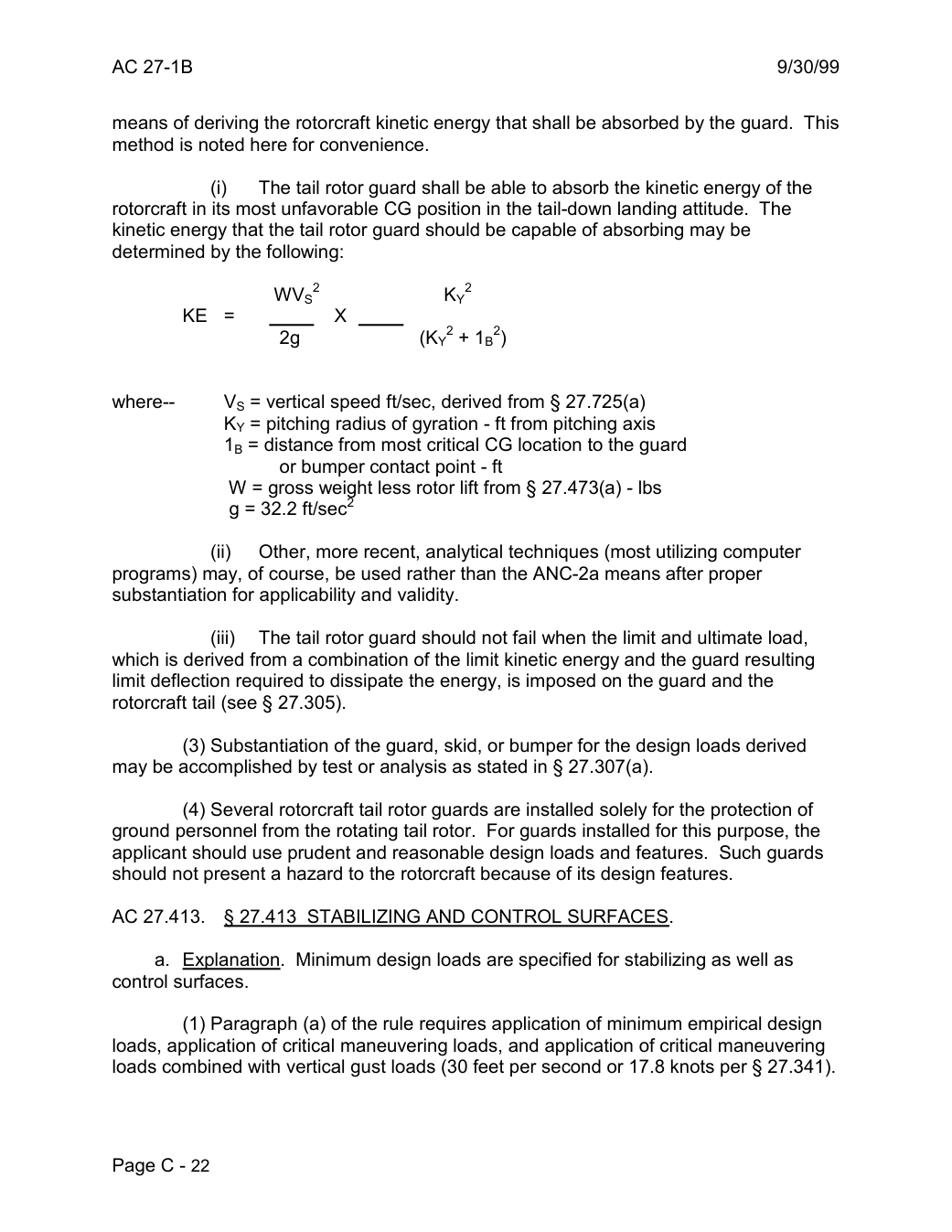
(i) The tail rotor guard shall be able to absorb the kinetic energy of the rotorcraft in its most unfavorable CG position in the tail-down landing attitude. The kinetic energy that the tail rotor guard should be capable of absorbing may be determined by the following:
2
WVS
2 KY
2)
KE = X 2g (KY
2 + 1B
where-- VS = vertical speed ft/sec, derived from § 27.725(a) KY = pitching radius of gyration - ft from pitching axis 1B = distance from most critical CG location to the guard
or bumper contact point - ft W = gross weight less rotor lift from § 27.473(a) - lbs g = 32.2 ft/sec2
(ii) Other, more recent, analytical techniques (most utilizing computer programs) may, of course, be used rather than the ANC-2a means after proper substantiation for applicability and validity.
(iii) The tail rotor guard should not fail when the limit and ultimate load, which is derived from a combination of the limit kinetic energy and the guard resulting limit deflection required to dissipate the energy, is imposed on the guard and the rotorcraft tail (see § 27.305).
(3) Substantiation of the guard, skid, or bumper for the design loads derived may be accomplished by test or analysis as stated in § 27.307(a).
(4) Several rotorcraft tail rotor guards are installed solely for the protection of ground personnel from the rotating tail rotor. For guards installed for this purpose, the applicant should use prudent and reasonable design loads and features. Such guards should not present a hazard to the rotorcraft because of its design features.
AC 27.413. § 27.413 STABILIZING AND CONTROL SURFACES.
a. Explanation. Minimum design loads are specified for stabilizing as well as control surfaces.
(1) Paragraph (a) of the rule requires application of minimum empirical design loads, application of critical maneuvering loads, and application of critical maneuvering loads combined with vertical gust loads (30 feet per second or 17.8 knots per § 27.341).
View figures, tables and original page layout
Connected references
Source-backed citations and subject-based engineering context are labelled separately. These links do not establish equivalence or project acceptance.
Related technical context
Engineering contextEvidence and scope
AC 27-1B and AC 29-2C — published scope
Aerospace Consulting navigation suggestion based on the subject and stated scope of the two publications.
This connection does not establish regulatory equivalence, acceptance of a newer edition, or applicability of a project-specific precedent to another programme.
Supporting sourceRelated technical context
Engineering contextEvidence and scope
CS-27 and AC 27-1B — published scope
Aerospace Consulting navigation suggestion based on the subject and stated scope of the two publications.
This connection does not establish regulatory equivalence, acceptance of a newer edition, or applicability of a project-specific precedent to another programme.
Supporting source