
AC 27-1B
Certification of Normal Category Rotorcraft — Changes 1–9
27-1B · Changes 1–9 incorporated Source checked 2026-11-28
Scope, source and reading notes
This source includes guidance for different amendments of Part 27. Match the guidance to the aircraft’s agreed certification basis: the 27.1309 entries for Amendments 27-21, 27-46 and 27-51 are separate. The base AC was issued on 30 September 1999; Change 9 is dated 23 June 2023. The FAA catalogue’s 30 September 2008 date is not the date of the latest change.
Aerospace Consulting reference note: Complete normal-category rotorcraft guidance, including system safety, equipment, flight guidance and IFR certification.
The complete selected publication is available in reading text and as the original PDF. Reading text is extracted from the official PDF; page layout is simplified, and figures and tables should be checked in the original page view.
Search covers extracted text. Words contained only in graphics may not be searchable. The original publication is available below.
Official source recordOriginal PDF on this siteSource: FAA. Reproduced with source acknowledgment; source edition and status are shown above. SHA-256: 2dfac16a3644dc18997069cca78746c10726e4b70d3aba996fc87843ffe68a2b
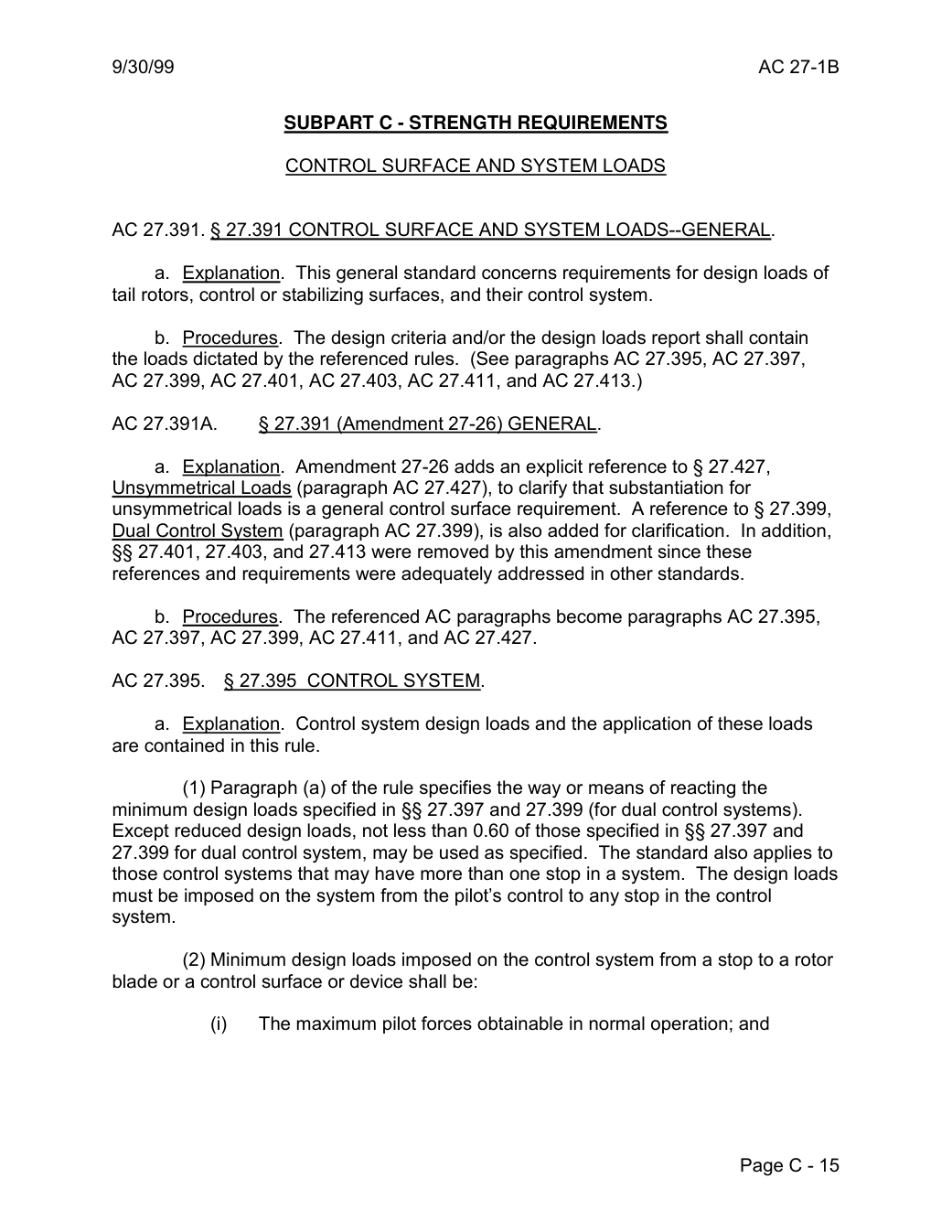
SUBPART C - STRENGTH REQUIREMENTS
CONTROL SURFACE AND SYSTEM LOADS
AC 27.391. § 27.391 CONTROL SURFACE AND SYSTEM LOADS--GENERAL.
a. Explanation. This general standard concerns requirements for design loads of tail rotors, control or stabilizing surfaces, and their control system.
b. Procedures. The design criteria and/or the design loads report shall contain the loads dictated by the referenced rules. (See paragraphs AC 27.395, AC 27.397, AC 27.399, AC 27.401, AC 27.403, AC 27.411, and AC 27.413.)
AC 27.391A. § 27.391 (Amendment 27-26) GENERAL.
a. Explanation. Amendment 27-26 adds an explicit reference to § 27.427, Unsymmetrical Loads (paragraph AC 27.427), to clarify that substantiation for unsymmetrical loads is a general control surface requirement. A reference to § 27.399, Dual Control System (paragraph AC 27.399), is also added for clarification. In addition, §§ 27.401, 27.403, and 27.413 were removed by this amendment since these references and requirements were adequately addressed in other standards.
b. Procedures. The referenced AC paragraphs become paragraphs AC 27.395, AC 27.397, AC 27.399, AC 27.411, and AC 27.427.
AC 27.395. § 27.395 CONTROL SYSTEM.
a. Explanation. Control system design loads and the application of these loads are contained in this rule.
(1) Paragraph (a) of the rule specifies the way or means of reacting the minimum design loads specified in §§ 27.397 and 27.399 (for dual control systems). Except reduced design loads, not less than 0.60 of those specified in §§ 27.397 and 27.399 for dual control system, may be used as specified. The standard also applies to those control systems that may have more than one stop in a system. The design loads must be imposed on the system from the pilot’s control to any stop in the control system.
(2) Minimum design loads imposed on the control system from a stop to a rotor blade or a control surface or device shall be:
(i) The maximum pilot forces obtainable in normal operation; and
View figures, tables and original page layout
Connected references
Source-backed citations and subject-based engineering context are labelled separately. These links do not establish equivalence or project acceptance.
Related technical context
Engineering contextEvidence and scope
AC 27-1B and AC 29-2C — published scope
Aerospace Consulting navigation suggestion based on the subject and stated scope of the two publications.
This connection does not establish regulatory equivalence, acceptance of a newer edition, or applicability of a project-specific precedent to another programme.
Supporting sourceRelated technical context
Engineering contextEvidence and scope
CS-27 and AC 27-1B — published scope
Aerospace Consulting navigation suggestion based on the subject and stated scope of the two publications.
This connection does not establish regulatory equivalence, acceptance of a newer edition, or applicability of a project-specific precedent to another programme.
Supporting source