
AC 27-1B
Certification of Normal Category Rotorcraft — Changes 1–9
27-1B · Changes 1–9 incorporated Source checked 2026-11-28
Scope, source and reading notes
This source includes guidance for different amendments of Part 27. Match the guidance to the aircraft’s agreed certification basis: the 27.1309 entries for Amendments 27-21, 27-46 and 27-51 are separate. The base AC was issued on 30 September 1999; Change 9 is dated 23 June 2023. The FAA catalogue’s 30 September 2008 date is not the date of the latest change.
Aerospace Consulting reference note: Complete normal-category rotorcraft guidance, including system safety, equipment, flight guidance and IFR certification.
The complete selected publication is available in reading text and as the original PDF. Reading text is extracted from the official PDF; page layout is simplified, and figures and tables should be checked in the original page view.
Search covers extracted text. Words contained only in graphics may not be searchable. The original publication is available below.
Official source recordOriginal PDF on this siteSource: FAA. Reproduced with source acknowledgment; source edition and status are shown above. SHA-256: 2dfac16a3644dc18997069cca78746c10726e4b70d3aba996fc87843ffe68a2b
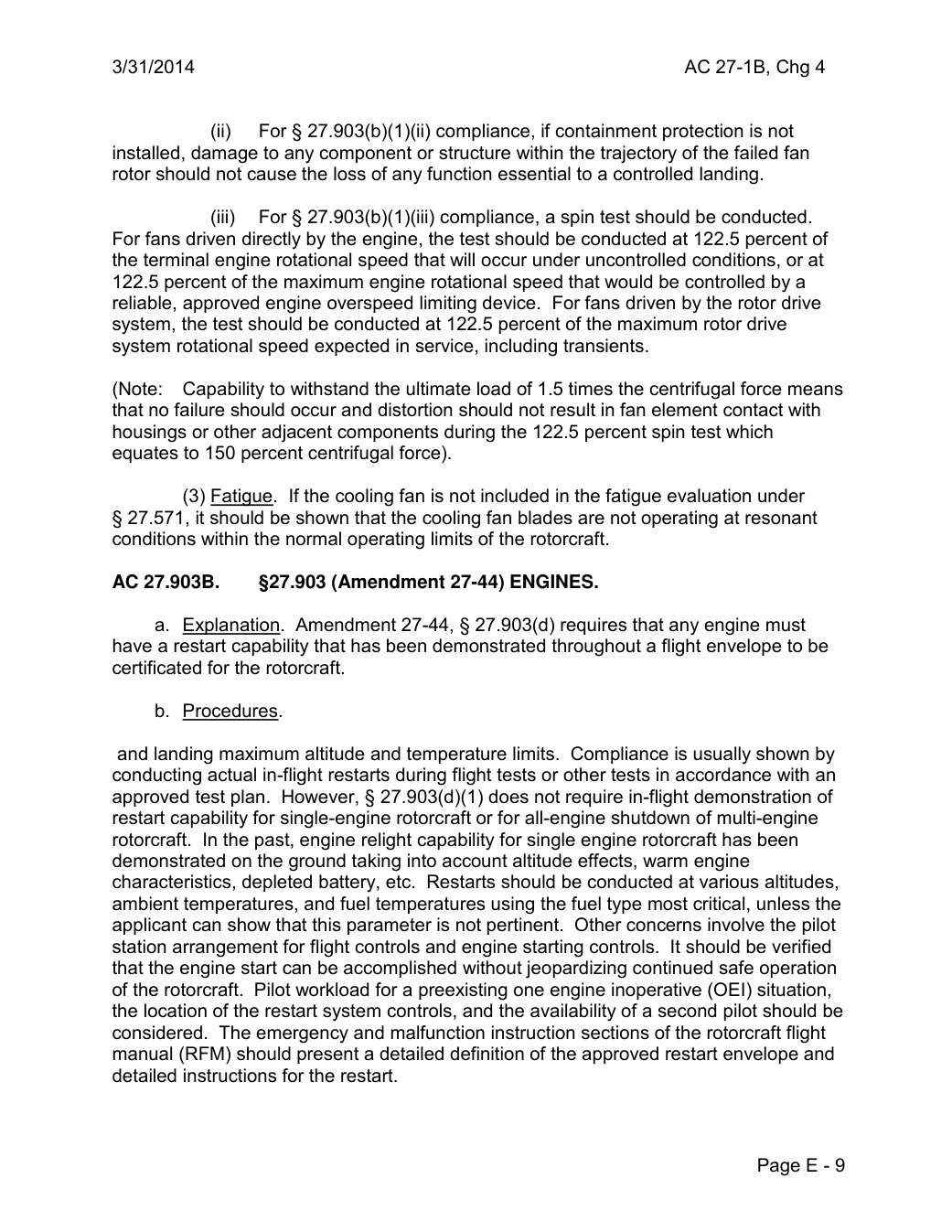
(ii) For § 27.903(b)(1)(ii) compliance, if containment protection is not installed, damage to any component or structure within the trajectory of the failed fan rotor should not cause the loss of any function essential to a controlled landing.
(iii) For § 27.903(b)(1)(iii) compliance, a spin test should be conducted. For fans driven directly by the engine, the test should be conducted at 122.5 percent of the terminal engine rotational speed that will occur under uncontrolled conditions, or at 122.5 percent of the maximum engine rotational speed that would be controlled by a reliable, approved engine overspeed limiting device. For fans driven by the rotor drive system, the test should be conducted at 122.5 percent of the maximum rotor drive system rotational speed expected in service, including transients.
(Note: Capability to withstand the ultimate load of 1.5 times the centrifugal force means that no failure should occur and distortion should not result in fan element contact with housings or other adjacent components during the 122.5 percent spin test which equates to 150 percent centrifugal force).
(3) Fatigue. If the cooling fan is not included in the fatigue evaluation under § 27.571, it should be shown that the cooling fan blades are not operating at resonant conditions within the normal operating limits of the rotorcraft.
AC 27.903B. §27.903 (Amendment 27-44) ENGINES.
a. Explanation. Amendment 27-44, § 27.903(d) requires that any engine must have a restart capability that has been demonstrated throughout a flight envelope to be certificated for the rotorcraft.
b. Procedures.
and landing maximum altitude and temperature limits. Compliance is usually shown by conducting actual in-flight restarts during flight tests or other tests in accordance with an approved test plan. However, § 27.903(d)(1) does not require in-flight demonstration of restart capability for single-engine rotorcraft or for all-engine shutdown of multi-engine rotorcraft. In the past, engine relight capability for single engine rotorcraft has been demonstrated on the ground taking into account altitude effects, warm engine characteristics, depleted battery, etc. Restarts should be conducted at various altitudes, ambient temperatures, and fuel temperatures using the fuel type most critical, unless the applicant can show that this parameter is not pertinent. Other concerns involve the pilot station arrangement for flight controls and engine starting controls. It should be verified that the engine start can be accomplished without jeopardizing continued safe operation of the rotorcraft. Pilot workload for a preexisting one engine inoperative (OEI) situation, the location of the restart system controls, and the availability of a second pilot should be considered. The emergency and malfunction instruction sections of the rotorcraft flight manual (RFM) should present a detailed definition of the approved restart envelope and detailed instructions for the restart.
View figures, tables and original page layout
Connected references
Source-backed citations and subject-based engineering context are labelled separately. These links do not establish equivalence or project acceptance.
Related technical context
Engineering contextEvidence and scope
AC 27-1B and AC 29-2C — published scope
Aerospace Consulting navigation suggestion based on the subject and stated scope of the two publications.
This connection does not establish regulatory equivalence, acceptance of a newer edition, or applicability of a project-specific precedent to another programme.
Supporting sourceRelated technical context
Engineering contextEvidence and scope
CS-27 and AC 27-1B — published scope
Aerospace Consulting navigation suggestion based on the subject and stated scope of the two publications.
This connection does not establish regulatory equivalence, acceptance of a newer edition, or applicability of a project-specific precedent to another programme.
Supporting source