
AC 27-1B
Certification of Normal Category Rotorcraft — Changes 1–9
27-1B · Changes 1–9 incorporated Source checked 2026-11-28
Scope, source and reading notes
This source includes guidance for different amendments of Part 27. Match the guidance to the aircraft’s agreed certification basis: the 27.1309 entries for Amendments 27-21, 27-46 and 27-51 are separate. The base AC was issued on 30 September 1999; Change 9 is dated 23 June 2023. The FAA catalogue’s 30 September 2008 date is not the date of the latest change.
Aerospace Consulting reference note: Complete normal-category rotorcraft guidance, including system safety, equipment, flight guidance and IFR certification.
The complete selected publication is available in reading text and as the original PDF. Reading text is extracted from the official PDF; page layout is simplified, and figures and tables should be checked in the original page view.
Search covers extracted text. Words contained only in graphics may not be searchable. The original publication is available below.
Official source recordOriginal PDF on this siteSource: FAA. Reproduced with source acknowledgment; source edition and status are shown above. SHA-256: 2dfac16a3644dc18997069cca78746c10726e4b70d3aba996fc87843ffe68a2b
*Requires acceptance by the cognizant Flight Standards District Office
Note: Some rotorcraft manufacturers have qualified certain locations on the underside of their aircraft for mounting external equipment. The manufacturers will typically specify external equipment weight and dimensional limitations at those locations. The applicant should contact the manufacturer to see if this information is available as it could be used to reduce the applicant's certification effort.
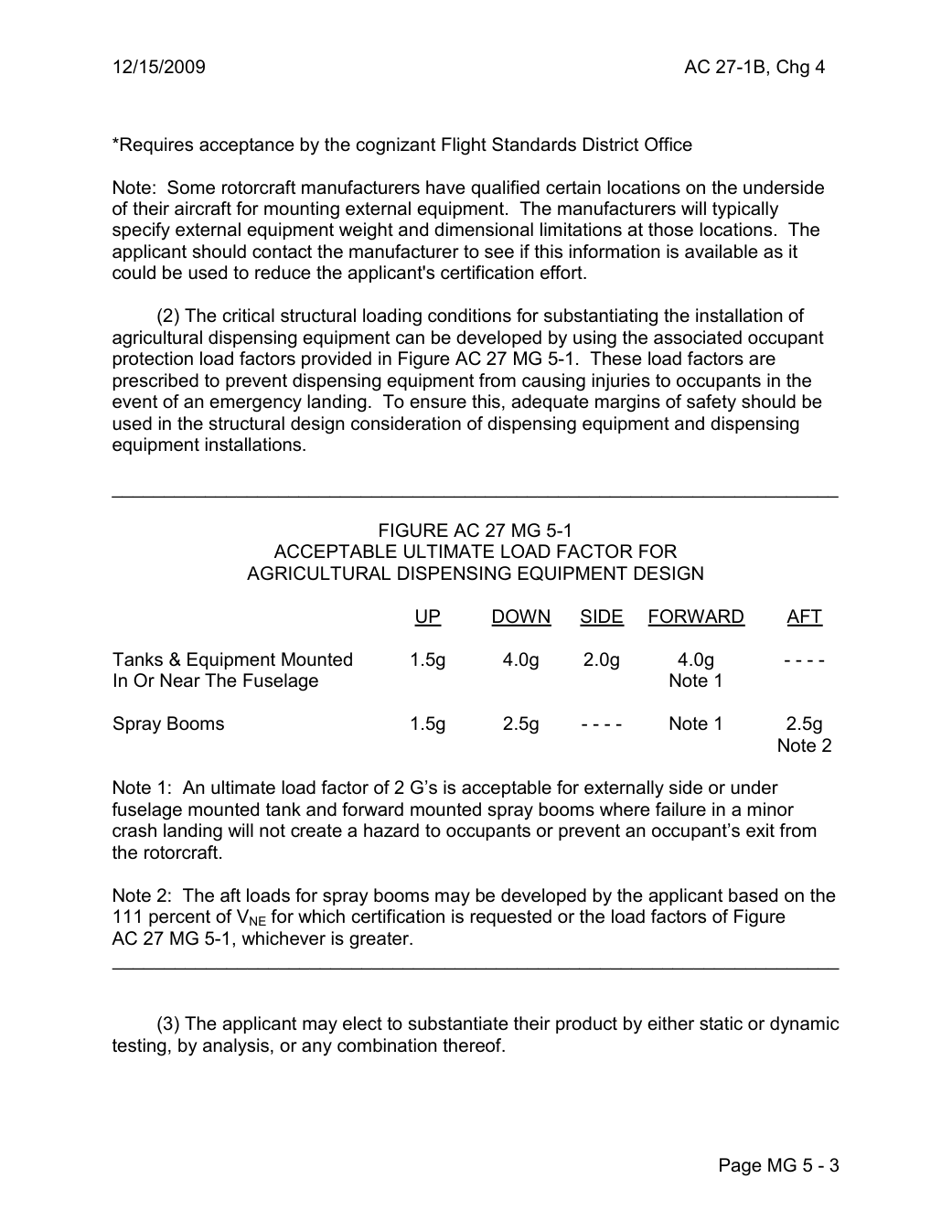
(2) The critical structural loading conditions for substantiating the installation of agricultural dispensing equipment can be developed by using the associated occupant protection load factors provided in Figure AC 27 MG 5-1. These load factors are prescribed to prevent dispensing equipment from causing injuries to occupants in the event of an emergency landing. To ensure this, adequate margins of safety should be used in the structural design consideration of dispensing equipment and dispensing equipment installations.
______________________________________________________________________
FIGURE AC 27 MG 5-1 ACCEPTABLE ULTIMATE LOAD FACTOR FOR AGRICULTURAL DISPENSING EQUIPMENT DESIGN
UP DOWN SIDE FORWARD AFT
- - - -
Tanks & Equipment Mounted In Or Near The Fuselage
1.5g 4.0g 2.0g 4.0g Note 1
Spray Booms 1.5g 2.5g - - - - Note 1 2.5g Note 2
Note 1: An ultimate load factor of 2 G’s is acceptable for externally side or under fuselage mounted tank and forward mounted spray booms where failure in a minor crash landing will not create a hazard to occupants or prevent an occupant’s exit from the rotorcraft.
Note 2: The aft loads for spray booms may be developed by the applicant based on the 111 percent of VNE for which certification is requested or the load factors of Figure AC 27 MG 5-1, whichever is greater.
______________________________________________________________________
(3) The applicant may elect to substantiate their product by either static or dynamic testing, by analysis, or any combination thereof.
View figures, tables and original page layout
Connected references
Source-backed citations and subject-based engineering context are labelled separately. These links do not establish equivalence or project acceptance.
Related technical context
Engineering contextEvidence and scope
AC 27-1B and AC 29-2C — published scope
Aerospace Consulting navigation suggestion based on the subject and stated scope of the two publications.
This connection does not establish regulatory equivalence, acceptance of a newer edition, or applicability of a project-specific precedent to another programme.
Supporting sourceRelated technical context
Engineering contextEvidence and scope
CS-27 and AC 27-1B — published scope
Aerospace Consulting navigation suggestion based on the subject and stated scope of the two publications.
This connection does not establish regulatory equivalence, acceptance of a newer edition, or applicability of a project-specific precedent to another programme.
Supporting source