
AC 27-1B
Certification of Normal Category Rotorcraft — Changes 1–9
27-1B · Changes 1–9 incorporated Source checked 2026-11-28
Scope, source and reading notes
This source includes guidance for different amendments of Part 27. Match the guidance to the aircraft’s agreed certification basis: the 27.1309 entries for Amendments 27-21, 27-46 and 27-51 are separate. The base AC was issued on 30 September 1999; Change 9 is dated 23 June 2023. The FAA catalogue’s 30 September 2008 date is not the date of the latest change.
Aerospace Consulting reference note: Complete normal-category rotorcraft guidance, including system safety, equipment, flight guidance and IFR certification.
The complete selected publication is available in reading text and as the original PDF. Reading text is extracted from the official PDF; page layout is simplified, and figures and tables should be checked in the original page view.
Search covers extracted text. Words contained only in graphics may not be searchable. The original publication is available below.
Official source recordOriginal PDF on this siteSource: FAA. Reproduced with source acknowledgment; source edition and status are shown above. SHA-256: 2dfac16a3644dc18997069cca78746c10726e4b70d3aba996fc87843ffe68a2b
(7) Aided flight. A flight in which the flight crew references NVG imagery to assist visual flight.
(8) Unaided flight. A flight in which the flight crew does not reference NVG imagery.
(9) Transparencies. Windshields, windows, chin bubbles, and overhead windows through which the crew views the outside scene with NVGs.
(10) Inadvertent instrument meteorological conditions (IMC). An unplanned encounter with visual conditions that do not permit continued flight under VFR where conditions do not allow for the visual determination of a usable horizon (e.g., fog, snow showers, or night operations over unlit surfaces such as water). Some examples where inadvertent IMC may occur are flight into areas with no lights or other features that allow for visual contact with the ground or horizon; actual IMC-like entering clouds; brownout or white out during approaches or takeoffs from dusty or snow covered unimproved landing zones; or whiteout because of blowing and falling snow.
(11) Unimproved landing area. Any site that is not an airport, heliport, or other civil aviation authority approved landing site.
d. References (use the current versions of the following references).
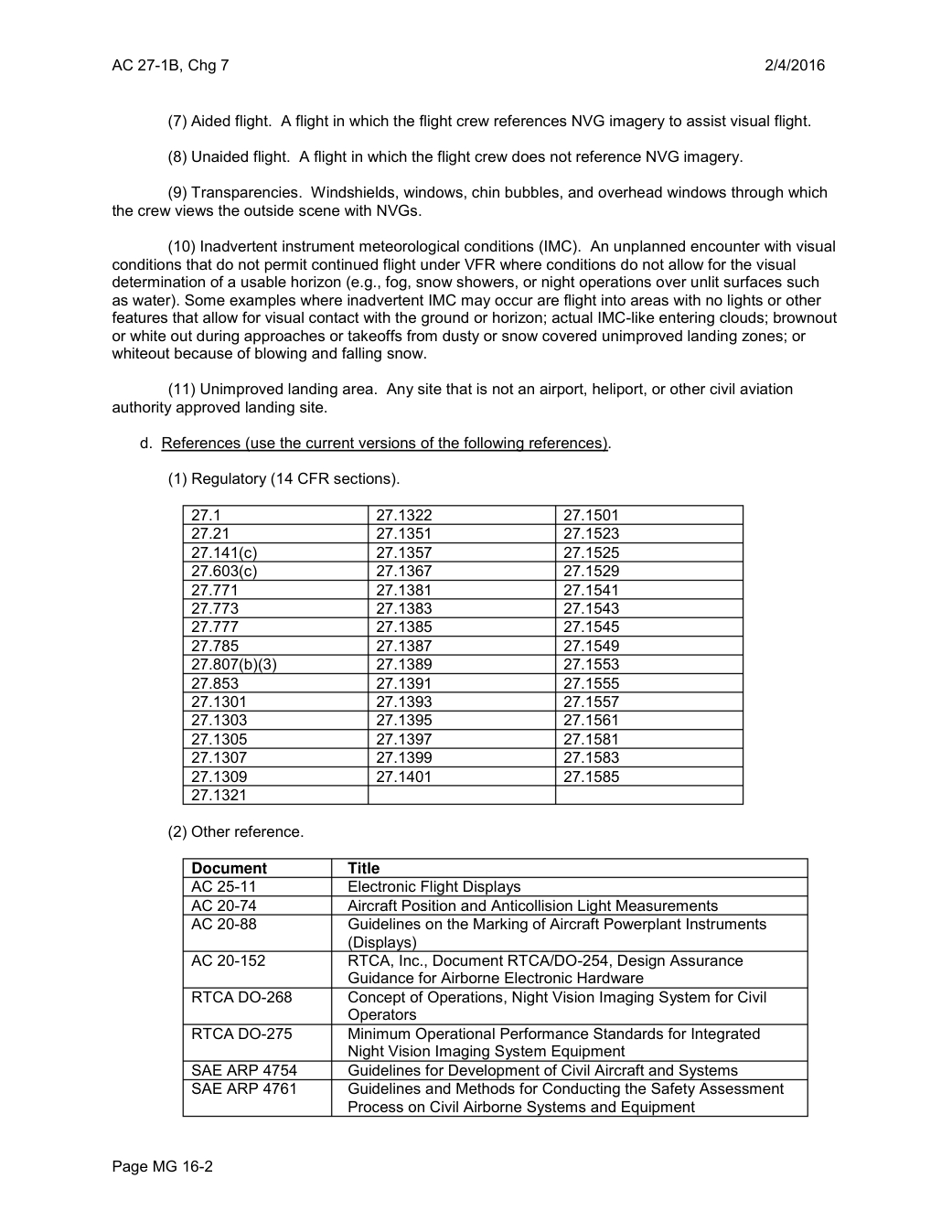
(1) Regulatory (14 CFR sections).
27.1 27.1322 27.1501 27.21 27.1351 27.1523 27.141(c) 27.603(c) 27.771
27.1357 27.1367 27.1381
27.1525 27.1529 27.1541 27.773 27.1383 27.1543 27.777 27.1385 27.1545 27.785 27.1387 27.1549 27.807(b)(3) 27.853
27.1389 27.1391
27.1553 27.1555 27.1301 27.1393 27.1557 27.1303 27.1395 27.1561 27.1305 27.1397 27.1581 27.1307 27.1399 27.1583 27.1309 27.1401 27.1585 27.1321
(2) Other reference.
Document Title AC 25-11 Electronic Flight Displays AC 20-74 Aircraft Position and Anticollision Light Measurements AC 20-88 Guidelines on the Marking of Aircraft Powerplant Instruments (Displays) AC 20-152 RTCA, Inc., Document RTCA/DO-254, Design Assurance Guidance for Airborne Electronic Hardware RTCA DO-268 Concept of Operations, Night Vision Imaging System for Civil Operators RTCA DO-275 Minimum Operational Performance Standards for Integrated
Night Vision Imaging System Equipment SAE ARP 4754 Guidelines for Development of Civil Aircraft and Systems SAE ARP 4761 Guidelines and Methods for Conducting the Safety Assessment Process on Civil Airborne Systems and Equipment
View figures, tables and original page layout
Connected references
Source-backed citations and subject-based engineering context are labelled separately. These links do not establish equivalence or project acceptance.
Related technical context
Engineering contextEvidence and scope
AC 27-1B and AC 29-2C — published scope
Aerospace Consulting navigation suggestion based on the subject and stated scope of the two publications.
This connection does not establish regulatory equivalence, acceptance of a newer edition, or applicability of a project-specific precedent to another programme.
Supporting sourceRelated technical context
Engineering contextEvidence and scope
CS-27 and AC 27-1B — published scope
Aerospace Consulting navigation suggestion based on the subject and stated scope of the two publications.
This connection does not establish regulatory equivalence, acceptance of a newer edition, or applicability of a project-specific precedent to another programme.
Supporting source