
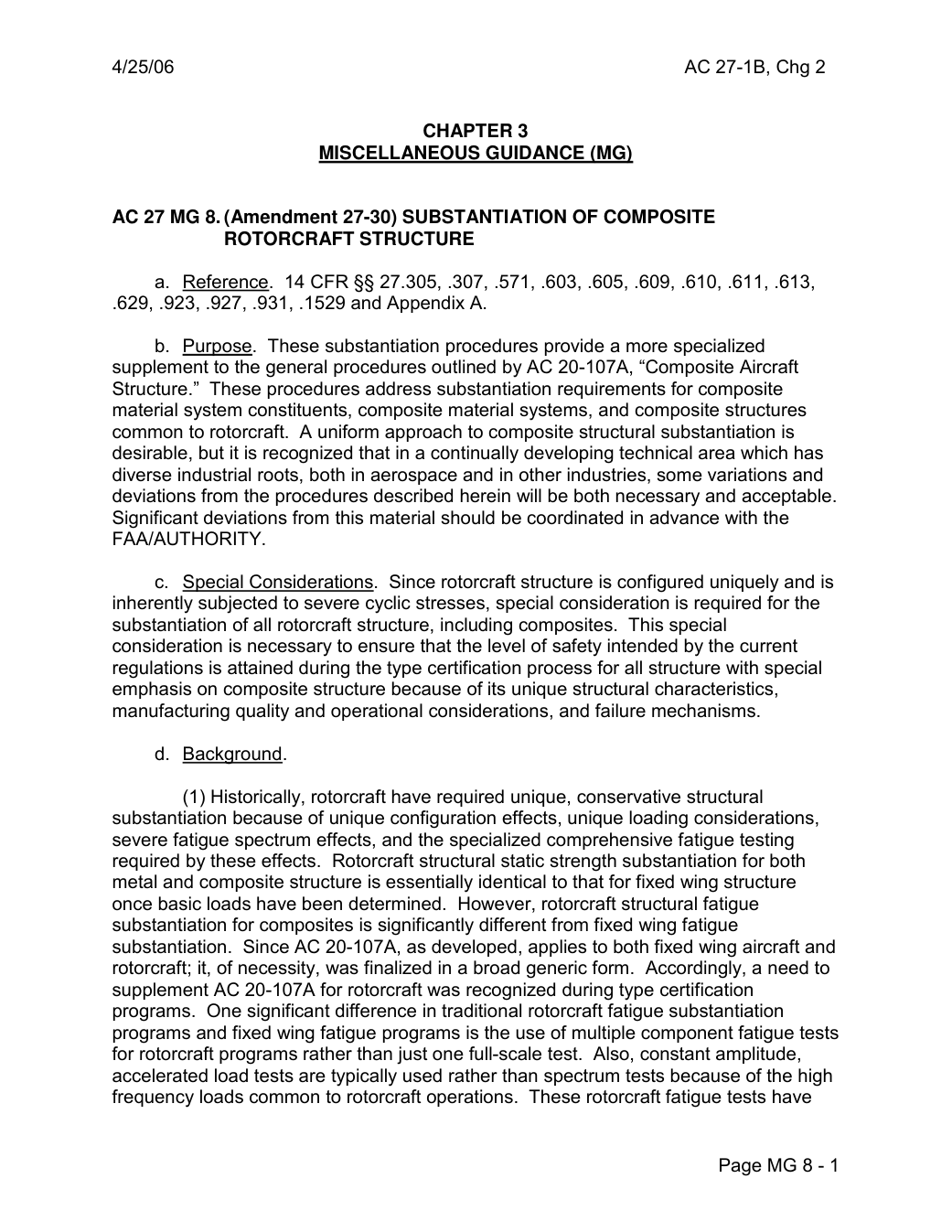
Original FAA page, including its printed amendment and change markings. Extracted words support search; text reflow has not been reviewed.
AC 27-1B · 857Open saved PDF here ↗
Extracted text for finding words
This extraction supports search. Read the original page for complete notation and layout.
4/25/06                                       AC 27-1B, Chg 2


                        CHAPTER 3
                 MISCELLANEOUS GUIDANCE (MG)

AC 27 MG 8. (Amendment 27-30) SUBSTANTIATION OF COMPOSITE
         ROTORCRAFT STRUCTURE

     a. Reference. 14 CFR §§ 27.305, .307, .571, .603, .605, .609, .610, .611, .613,
.629, .923, .927, .931, .1529 and Appendix A.

     b. Purpose. These substantiation procedures provide a more specialized
supplement to the general procedures outlined by AC 20-107A, “Composite Aircraft
Structure.” These procedures address substantiation requirements for composite
material system constituents, composite material systems, and composite structures
common to rotorcraft. A uniform approach to composite structural substantiation is
desirable, but it is recognized that in a continually developing technical area which has
diverse industrial roots, both in aerospace and in other industries, some variations and
deviations from the procedures described herein will be both necessary and acceptable.
Significant deviations from this material should be coordinated in advance with the
FAA/AUTHORITY.

      c.  Special Considerations. Since rotorcraft structure is configured uniquely and is
inherently subjected to severe cyclic stresses, special consideration is required for the
substantiation of all rotorcraft structure, including composites. This special
consideration is necessary to ensure that the level of safety intended by the current
regulations is attained during the type certification process for all structure with special
emphasis on composite structure because of its unique structural characteristics,
manufacturing quality and operational considerations, and failure mechanisms.

     d. Background.

         (1) Historically, rotorcraft have required unique, conservative structural
substantiation because of unique configuration effects, unique loading considerations,
severe fatigue spectrum effects, and the specialized comprehensive fatigue testing
required by these effects. Rotorcraft structural static strength substantiation for both
metal and composite structure is essentially identical to that for fixed wing structure
once basic loads have been determined. However, rotorcraft structural fatigue
substantiation for composites is significantly different from fixed wing fatigue
substantiation. Since AC 20-107A, as developed, applies to both fixed wing aircraft and
rotorcraft; it, of necessity, was finalized in a broad generic form. Accordingly, a need to
supplement AC 20-107A for rotorcraft was recognized during type certification
programs. One significant difference in traditional rotorcraft fatigue substantiation
programs and fixed wing fatigue programs is the use of multiple component fatigue tests
for rotorcraft programs rather than just one full-scale test. Also, constant amplitude,
accelerated load tests are typically used rather than spectrum tests because of the high
frequency loads common to rotorcraft operations. These rotorcraft fatigue tests have


                                                        Page MG 8 - 1