
Original FAA page, including its printed amendment and change markings. Extracted words support search; text reflow has not been reviewed.
AC 27-1B · 851Open saved PDF here ↗
Extracted text for finding words
This extraction supports search. Read the original page for complete notation and layout.
2/27/2014                                      AC 27-1B, Chg 4


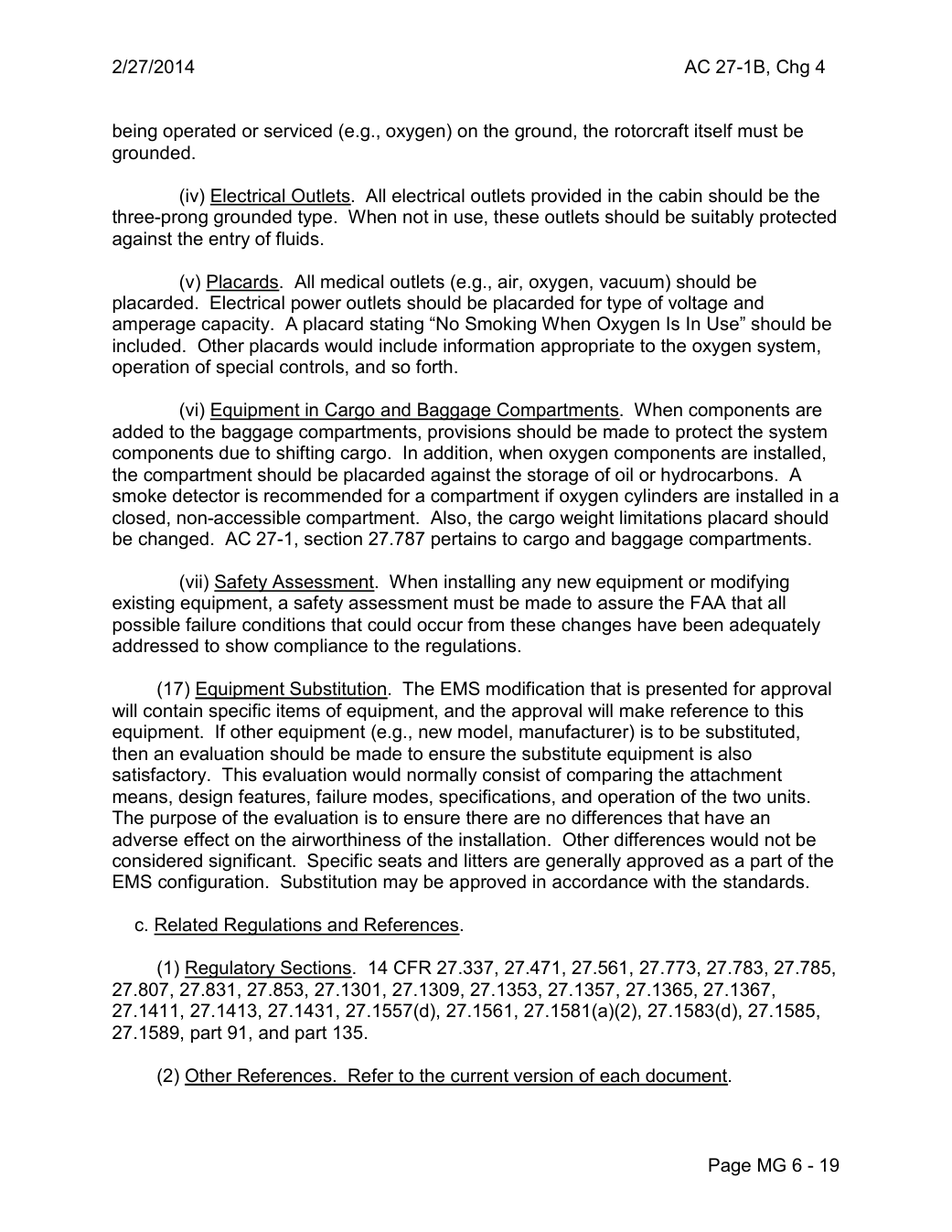
being operated or serviced (e.g., oxygen) on the ground, the rotorcraft itself must be
grounded.

          (iv) Electrical Outlets. All electrical outlets provided in the cabin should be the
three-prong grounded type. When not in use, these outlets should be suitably protected
against the entry of fluids.

         (v) Placards.  All medical outlets (e.g., air, oxygen, vacuum) should be
placarded. Electrical power outlets should be placarded for type of voltage and
amperage capacity. A placard stating “No Smoking When Oxygen Is In Use” should be
included. Other placards would include information appropriate to the oxygen system,
operation of special controls, and so forth.

          (vi) Equipment in Cargo and Baggage Compartments. When components are
added to the baggage compartments, provisions should be made to protect the system
components due to shifting cargo. In addition, when oxygen components are installed,
the compartment should be placarded against the storage of oil or hydrocarbons. A
smoke detector is recommended for a compartment if oxygen cylinders are installed in a
closed, non-accessible compartment. Also, the cargo weight limitations placard should
be changed. AC 27-1, section 27.787 pertains to cargo and baggage compartments.

           (vii) Safety Assessment. When installing any new equipment or modifying
existing equipment, a safety assessment must be made to assure the FAA that all
possible failure conditions that could occur from these changes have been adequately
addressed to show compliance to the regulations.

     (17) Equipment Substitution. The EMS modification that is presented for approval
will contain specific items of equipment, and the approval will make reference to this
equipment.  If other equipment (e.g., new model, manufacturer) is to be substituted,
then an evaluation should be made to ensure the substitute equipment is also
satisfactory. This evaluation would normally consist of comparing the attachment
means, design features, failure modes, specifications, and operation of the two units.
The purpose of the evaluation is to ensure there are no differences that have an
adverse effect on the airworthiness of the installation. Other differences would not be
considered significant. Specific seats and litters are generally approved as a part of the
EMS configuration. Substitution may be approved in accordance with the standards.

   c. Related Regulations and References.

      (1) Regulatory Sections. 14 CFR 27.337, 27.471, 27.561, 27.773, 27.783, 27.785,
27.807, 27.831, 27.853, 27.1301, 27.1309, 27.1353, 27.1357, 27.1365, 27.1367,
27.1411, 27.1413, 27.1431, 27.1557(d), 27.1561, 27.1581(a)(2), 27.1583(d), 27.1585,
27.1589, part 91, and part 135.

      (2) Other References. Refer to the current version of each document.


                                                       Page MG 6 - 19