Certification of Normal Category Rotorcraft — Changes 1–9
Normal category rotorcraft guidance with Changes 1–9 incorporated. Search the complete AC or start with the system safety, flight controls and instrument-flight guidance.
This source includes guidance for different amendments of Part 27. Match the guidance to the aircraft’s agreed certification basis: the 27.1309 entries for Amendments 27-21, 27-46 and 27-51 are separate. The base AC was issued on 30 September 1999; Change 9 is dated 23 June 2023. The FAA catalogue’s 30 September 2008 date is not the date of the latest change.
The source, within reach.
Search within this AC, jump to a source page, or download the complete saved publication.
This extraction supports search. Read the original page for complete notation and layout.
9/30/99                                             AC 27-1B

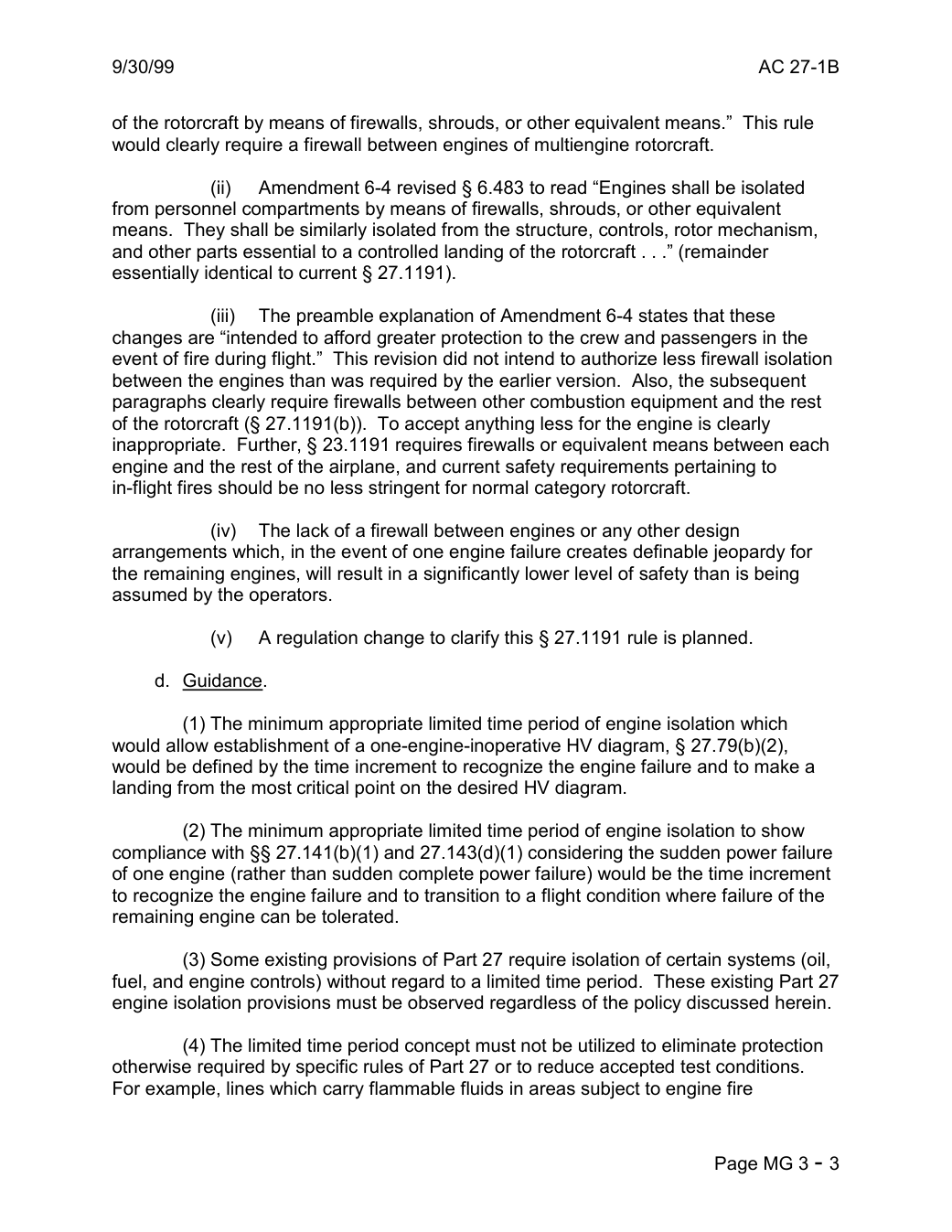
of the rotorcraft by means of firewalls, shrouds, or other equivalent means.” This rule
would clearly require a firewall between engines of multiengine rotorcraft.

                   (ii)  Amendment 6-4 revised § 6.483 to read “Engines shall be isolated
from personnel compartments by means of firewalls, shrouds, or other equivalent
means. They shall be similarly isolated from the structure, controls, rotor mechanism,
and other parts essential to a controlled landing of the rotorcraft . . .” (remainder
essentially identical to current § 27.1191).

                    (iii)  The preamble explanation of Amendment 6-4 states that these
changes are “intended to afford greater protection to the crew and passengers in the
event of fire during flight.” This revision did not intend to authorize less firewall isolation
between the engines than was required by the earlier version. Also, the subsequent
paragraphs clearly require firewalls between other combustion equipment and the rest
of the rotorcraft (§ 27.1191(b)). To accept anything less for the engine is clearly
inappropriate. Further, § 23.1191 requires firewalls or equivalent means between each
engine and the rest of the airplane, and current safety requirements pertaining to
in-flight fires should be no less stringent for normal category rotorcraft.

               (iv)  The lack of a firewall between engines or any other design
arrangements which, in the event of one engine failure creates definable jeopardy for
the remaining engines, will result in a significantly lower level of safety than is being
assumed by the operators.

              (v)  A regulation change to clarify this § 27.1191 rule is planned.

     d. Guidance.

         (1) The minimum appropriate limited time period of engine isolation which
would allow establishment of a one-engine-inoperative HV diagram, § 27.79(b)(2),
would be defined by the time increment to recognize the engine failure and to make a
landing from the most critical point on the desired HV diagram.

         (2) The minimum appropriate limited time period of engine isolation to show
compliance with §§ 27.141(b)(1) and 27.143(d)(1) considering the sudden power failure
of one engine (rather than sudden complete power failure) would be the time increment
to recognize the engine failure and to transition to a flight condition where failure of the
remaining engine can be tolerated.

         (3) Some existing provisions of Part 27 require isolation of certain systems (oil,
fuel, and engine controls) without regard to a limited time period. These existing Part 27
engine isolation provisions must be observed regardless of the policy discussed herein.

         (4) The limited time period concept must not be utilized to eliminate protection
otherwise required by specific rules of Part 27 or to reduce accepted test conditions.
For example, lines which carry flammable fluids in areas subject to engine fire

                                                       Page MG 3 - 3
Saved from the FAA on November 17, 2026. All original pages are retained. Engineering explanations are presented separately below.
Aerospace Consulting / Engineering perspective
Start with the certification basis and the function.
Identify the applicable amendment before selecting the safety guidance. Connect intended functions and operating conditions to failure conditions, architecture decisions, common-cause considerations, verification and limitations. For flight controls and IFR work, carry the relevant 27.672, 27.1329 and Appendix B assumptions into the system safety and compliance evidence.
1196 original pages. 0 pages have reviewed text reflows. Original-first pages retain the source layout, with extracted text available for finding words.
A focused review, an agreed assessment package or ongoing support alongside your team. We can agree the relevant inputs and scope in the initial conversation.
This opens your email application.
Start a conversation
Tell us about your programme, the system you are developing and the support you need.
We can agree a focused use-case review, a defined evidence package or ongoing programme support.
This opens your email application.
Specialist aerospace expertise
Aerospace Consulting is led by Hussein Khimji, an FAA Designated Engineering Representative in systems and equipment, with a focus on system safety, flight controls and avionics.
We work with aircraft developers and systems suppliers to connect technical decisions, safety assessments and certification evidence.
This is the proposed introduction. The full About page will add your approved biography and associate expertise.
Systems engineering & development assurance
Tell us about the aircraft or system, its intended function, stage of development and the support you need.