Certification of Normal Category Rotorcraft — Changes 1–9
Normal category rotorcraft guidance with Changes 1–9 incorporated. Search the complete AC or start with the system safety, flight controls and instrument-flight guidance.
This source includes guidance for different amendments of Part 27. Match the guidance to the aircraft’s agreed certification basis: the 27.1309 entries for Amendments 27-21, 27-46 and 27-51 are separate. The base AC was issued on 30 September 1999; Change 9 is dated 23 June 2023. The FAA catalogue’s 30 September 2008 date is not the date of the latest change.
The source, within reach.
Search within this AC, jump to a source page, or download the complete saved publication.
This extraction supports search. Read the original page for complete notation and layout.
9/30/99                                             AC 27-1B


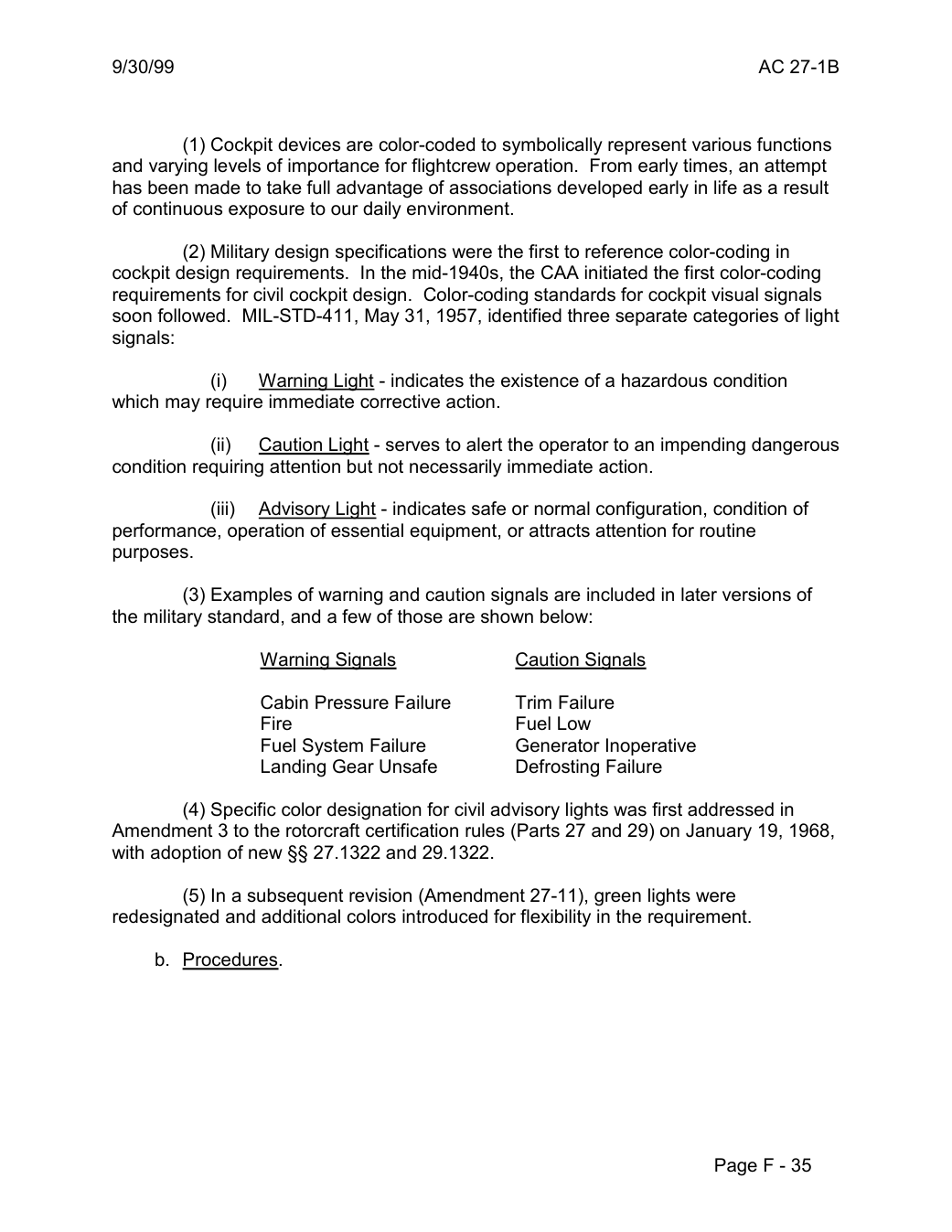
         (1) Cockpit devices are color-coded to symbolically represent various functions
and varying levels of importance for flightcrew operation. From early times, an attempt
has been made to take full advantage of associations developed early in life as a result
of continuous exposure to our daily environment.

         (2) Military design specifications were the first to reference color-coding in
cockpit design requirements. In the mid-1940s, the CAA initiated the first color-coding
requirements for civil cockpit design. Color-coding standards for cockpit visual signals
soon followed. MIL-STD-411, May 31, 1957, identified three separate categories of light
signals:

                  (i)   Warning Light - indicates the existence of a hazardous condition
which may require immediate corrective action.

                   (ii)   Caution Light - serves to alert the operator to an impending dangerous
condition requiring attention but not necessarily immediate action.

                    (iii)   Advisory Light - indicates safe or normal configuration, condition of
performance, operation of essential equipment, or attracts attention for routine
purposes.

         (3) Examples of warning and caution signals are included in later versions of
the military standard, and a few of those are shown below:

               Warning Signals             Caution Signals

               Cabin Pressure Failure       Trim Failure
                   Fire                        Fuel Low
                Fuel System Failure          Generator Inoperative
                Landing Gear Unsafe         Defrosting Failure

         (4) Specific color designation for civil advisory lights was first addressed in
Amendment 3 to the rotorcraft certification rules (Parts 27 and 29) on January 19, 1968,
with adoption of new §§ 27.1322 and 29.1322.

         (5) In a subsequent revision (Amendment 27-11), green lights were
redesignated and additional colors introduced for flexibility in the requirement.

     b. Procedures.


                                                       Page F - 35
Saved from the FAA on November 17, 2026. All original pages are retained. Engineering explanations are presented separately below.
Aerospace Consulting / Engineering perspective
Start with the certification basis and the function.
Identify the applicable amendment before selecting the safety guidance. Connect intended functions and operating conditions to failure conditions, architecture decisions, common-cause considerations, verification and limitations. For flight controls and IFR work, carry the relevant 27.672, 27.1329 and Appendix B assumptions into the system safety and compliance evidence.
1196 original pages. 0 pages have reviewed text reflows. Original-first pages retain the source layout, with extracted text available for finding words.
A focused review, an agreed assessment package or ongoing support alongside your team. We can agree the relevant inputs and scope in the initial conversation.
This opens your email application.
Start a conversation
Tell us about your programme, the system you are developing and the support you need.
We can agree a focused use-case review, a defined evidence package or ongoing programme support.
This opens your email application.
Specialist aerospace expertise
Aerospace Consulting is led by Hussein Khimji, an FAA Designated Engineering Representative in systems and equipment, with a focus on system safety, flight controls and avionics.
We work with aircraft developers and systems suppliers to connect technical decisions, safety assessments and certification evidence.
This is the proposed introduction. The full About page will add your approved biography and associate expertise.
Systems engineering & development assurance
Tell us about the aircraft or system, its intended function, stage of development and the support you need.