
FAA / Advisory circular

AC 27-1B

Certification of Normal Category Rotorcraft — Changes 1–9

Normal category rotorcraft guidance with Changes 1–9 incorporated. Search the complete AC or start with the system safety, flight controls and instrument-flight guidance.

Start with the scope.

This source includes guidance for different amendments of Part 27. Match the guidance to the aircraft’s agreed certification basis: the 27.1309 entries for Amendments 27-21, 27-46 and 27-51 are separate. The base AC was issued on 30 September 1999; Change 9 is dated 23 June 2023. The FAA catalogue’s 30 September 2008 date is not the date of the latest change.

The source, within reach.

Search within this AC, jump to a source page, or download the complete saved publication.

Download saved FAA PDF ↓

Read the source

The document, within reach.

FAA source document

Printed page F-30.19

PDF page 609 of 1196

Enlarge original ↗

Original FAA page, including its printed amendment and change markings. Extracted words support search; text reflow has not been reviewed.
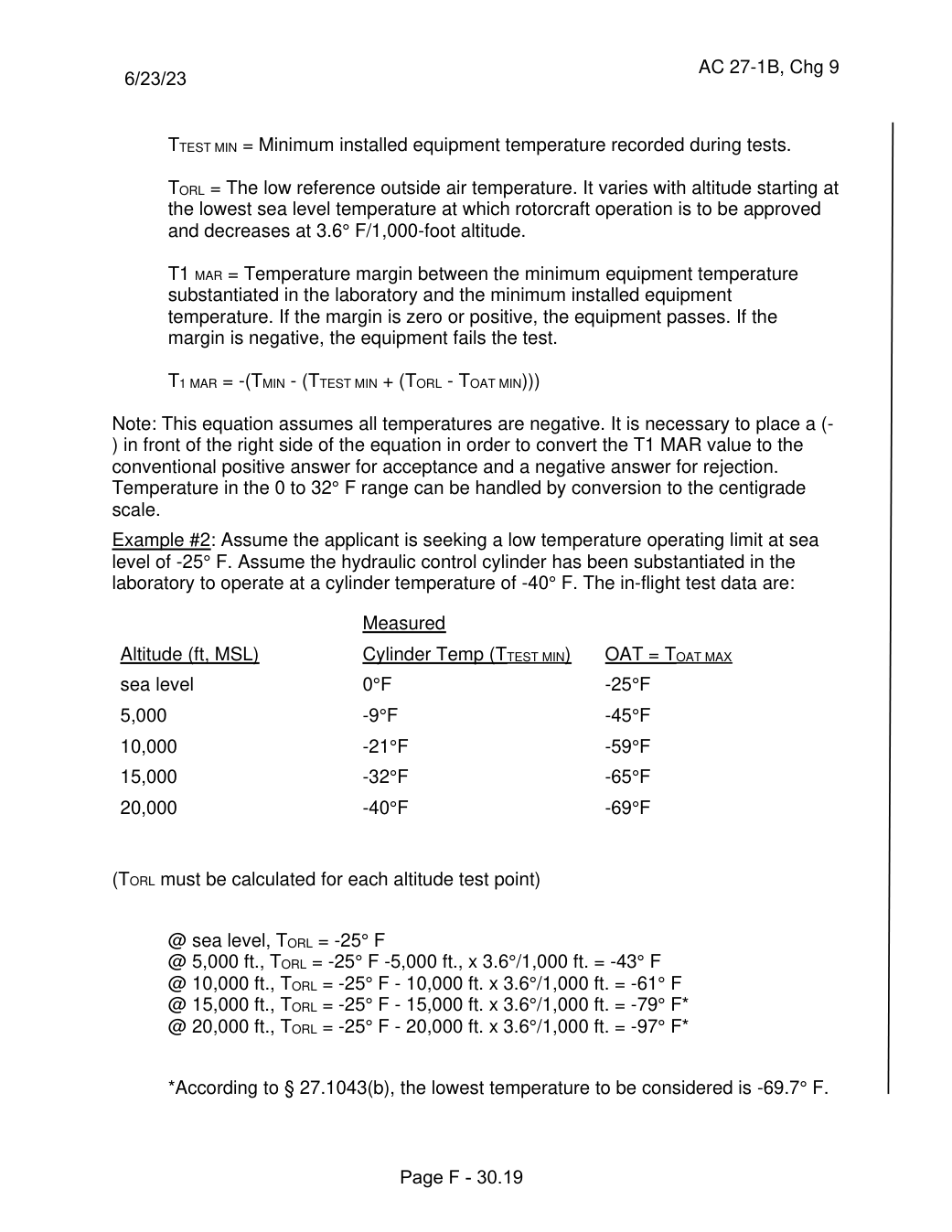
Original FAA AC 27-1B, PDF page 609
AC 27-1B · F-30.19Open saved PDF here ↗
Extracted text for finding words

This extraction supports search. Read the original page for complete notation and layout.

                                             AC 27-1B, Chg 9
 6/23/23


      TTEST MIN = Minimum installed equipment temperature recorded during tests.

      TORL = The low reference outside air temperature. It varies with altitude starting at
      the lowest sea level temperature at which rotorcraft operation is to be approved
     and decreases at 3.6° F/1,000-foot altitude.

     T1 MAR = Temperature margin between the minimum equipment temperature
       substantiated in the laboratory and the minimum installed equipment
      temperature. If the margin is zero or positive, the equipment passes. If the
      margin is negative, the equipment fails the test.

      T1 MAR = -(TMIN - (TTEST MIN + (TORL - TOAT MIN)))

Note: This equation assumes all temperatures are negative. It is necessary to place a (­
) in front of the right side of the equation in order to convert the T1 MAR value to the
conventional positive answer for acceptance and a negative answer for rejection.
Temperature in the 0 to 32° F range can be handled by conversion to the centigrade
scale.
Example #2: Assume the applicant is seeking a low temperature operating limit at sea
level of -25° F. Assume the hydraulic control cylinder has been substantiated in the
laboratory to operate at a cylinder temperature of -40° F. The in-flight test data are:

                        Measured
 Altitude (ft, MSL)            Cylinder Temp (TTEST MIN)   OAT = TOAT MAX
 sea level                 0°F                       -25°F
 5,000                      -9°F                       -45°F
 10,000                    -21°F                     -59°F
 15,000                    -32°F                     -65°F
 20,000                    -40°F                     -69°F


(TORL must be calculated for each altitude test point)


   @ sea level, TORL = -25° F
   @ 5,000 ft., TORL = -25° F -5,000 ft., x 3.6°/1,000 ft. = -43° F
   @ 10,000 ft., TORL = -25° F - 10,000 ft. x 3.6°/1,000 ft. = -61° F
   @ 15,000 ft., TORL = -25° F - 15,000 ft. x 3.6°/1,000 ft. = -79° F*
   @ 20,000 ft., TORL = -25° F - 20,000 ft. x 3.6°/1,000 ft. = -97° F*


      *According to § 27.1043(b), the lowest temperature to be considered is -69.7° F.


                          Page F - 30.19

Saved from the FAA on November 17, 2026. All original pages are retained. Engineering explanations are presented separately below.

Aerospace Consulting / Engineering perspective

Start with the certification basis and the function.

Identify the applicable amendment before selecting the safety guidance. Connect intended functions and operating conditions to failure conditions, architecture decisions, common-cause considerations, verification and limitations. For flight controls and IFR work, carry the relevant 27.672, 27.1329 and Appendix B assumptions into the system safety and compliance evidence.

Explore the rotorcraft safety and certification approach →
Source edition and reading coverage

1196 original pages. 0 pages have reviewed text reflows. Original-first pages retain the source layout, with extracted text available for finding words.

Source SHA-256: 2dfac16a3644dc18997069cca78746c10726e4b70d3aba996fc87843ffe68a2b

This is a dated source copy. Automatic source acquisition is not yet scheduled.

Original FAA PDF ↗

Working through a certification question?

Bring the aircraft, the basis and the issue your team needs to resolve.

Discuss your programme →