
Original FAA page, including its printed amendment and change markings. Extracted words support search; text reflow has not been reviewed.
AC 27-1B · F-30.6Open saved PDF here ↗
Extracted text for finding words
This extraction supports search. Read the original page for complete notation and layout.
                                            AC 27-1B, Chg 96/23/23


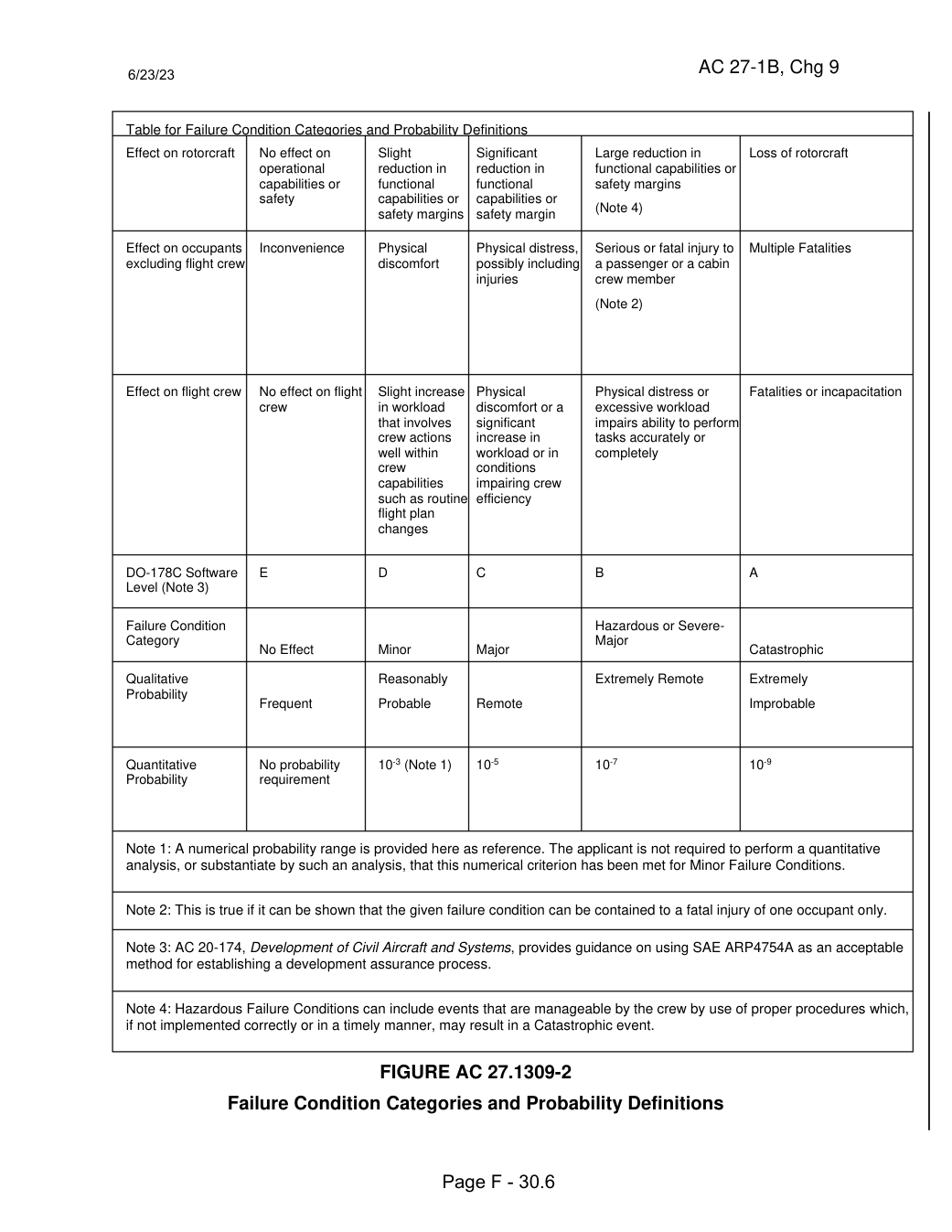
Table for Failure Condition Categories and Probability Definitions

Effect on rotorcraft   No effect on         Slight            Significant         Large reduction in       Loss of rotorcraft
                      operational         reduction in     reduction in         functional capabilities or
                        capabilities or       functional       functional           safety margins
                       safety               capabilities or   capabilities or
                                                                        (Note 4)                                           safety margins  safety margin

Effect on occupants   Inconvenience     Physical        Physical distress,   Serious or fatal injury to   Multiple Fatalities
excluding flight crew                      discomfort      possibly including  a passenger or a cabin
                                                                   injuries           crew member

                                                                        (Note 2)


Effect on flight crew  No effect on flight   Slight increase  Physical           Physical distress or        Fatalities or incapacitation
                   crew                  in workload     discomfort or a     excessive workload
                                              that involves     significant          impairs ability to perform
                                    crew actions    increase in         tasks accurately or
                                            well within      workload or in      completely
                                    crew            conditions
                                              capabilities     impairing crew
                                    such as routine  efficiency
                                                      flight plan
                                   changes


DO-178C Software  E           D         C            B                A
Level (Note 3)


Failure Condition                                                    Hazardous or Severe-
Category                                                               Major
                No Effect          Minor          Major                                       Catastrophic

Qualitative                           Reasonably                       Extremely Remote       Extremely
Probability
                    Frequent          Probable      Remote                                  Improbable


Quantitative       No probability       10-3 (Note 1)    10-5                 10-7                       10-9
Probability           requirement


Note 1: A numerical probability range is provided here as reference. The applicant is not required to perform a quantitative
analysis, or substantiate by such an analysis, that this numerical criterion has been met for Minor Failure Conditions.


Note 2: This is true if it can be shown that the given failure condition can be contained to a fatal injury of one occupant only.

Note 3: AC 20-174, Development of Civil Aircraft and Systems, provides guidance on using SAE ARP4754A as an acceptable
method for establishing a development assurance process.


Note 4: Hazardous Failure Conditions can include events that are manageable by the crew by use of proper procedures which,
if not implemented correctly or in a timely manner, may result in a Catastrophic event.

                      FIGURE AC 27.1309-2
            Failure Condition Categories and Probability Definitions


                             Page F - 30.6