Certification of Normal Category Rotorcraft — Changes 1–9
Normal category rotorcraft guidance with Changes 1–9 incorporated. Search the complete AC or start with the system safety, flight controls and instrument-flight guidance.
This source includes guidance for different amendments of Part 27. Match the guidance to the aircraft’s agreed certification basis: the 27.1309 entries for Amendments 27-21, 27-46 and 27-51 are separate. The base AC was issued on 30 September 1999; Change 9 is dated 23 June 2023. The FAA catalogue’s 30 September 2008 date is not the date of the latest change.
The source, within reach.
Search within this AC, jump to a source page, or download the complete saved publication.
This extraction supports search. Read the original page for complete notation and layout.
3/31/2014                                      AC 27-1B, Chg 4


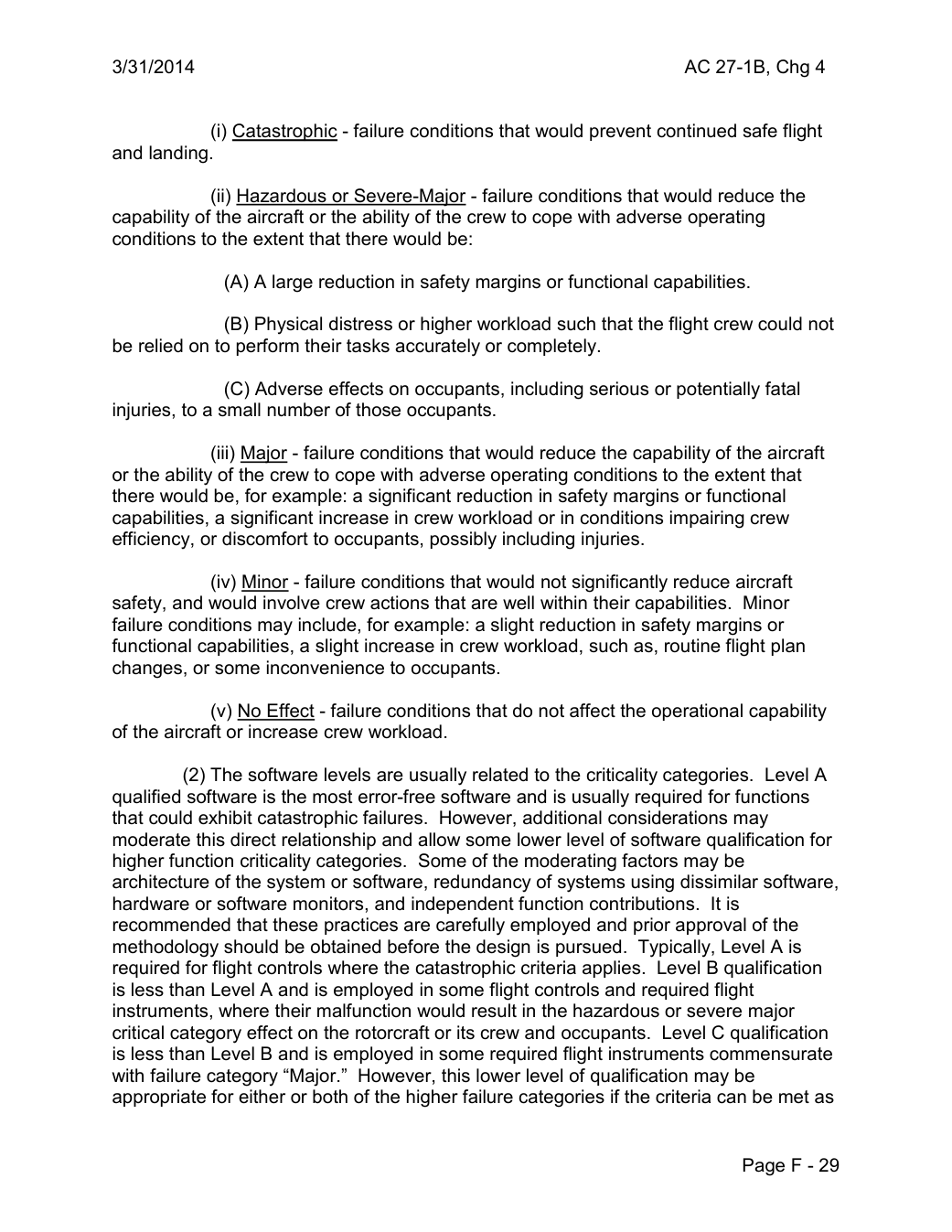
                  (i) Catastrophic - failure conditions that would prevent continued safe flight
and landing.

                   (ii) Hazardous or Severe-Major - failure conditions that would reduce the
capability of the aircraft or the ability of the crew to cope with adverse operating
conditions to the extent that there would be:

              (A) A large reduction in safety margins or functional capabilities.

              (B) Physical distress or higher workload such that the flight crew could not
be relied on to perform their tasks accurately or completely.

             (C) Adverse effects on occupants, including serious or potentially fatal
injuries, to a small number of those occupants.

                    (iii) Major - failure conditions that would reduce the capability of the aircraft
or the ability of the crew to cope with adverse operating conditions to the extent that
there would be, for example: a significant reduction in safety margins or functional
capabilities, a significant increase in crew workload or in conditions impairing crew
efficiency, or discomfort to occupants, possibly including injuries.

               (iv) Minor - failure conditions that would not significantly reduce aircraft
safety, and would involve crew actions that are well within their capabilities. Minor
failure conditions may include, for example: a slight reduction in safety margins or
functional capabilities, a slight increase in crew workload, such as, routine flight plan
changes, or some inconvenience to occupants.

              (v) No Effect - failure conditions that do not affect the operational capability
of the aircraft or increase crew workload.

         (2) The software levels are usually related to the criticality categories. Level A
qualified software is the most error-free software and is usually required for functions
that could exhibit catastrophic failures. However, additional considerations may
moderate this direct relationship and allow some lower level of software qualification for
higher function criticality categories. Some of the moderating factors may be
architecture of the system or software, redundancy of systems using dissimilar software,
hardware or software monitors, and independent function contributions.  It is
recommended that these practices are carefully employed and prior approval of the
methodology should be obtained before the design is pursued. Typically, Level A is
required for flight controls where the catastrophic criteria applies. Level B qualification
is less than Level A and is employed in some flight controls and required flight
instruments, where their malfunction would result in the hazardous or severe major
critical category effect on the rotorcraft or its crew and occupants. Level C qualification
is less than Level B and is employed in some required flight instruments commensurate
with failure category “Major.” However, this lower level of qualification may be
appropriate for either or both of the higher failure categories if the criteria can be met as


                                                          Page F - 29
Saved from the FAA on November 17, 2026. All original pages are retained. Engineering explanations are presented separately below.
Aerospace Consulting / Engineering perspective
Start with the certification basis and the function.
Identify the applicable amendment before selecting the safety guidance. Connect intended functions and operating conditions to failure conditions, architecture decisions, common-cause considerations, verification and limitations. For flight controls and IFR work, carry the relevant 27.672, 27.1329 and Appendix B assumptions into the system safety and compliance evidence.
1196 original pages. 0 pages have reviewed text reflows. Original-first pages retain the source layout, with extracted text available for finding words.
A focused review, an agreed assessment package or ongoing support alongside your team. We can agree the relevant inputs and scope in the initial conversation.
This opens your email application.
Start a conversation
Tell us about your programme, the system you are developing and the support you need.
We can agree a focused use-case review, a defined evidence package or ongoing programme support.
This opens your email application.
Specialist aerospace expertise
Aerospace Consulting is led by Hussein Khimji, an FAA Designated Engineering Representative in systems and equipment, with a focus on system safety, flight controls and avionics.
We work with aircraft developers and systems suppliers to connect technical decisions, safety assessments and certification evidence.
This is the proposed introduction. The full About page will add your approved biography and associate expertise.
Systems engineering & development assurance
Tell us about the aircraft or system, its intended function, stage of development and the support you need.