Certification of Normal Category Rotorcraft — Changes 1–9
Normal category rotorcraft guidance with Changes 1–9 incorporated. Search the complete AC or start with the system safety, flight controls and instrument-flight guidance.
This source includes guidance for different amendments of Part 27. Match the guidance to the aircraft’s agreed certification basis: the 27.1309 entries for Amendments 27-21, 27-46 and 27-51 are separate. The base AC was issued on 30 September 1999; Change 9 is dated 23 June 2023. The FAA catalogue’s 30 September 2008 date is not the date of the latest change.
The source, within reach.
Search within this AC, jump to a source page, or download the complete saved publication.
This extraction supports search. Read the original page for complete notation and layout.
AC 27-1B, Chg 4                                                     3/31/2014


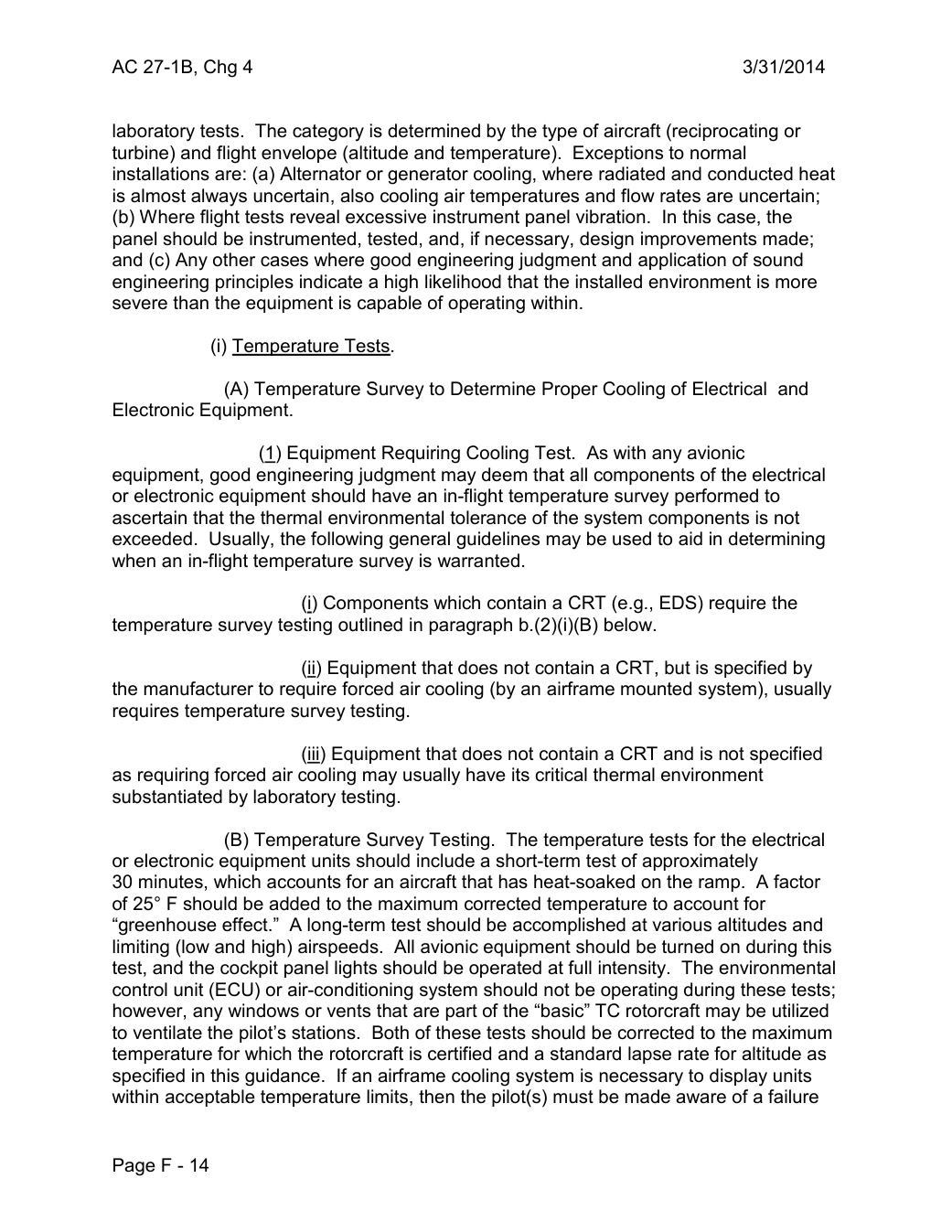
laboratory tests. The category is determined by the type of aircraft (reciprocating or
turbine) and flight envelope (altitude and temperature). Exceptions to normal
installations are: (a) Alternator or generator cooling, where radiated and conducted heat
is almost always uncertain, also cooling air temperatures and flow rates are uncertain;
(b) Where flight tests reveal excessive instrument panel vibration. In this case, the
panel should be instrumented, tested, and, if necessary, design improvements made;
and (c) Any other cases where good engineering judgment and application of sound
engineering principles indicate a high likelihood that the installed environment is more
severe than the equipment is capable of operating within.

                  (i) Temperature Tests.

              (A) Temperature Survey to Determine Proper Cooling of Electrical and
Electronic Equipment.

                   (1) Equipment Requiring Cooling Test. As with any avionic
equipment, good engineering judgment may deem that all components of the electrical
or electronic equipment should have an in-flight temperature survey performed to
ascertain that the thermal environmental tolerance of the system components is not
exceeded. Usually, the following general guidelines may be used to aid in determining
when an in-flight temperature survey is warranted.

                                  (i) Components which contain a CRT (e.g., EDS) require the
temperature survey testing outlined in paragraph b.(2)(i)(B) below.

                                     (ii) Equipment that does not contain a CRT, but is specified by
the manufacturer to require forced air cooling (by an airframe mounted system), usually
requires temperature survey testing.

                                      (iii) Equipment that does not contain a CRT and is not specified
as requiring forced air cooling may usually have its critical thermal environment
substantiated by laboratory testing.

              (B) Temperature Survey Testing. The temperature tests for the electrical
or electronic equipment units should include a short-term test of approximately
30 minutes, which accounts for an aircraft that has heat-soaked on the ramp. A factor
of 25° F should be added to the maximum corrected temperature to account for
“greenhouse effect.” A long-term test should be accomplished at various altitudes and
limiting (low and high) airspeeds.  All avionic equipment should be turned on during this
test, and the cockpit panel lights should be operated at full intensity. The environmental
control unit (ECU) or air-conditioning system should not be operating during these tests;
however, any windows or vents that are part of the “basic” TC rotorcraft may be utilized
to ventilate the pilot’s stations. Both of these tests should be corrected to the maximum
temperature for which the rotorcraft is certified and a standard lapse rate for altitude as
specified in this guidance.  If an airframe cooling system is necessary to display units
within acceptable temperature limits, then the pilot(s) must be made aware of a failure


Page F - 14
Saved from the FAA on November 17, 2026. All original pages are retained. Engineering explanations are presented separately below.
Aerospace Consulting / Engineering perspective
Start with the certification basis and the function.
Identify the applicable amendment before selecting the safety guidance. Connect intended functions and operating conditions to failure conditions, architecture decisions, common-cause considerations, verification and limitations. For flight controls and IFR work, carry the relevant 27.672, 27.1329 and Appendix B assumptions into the system safety and compliance evidence.
1196 original pages. 0 pages have reviewed text reflows. Original-first pages retain the source layout, with extracted text available for finding words.
A focused review, an agreed assessment package or ongoing support alongside your team. We can agree the relevant inputs and scope in the initial conversation.
This opens your email application.
Start a conversation
Tell us about your programme, the system you are developing and the support you need.
We can agree a focused use-case review, a defined evidence package or ongoing programme support.
This opens your email application.
Specialist aerospace expertise
Aerospace Consulting is led by Hussein Khimji, an FAA Designated Engineering Representative in systems and equipment, with a focus on system safety, flight controls and avionics.
We work with aircraft developers and systems suppliers to connect technical decisions, safety assessments and certification evidence.
This is the proposed introduction. The full About page will add your approved biography and associate expertise.
Systems engineering & development assurance
Tell us about the aircraft or system, its intended function, stage of development and the support you need.