Certification of Normal Category Rotorcraft — Changes 1–9
Normal category rotorcraft guidance with Changes 1–9 incorporated. Search the complete AC or start with the system safety, flight controls and instrument-flight guidance.
This source includes guidance for different amendments of Part 27. Match the guidance to the aircraft’s agreed certification basis: the 27.1309 entries for Amendments 27-21, 27-46 and 27-51 are separate. The base AC was issued on 30 September 1999; Change 9 is dated 23 June 2023. The FAA catalogue’s 30 September 2008 date is not the date of the latest change.
The source, within reach.
Search within this AC, jump to a source page, or download the complete saved publication.
This extraction supports search. Read the original page for complete notation and layout.
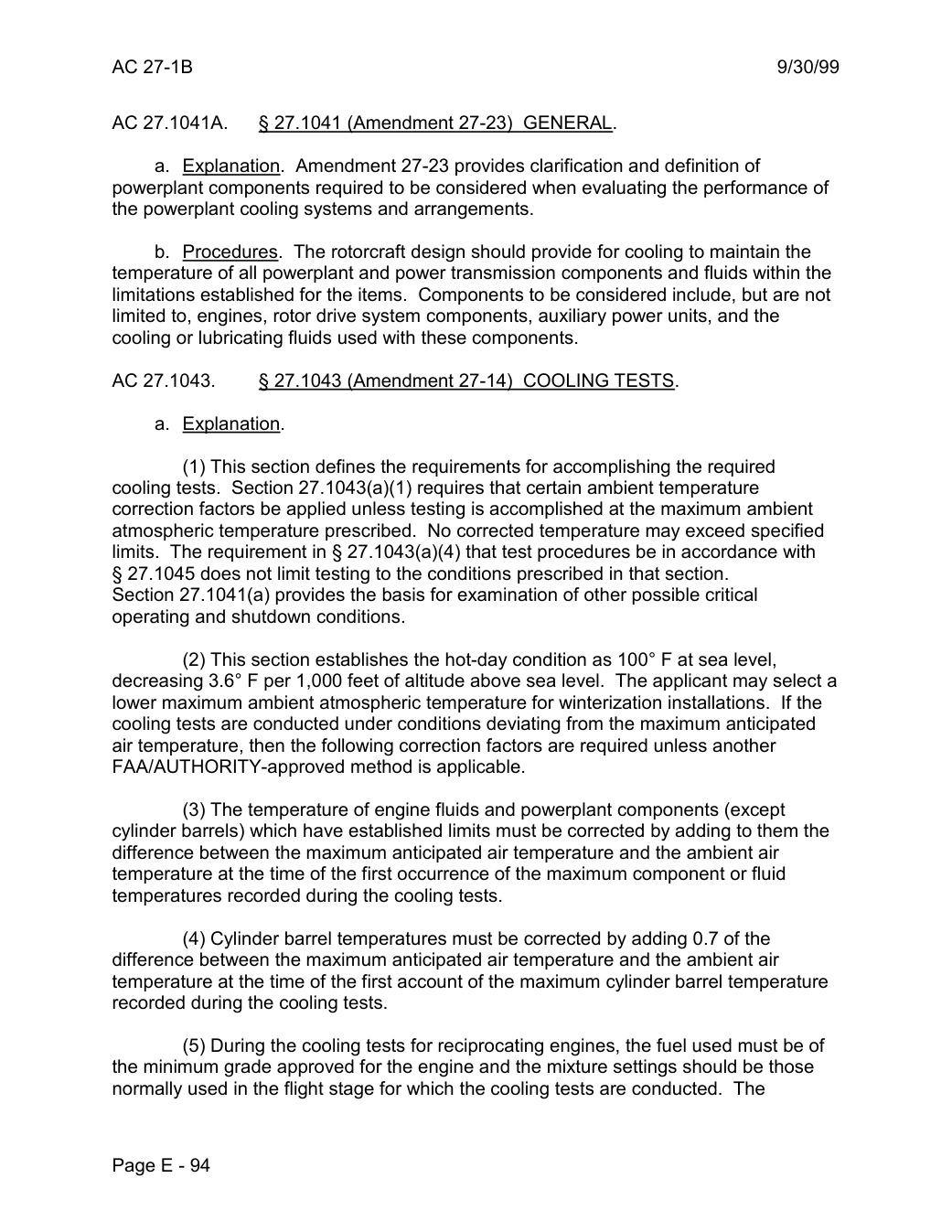
AC 27-1B                                                                  9/30/99

AC 27.1041A.   § 27.1041 (Amendment 27-23) GENERAL.

     a. Explanation. Amendment 27-23 provides clarification and definition of
powerplant components required to be considered when evaluating the performance of
the powerplant cooling systems and arrangements.

     b. Procedures. The rotorcraft design should provide for cooling to maintain the
temperature of all powerplant and power transmission components and fluids within the
limitations established for the items. Components to be considered include, but are not
limited to, engines, rotor drive system components, auxiliary power units, and the
cooling or lubricating fluids used with these components.

AC 27.1043.    § 27.1043 (Amendment 27-14) COOLING TESTS.

     a. Explanation.

         (1) This section defines the requirements for accomplishing the required
cooling tests. Section 27.1043(a)(1) requires that certain ambient temperature
correction factors be applied unless testing is accomplished at the maximum ambient
atmospheric temperature prescribed. No corrected temperature may exceed specified
limits. The requirement in § 27.1043(a)(4) that test procedures be in accordance with
§ 27.1045 does not limit testing to the conditions prescribed in that section.
Section 27.1041(a) provides the basis for examination of other possible critical
operating and shutdown conditions.

         (2) This section establishes the hot-day condition as 100° F at sea level,
decreasing 3.6° F per 1,000 feet of altitude above sea level. The applicant may select a
lower maximum ambient atmospheric temperature for winterization installations.  If the
cooling tests are conducted under conditions deviating from the maximum anticipated
air temperature, then the following correction factors are required unless another
FAA/AUTHORITY-approved method is applicable.

         (3) The temperature of engine fluids and powerplant components (except
cylinder barrels) which have established limits must be corrected by adding to them the
difference between the maximum anticipated air temperature and the ambient air
temperature at the time of the first occurrence of the maximum component or fluid
temperatures recorded during the cooling tests.

         (4) Cylinder barrel temperatures must be corrected by adding 0.7 of the
difference between the maximum anticipated air temperature and the ambient air
temperature at the time of the first account of the maximum cylinder barrel temperature
recorded during the cooling tests.

         (5) During the cooling tests for reciprocating engines, the fuel used must be of
the minimum grade approved for the engine and the mixture settings should be those
normally used in the flight stage for which the cooling tests are conducted. The


Page E - 94
Saved from the FAA on November 17, 2026. All original pages are retained. Engineering explanations are presented separately below.
Aerospace Consulting / Engineering perspective
Start with the certification basis and the function.
Identify the applicable amendment before selecting the safety guidance. Connect intended functions and operating conditions to failure conditions, architecture decisions, common-cause considerations, verification and limitations. For flight controls and IFR work, carry the relevant 27.672, 27.1329 and Appendix B assumptions into the system safety and compliance evidence.
1196 original pages. 0 pages have reviewed text reflows. Original-first pages retain the source layout, with extracted text available for finding words.
A focused review, an agreed assessment package or ongoing support alongside your team. We can agree the relevant inputs and scope in the initial conversation.
This opens your email application.
Start a conversation
Tell us about your programme, the system you are developing and the support you need.
We can agree a focused use-case review, a defined evidence package or ongoing programme support.
This opens your email application.
Specialist aerospace expertise
Aerospace Consulting is led by Hussein Khimji, an FAA Designated Engineering Representative in systems and equipment, with a focus on system safety, flight controls and avionics.
We work with aircraft developers and systems suppliers to connect technical decisions, safety assessments and certification evidence.
This is the proposed introduction. The full About page will add your approved biography and associate expertise.
Systems engineering & development assurance
Tell us about the aircraft or system, its intended function, stage of development and the support you need.