Certification of Normal Category Rotorcraft — Changes 1–9
Normal category rotorcraft guidance with Changes 1–9 incorporated. Search the complete AC or start with the system safety, flight controls and instrument-flight guidance.
This source includes guidance for different amendments of Part 27. Match the guidance to the aircraft’s agreed certification basis: the 27.1309 entries for Amendments 27-21, 27-46 and 27-51 are separate. The base AC was issued on 30 September 1999; Change 9 is dated 23 June 2023. The FAA catalogue’s 30 September 2008 date is not the date of the latest change.
The source, within reach.
Search within this AC, jump to a source page, or download the complete saved publication.
This extraction supports search. Read the original page for complete notation and layout.
3/31/2014                                      AC 27-1B, Chg 4


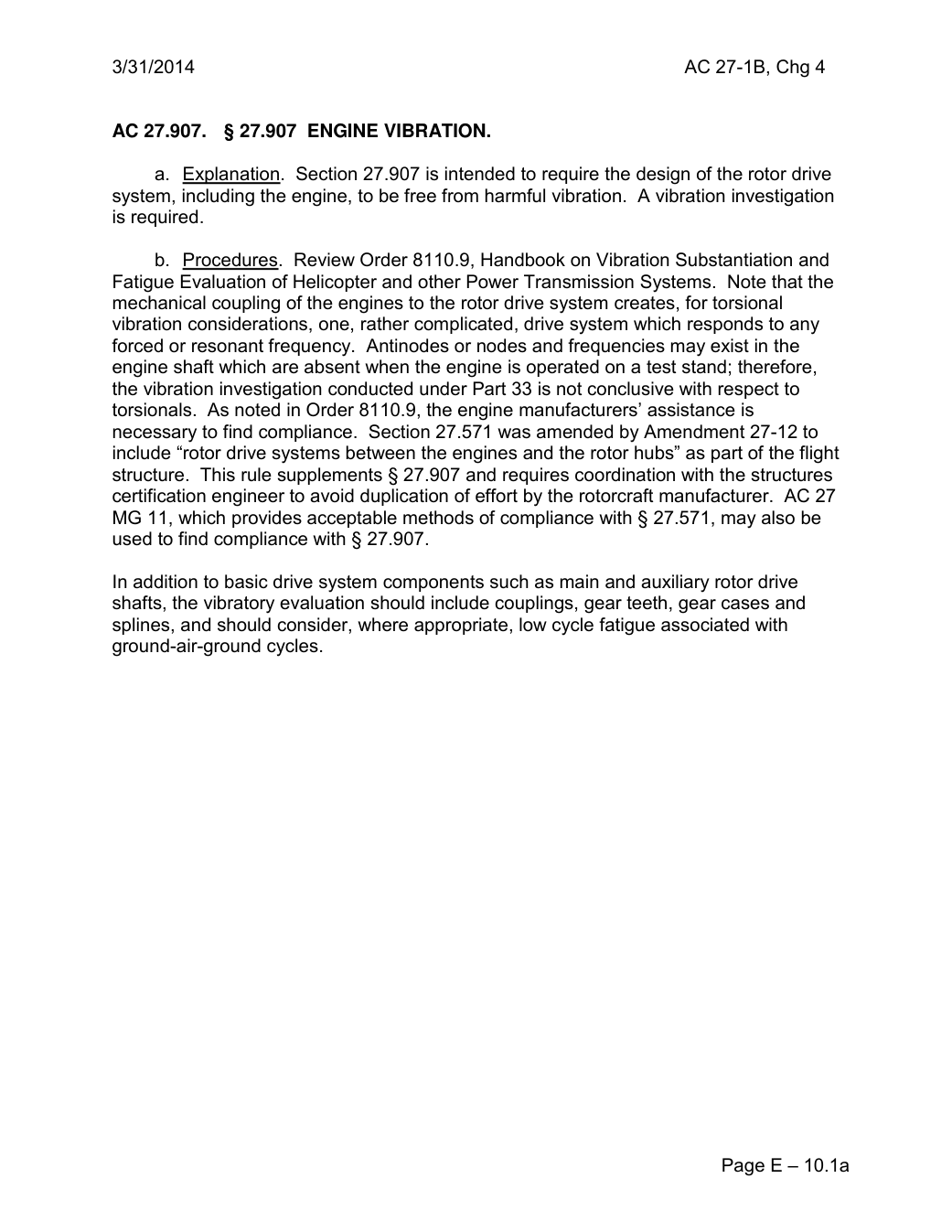
AC 27.907.  § 27.907 ENGINE VIBRATION.

     a. Explanation. Section 27.907 is intended to require the design of the rotor drive
system, including the engine, to be free from harmful vibration. A vibration investigation
is required.

     b. Procedures. Review Order 8110.9, Handbook on Vibration Substantiation and
Fatigue Evaluation of Helicopter and other Power Transmission Systems. Note that the
mechanical coupling of the engines to the rotor drive system creates, for torsional
vibration considerations, one, rather complicated, drive system which responds to any
forced or resonant frequency. Antinodes or nodes and frequencies may exist in the
engine shaft which are absent when the engine is operated on a test stand; therefore,
the vibration investigation conducted under Part 33 is not conclusive with respect to
torsionals. As noted in Order 8110.9, the engine manufacturers’ assistance is
necessary to find compliance. Section 27.571 was amended by Amendment 27-12 to
include “rotor drive systems between the engines and the rotor hubs” as part of the flight
structure. This rule supplements § 27.907 and requires coordination with the structures
certification engineer to avoid duplication of effort by the rotorcraft manufacturer. AC 27
MG 11, which provides acceptable methods of compliance with § 27.571, may also be
used to find compliance with § 27.907.

In addition to basic drive system components such as main and auxiliary rotor drive
shafts, the vibratory evaluation should include couplings, gear teeth, gear cases and
splines, and should consider, where appropriate, low cycle fatigue associated with
ground-air-ground cycles.


                                                        Page E – 10.1a
Saved from the FAA on November 17, 2026. All original pages are retained. Engineering explanations are presented separately below.
Aerospace Consulting / Engineering perspective
Start with the certification basis and the function.
Identify the applicable amendment before selecting the safety guidance. Connect intended functions and operating conditions to failure conditions, architecture decisions, common-cause considerations, verification and limitations. For flight controls and IFR work, carry the relevant 27.672, 27.1329 and Appendix B assumptions into the system safety and compliance evidence.
1196 original pages. 0 pages have reviewed text reflows. Original-first pages retain the source layout, with extracted text available for finding words.
A focused review, an agreed assessment package or ongoing support alongside your team. We can agree the relevant inputs and scope in the initial conversation.
This opens your email application.
Start a conversation
Tell us about your programme, the system you are developing and the support you need.
We can agree a focused use-case review, a defined evidence package or ongoing programme support.
This opens your email application.
Specialist aerospace expertise
Aerospace Consulting is led by Hussein Khimji, an FAA Designated Engineering Representative in systems and equipment, with a focus on system safety, flight controls and avionics.
We work with aircraft developers and systems suppliers to connect technical decisions, safety assessments and certification evidence.
This is the proposed introduction. The full About page will add your approved biography and associate expertise.
Systems engineering & development assurance
Tell us about the aircraft or system, its intended function, stage of development and the support you need.